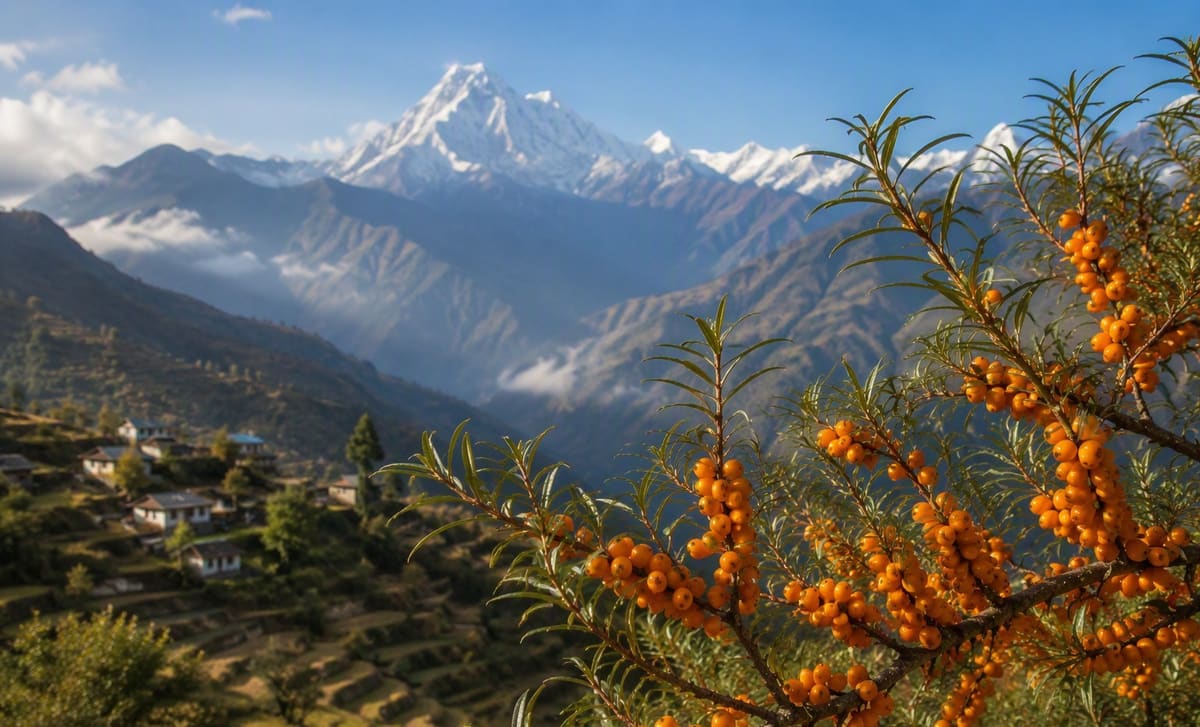
In Nepal, sea buckthorn belongs to the high country: the dry trans-Himalayan valleys in the rain shadow of the Annapurna and Dhaulagiri ranges. It grows wild there, it is gathered by hand, and it reaches the rest of the country as juice, dried berries, and oil from small mountain enterprises.
Mustang and the high valleys
Mustang is the district name buyers see most, and the Kali Gandaki valley running through it is classic sea buckthorn ground: cold, dry, high, and river-cut, with wild stands lining the banks. Similar valleys run across Nepal’s trans-Himalayan belt. Local use is old, and the region’s medical tradition, covered on the Tibetan medicine page, valued the berry long before export markets noticed it. The regions hub maps the whole Himalayan belt this valley sits in.
Smallholder by nature
There are no plantations here. The harvest is gathered from wild stands in a short autumn window and processed in small facilities, often with support from development projects that promote the berry as mountain income. That structure keeps volumes small and quality variable, but it also means the money stays in the villages that do the picking. India and Bhutan share the same pattern across the belt.
Buying notes
- Look for a named producer. Nepali mountain products with a company or cooperative on the label are the traceable ones.
- Expect honest variation. Small batches from wild berries vary by season and valley.
- Treat juice as food. Local juice is a tart mountain drink, not a measured supplement, and the same holds for the bottled juice sold further afield.
The neighboring valleys continue into Himachal Pradesh.
The rain-shadow terrain
The Kali Gandaki cuts one of the deepest gorges on earth between Annapurna and Dhaulagiri, and the rain shadow behind those walls is sea buckthorn country: dry, cold, high, and river-fed. The shrub lines the banks and slopes where little else fruits, which is why it matters locally far beyond its price. Similar trans-Himalayan valleys run across Nepal’s northern districts, all variations on the theme.
The development-project chapter
Outside organizations noticed the same thing locals always knew: a wild crop that grows on eroding slopes, feeds people, and sells is rare mountain gold. Projects have supported small processing facilities and planting along degraded slopes, aiming at income that stays in the valleys. The result is still smallholder in character, but the bottles travel further than the berries ever did.
For the trekker
Trekking routes through Mustang pass the stands themselves, and autumn trekkers see the berries at full color, sometimes pressed in front of them at tea houses and village shops. Buy the juice, taste the fresh berries carefully (they are ferociously sour), and let the wild patches be. The altitude and the thorns both punish enthusiasm.
The etiquette, plainly
These stands are village income gathered in a short window, and the families who pick them depend on the season. A trekker’s handful to taste is normal. A trekker’s bag for the road is someone’s sale walking away. The foraging page teaches the craft. The mountains teach the manners, and the where it grows page explains why this shrub owns exactly this terrain. Respect costs nothing here and pays for the next season, which is the best bargain on the mountain. The tea-house juice, bought on the spot, runs a close second. Ask what valley it came from and watch the conversation open.
What Mustang on a label means
The district name carries weight because the terrain is real, but the name alone is not a supply chain. A Nepali product should still name its maker, and mountain products bought inside Nepal, near the source, remain the freshest version this category offers anywhere.
Frequently asked questions
Where does sea buckthorn grow in Nepal?
In the dry trans-Himalayan valleys in the rain shadow of the high Himalayas, with Mustang as the best-known district. The shrub grows wild there along rivers and slopes, and local communities gather the berries by hand each autumn.
Can trekkers see sea buckthorn in Nepal?
Yes, easily, on autumn treks through Mustang and similar trans-Himalayan valleys, where wild stands line the rivers and village shops sell the juice. Taste a few berries, buy the local products, and leave the wild patches for the communities that harvest them.