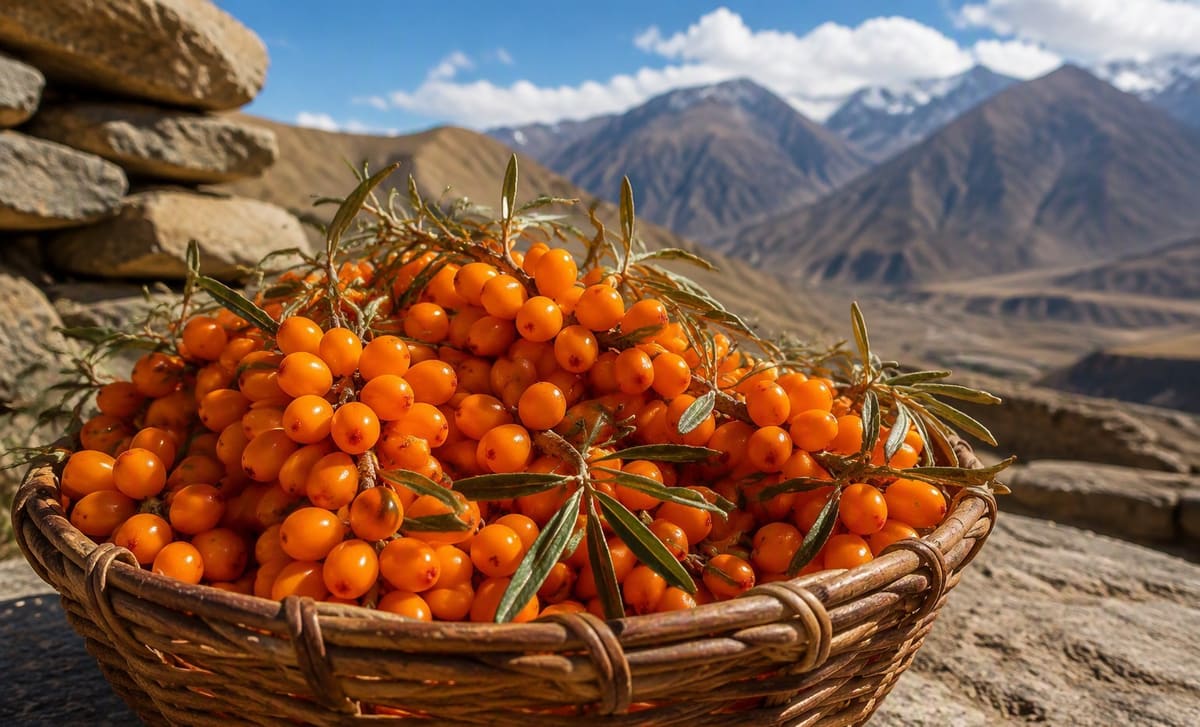
Leh berry is the Indian name for sea buckthorn, the orange berry of the shrub Hippophae rhamnoides. It is the same plant sold elsewhere as sea buckthorn or seaberry, so a Leh berry and a sea buckthorn are one fruit under two names. It grows in Ladakh, around Leh, which is where the name comes from. In India you meet it mostly as juice, plus oil, capsules, and dried berries. The name points to origin, not to grade. It tells you where the fruit likely grew, and nothing about quality on its own.
The one fact worth knowing: it is sea buckthorn
Start here, because it clears up most of the confusion. Leh berry isn’t a rare cousin of sea buckthorn. It isn’t a special Himalayan variety with its own botany either. It’s sea buckthorn, the species Hippophae rhamnoides, growing where it has grown in India for a very long time, and English speakers call that exact same plant sea buckthorn or seaberry. Crack open a Leh berry juice and a sea buckthorn softgel and you’re looking at fruit off the same thorny shrub. The regions hub lines Ladakh up beside every other place it grows, from Finland to China.
So here’s the rule you can carry to any shelf. Anything true of sea buckthorn is true of Leh berry, and anything unproven for one is just as unproven for the other. The name tells you geography, not grade.
Where the name came from
The berry takes its name from Leh, the main town of Ladakh, up in India’s far north. The label spread when a Ladakh-made juice built around the fruit reached shops across the country, and Leh berry became the everyday word people search and buy under. Where did that first juice come from? A high-altitude research laboratory in Leh worked out a sea buckthorn drink that wouldn’t freeze in the cold, then handed the method to local groups, and that’s the lineage behind the famous bottle. The Leh Berry brand review covers that specific product and its origin story.
Locally the plant carries older names, tsermang for the shrub and tsestalulu for the fruit, but those stay in Ladakh. And there is no settled Hindi word at all, since the shrub never grew in the Hindi-speaking plains, a naming gap the sea buckthorn in Hindi and Indian names page works through name by name. When you’re hunting for products or reading about the berry anywhere in India, Leh berry is the phrase that works, with sea buckthorn as the botanical backup.
What the names do and don’t tell you
Four names, one plant. Each word on a label signals something different, and none of them signals quality on its own.
| Name | Where you see it | What it tells you about quality |
|---|---|---|
| Leh berry | India, especially juices and hill-state products | Points to Ladakh or Himalayan origin. Says nothing about plant part or grade |
| Sea buckthorn | The global common name, tied to Hippophae rhamnoides | The botanical anchor. Confirms the species, not the quality |
| Seaberry | Common in North America | The same plant under a friendlier name. No quality signal at all |
| Tsermang, tsestalulu | Ladakhi, the local plant and fruit names | Authentic to the source, but rare on a label you can actually buy |
Why Ladakh grows it
Ladakh is a cold desert, and that’s exactly the address this shrub wants. High altitude, fierce sun, brutal winters, thin soil, and river valleys the roots can grip: it adds up to country where sea buckthorn thrives while most crops give up. People have gathered the berry from wild stands around Leh for generations. In recent decades it turned into a cash crop too, moving through local cooperatives that press it into juice and oil, and state agencies and researchers have pushed planting both as income and as a way to hold eroding slopes together.
The neighbouring high valleys of Himachal Pradesh, in Lahaul-Spiti and Kinnaur, run the same play. The India page tells the full growing story, and the Himachal Pradesh page covers the valleys next door. The short version is simple. This is genuine near-source fruit, and if you’re buying in India, that’s a real advantage.
What is sold as Leh berry, and the label
Juice is the format that made the name, and it’s still what most Leh berry products are. Around it you’ll find oil, capsules, and dried berries. Two quick label checks sort the shelf for you. First, the plant part, because berry oil leans toward omega-7 while seed oil leans toward omega-3 and omega-6, and the seed versus berry page is the decoder. Second, the regulator mark, because in India a food, juice, or supplement should carry the FSSAI logo and its 14-digit licence number.
A locally pressed juice is a tart food, not a studied supplement, so enjoy it as one and keep an eye on the acidity notes on the safety page. Want the full buying walk-through, the domestic brands, the marketplaces, and what a good label looks like line by line? The India buying guide does exactly that job.
The evidence, without the altitude halo
This is where an exotic name can quietly mislead you. Because Leh berry sounds special and grows somewhere remote, it’s easy to assume the health evidence must be special too. It isn’t, and that’s the honest point. Leh berry is sea buckthorn, so the same research applies, no stronger and no weaker for the Ladakh postcode. So does that mountain origin buy you better medicine? No. The graded picture looks like this.
Start with the strong case, blood lipids, graded ●●●● Strong. A 2022 meta-analysis of 15 randomized controlled trials found sea buckthorn significantly lowered triglycerides, total cholesterol, and LDL cholesterol, and raised HDL, with the biggest effect in people whose lipids were already abnormal. The cholesterol page has the detail.
Now the honest nulls, and they’re graded just as strongly, ●●●● Strong for the null. That same meta-analysis found no effect on fasting blood sugar, no effect on blood pressure, and no effect on body weight. Being from Ladakh changes none of that. Everything else sits lower and lighter, ●●●○ to ●○○○. Skin and dry-eye benefits rest on moderate evidence from small trials, and a good deal of the rest is traditional use or early laboratory work. The benefits hub grades each claim one at a time.
One thing every human trial here shares: it dosed the oil, and whole berries, at 1 to 3 grams a day, not a splash of juice. So a Leh berry juice is a pleasant, vitamin C rich food with a strong origin story, and the studied benefits belong to the concentrated oil. Both of those are true at once, and the name on the bottle changes neither.
Frequently asked questions
What is Leh berry?
Leh berry is the Indian trade name for sea buckthorn, the orange fruit of the shrub Hippophae rhamnoides. It grows in Ladakh, around Leh, which is where the name comes from. In India it is sold mostly as juice, plus oil, capsules, and dried berries.
Is Leh berry the same as sea buckthorn?
Yes, exactly the same plant. Leh berry is not a rare variety or a cousin of sea buckthorn. It is sea buckthorn, Hippophae rhamnoides, the same species sold elsewhere as sea buckthorn or seaberry. Two names, one fruit.
Are Leh berry benefits any different from sea buckthorn's?
No. Because Leh berry is sea buckthorn, the same research applies, no stronger for the Ladakh origin. The best-supported benefit is better blood lipids from the oil. There is no effect on blood sugar, blood pressure, or weight, and a lot of the rest is traditional or early lab work.
Why does sea buckthorn grow in Leh and Ladakh?
Ladakh is a cold desert, and the shrub thrives on exactly that: high altitude, fierce sun, hard winters, thin soil, and river valleys its roots can anchor. Those are conditions the lowlands cannot offer, which is why India's production stays in the mountains.