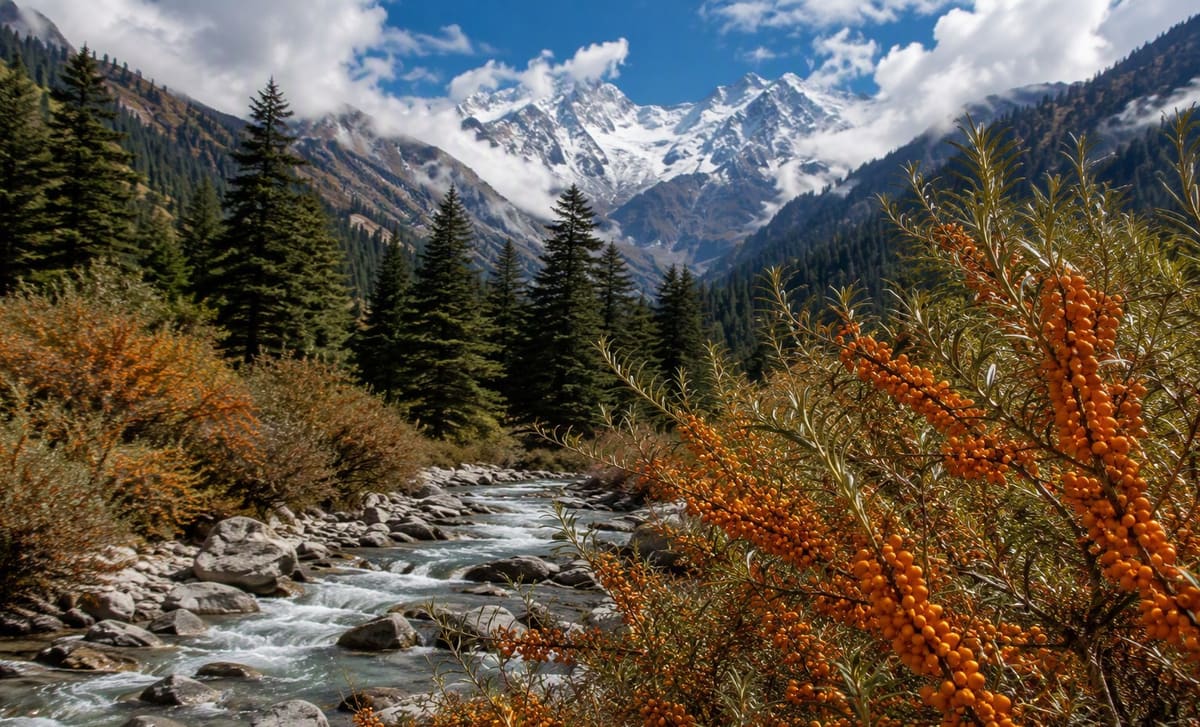
Ladakh gets the fame, but the neighboring high valleys of Himachal Pradesh are sea buckthorn country too. Wild stands line the rivers of Lahaul-Spiti and Kinnaur, the harvest stays small and hands-on, and what reaches buyers is juice, oil, and dried berries from mountain communities.
The valleys beyond Ladakh
Himachal’s sea buckthorn belt sits in its cold, dry trans-Himalayan districts: Lahaul-Spiti first, with Kinnaur and the upper reaches of Kullu alongside. The conditions rhyme with Ladakh, which our India page covers in detail: high altitude, harsh winters, thin soil, and river valleys the shrub can anchor. On eroding mountain slopes, a plant that holds soil and also feeds people earns its place twice.
Wild harvest, small scale
Most of the crop is gathered from wild and semi-wild stands rather than orchards, by hand, in a short autumn window. State agencies and researchers have encouraged planting as both cash crop and slope protection, but production stays smallholder in character: families and cooperatives, not plantations. The berries leave the valleys as juice, squash, oil, jam, and dried fruit, much of it sold through local markets and small mountain brands.
The same hand-gathered pattern runs across the Himalayan belt. Nepal and Bhutan work the same way, and the region’s deeper use tradition is covered on the Tibetan medicine page.
Buying notes for Himachal products
- Ask who made it. A Himachal product with a named cooperative or company behind it is traceable. A marketplace listing with only the word “Himalayan” is not.
- The plant part still decides. Berry oil and seed oil are different products, and the seed vs berry page decodes the labels.
- Expect batch variation. Small mountain processors vary from season to season. Treat juice and dried berries as food, not as measured supplements.
The full map sits on the regions hub, and the where it grows page explains why this shrub belongs to high country.
The terrain, closer
Lahaul-Spiti and Kinnaur are cold desert: rain shadow valleys where the monsoon does not reach, winters lock hard, and the sun at altitude is fierce. The shrub lines the rivers because the rivers are where the water is, and its roots double as slope armor on terrain that erodes easily. Every berry here begins on a slope or a bank that someone reached on foot.
The harvest window, honestly
The picking runs through autumn and it is hand work: beating or clipping branches over sheets, gloves against the thorns, and days that start cold. The thorns page explains what pickers are up against, and the short window is why fresh berries almost never leave the valleys. What travels is what keeps: juice, squash, oil, dried fruit.
For the traveler
Autumn visitors to these valleys find the berries in local markets and the products in small shops, often made within the district. Buy them there if you can: freshness is never better than at the source, and the money stays on the mountain. Altitude rules apply to foraging fantasies too, since the wild stands grow in terrain that punishes casual wandering.
The community-stand etiquette
Wild and semi-wild stands are gathered by the families and cooperatives near them, and they are income, not scenery. Visitors should ask before picking anything, keep it to a tasting handful, and leave the harvest to the people it belongs to. The foraging page covers technique. The etiquette here is simpler: the mountain’s economy is small, and the berries are spoken for. Buy the bottled version in the village shop and you have done right by the valley, the pickers, and your own shelf. That is the whole transaction.
Frequently asked questions
Where does sea buckthorn grow in Himachal Pradesh?
In the high, dry trans-Himalayan valleys, with Lahaul-Spiti as the core district and Kinnaur and the upper Kullu region alongside. The shrub grows wild and semi-wild along rivers and slopes there, in the same cold desert conditions that suit it in neighboring Ladakh.
When is the harvest in Himachal Pradesh?
Autumn, in a short window that varies with the valley and the season. The picking is hand work from wild and semi-wild stands, which is why fresh berries rarely leave the mountains and the valley output travels as juice, squash, oil, and dried fruit.