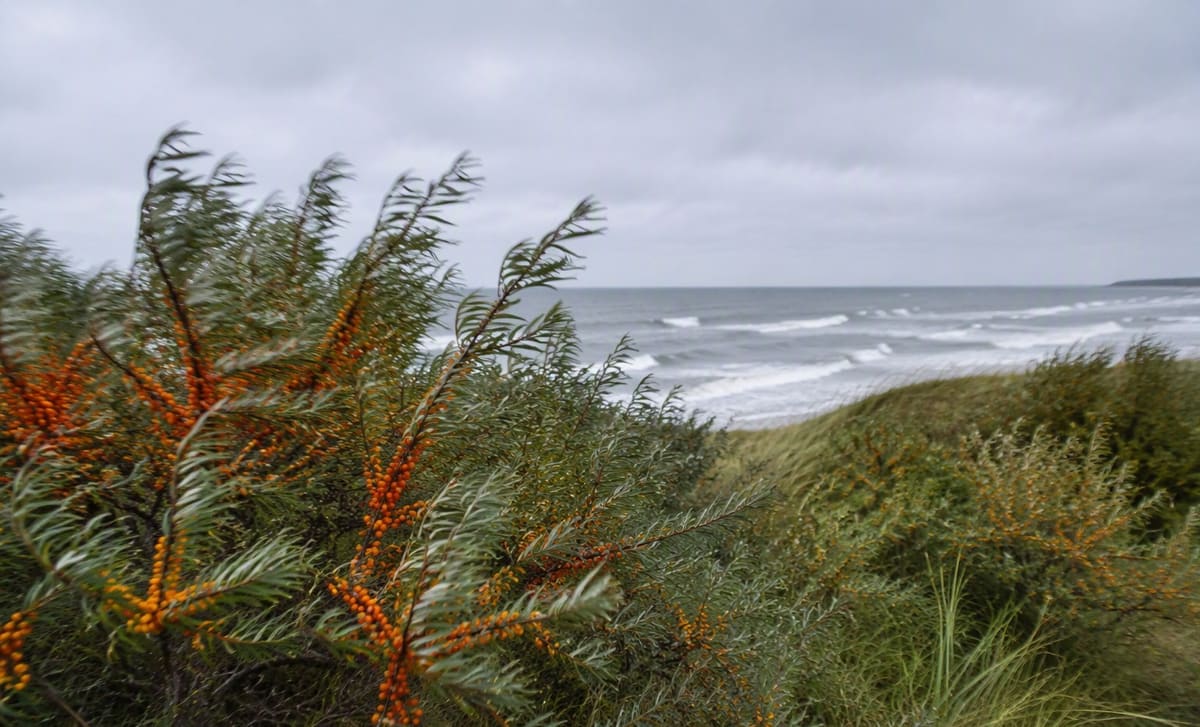
Europe is sea buckthorn’s western home. The shrub is native along the coasts from the Baltic to the Atlantic fringe and up river valleys inland, and European countries built much of the modern research, breeding, and organic market around it.
The native range
On Europe’s dunes, sea buckthorn is infrastructure: its roots hold the sand together. That role runs from the Baltic coasts through the German Bight to the Atlantic fringe, with inland stands along gravelly river valleys. The country pages go deeper: Germany for research and products, Finland for clinical work and northern growing, and the UK for the naturalized coastal story.
East meets west
Europe’s relationship with the berry has two roots. The western one is coastal and botanical. The eastern one runs through Russia, whose breeding programs created the garden varieties now grown across the continent, as the Russia page explains. Modern European orchards mostly plant those bred varieties, and the varieties page shows what that breeding changed.
The organic market
European buyers enjoy the world’s most certified sea buckthorn market. Organic labeling is common, origin disclosure is better than average, and “made in the EU” still leaves the “grown where” question open, since European processors also handle imported berries. The checks stay the same everywhere: named origin, named plant part, named producer. Run them yourself, or start from the organic bottles that passed ours.
For gardeners
Most of Europe suits the shrub, from coastal dunes to continental gardens, and our growing hub covers site, soil, and the male-female requirement. The regions hub maps Europe against the Himalayan and Asian origins.
The dune ecology, closer
On the coasts, sea buckthorn is not scenery but structure. Dune systems are sand in motion, and the shrub’s suckering thickets pin them in place, which is why coastal authorities planted it for generations and why many stands now sit inside protected reserves. The forager’s corollary: much of Europe’s wild crop is off-limits by design, and local rules decide what may be picked where. The where it grows page maps the habitat beyond the dunes.
The research map, in brief
Europe’s claim on the modern berry is intellectual as much as agricultural. Finnish laboratories produced human trials cited worldwide, German companies built product lines decades before the current boom, and breeding stations refined Russian material into varieties suited to western orchards. The result is a continent whose contribution is measured in papers and products rather than tonnage.
Reading European labels, precisely
Three labels, three meanings. Grown in names the berry’s origin. Made in names the processor’s address. An EU flag on the front settles neither, because European processors press imported berries every season. The honest bottle answers all three questions on the back label, and the organic paperwork, where it exists, names the farm origin too.
For the European gardener
Garden centers across the continent sell bred varieties grafted or cutting-grown, which matters: named varieties berry true, while seedlings are a lottery. The choice between a native-type shrub and a bred variety is really a choice between habitat value and dessert berries, and the greek origins page adds the footnote that Europe’s relationship with the shrub predates every industry on this page.
The foraging season
Where picking is allowed, the window runs from late summer into autumn, later in the north. Expect thorns, stained fingers, and slow work, and expect the best patches to be known already. Locals guard them the way mushroom spots are guarded. The rule of thumb across the continent is simple: dunes and reserves mean no, ordinary farmland edges mean ask, and a basket never outranks a sign. When in doubt, the local tourist office knows the local rules, and the fines know them too.
Frequently asked questions
Is sea buckthorn native to Europe?
Yes. It is native along the coasts of Northern and Western Europe, from the Baltic to the Atlantic fringe, and up river valleys inland. Several European countries also farm it, led by Germany and Finland for research and products.
Can I forage sea buckthorn in Europe?
Sometimes, and only where local rules allow. Much of the wild coastal crop grows inside protected dune and nature reserves where picking is restricted or banned, since the shrubs are working erosion control. Where picking is permitted, the autumn window applies, along with gloves for the thorns.