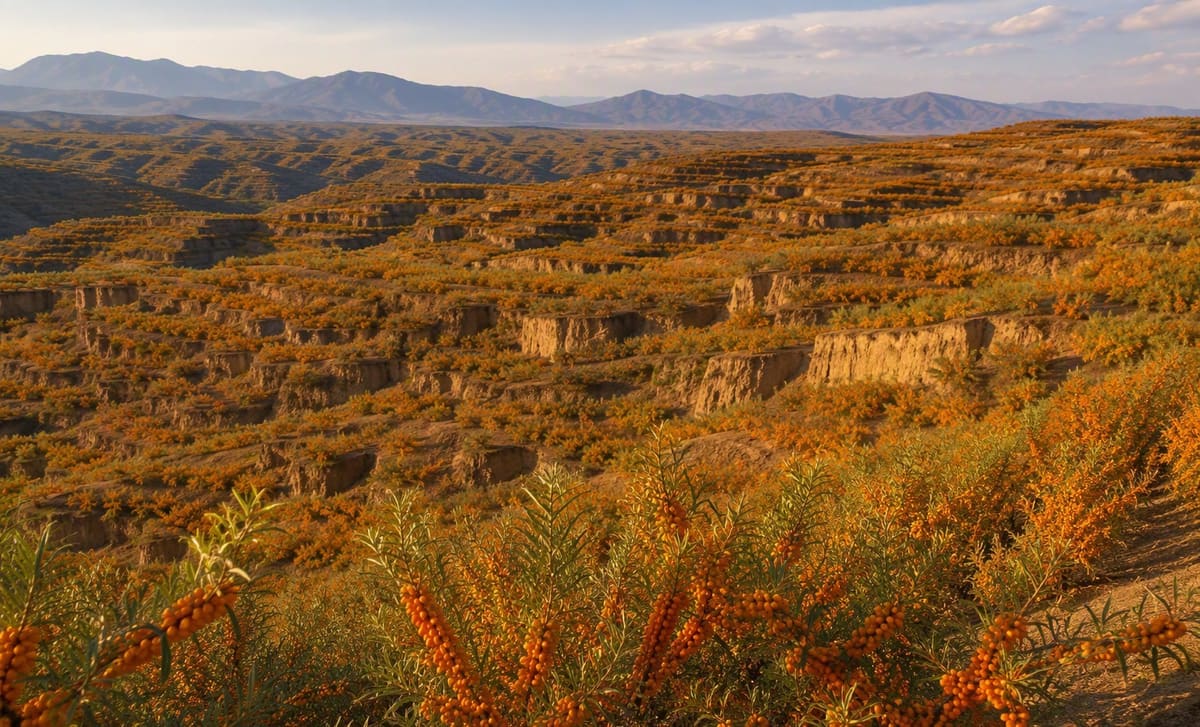
China is the giant of sea buckthorn: the largest wild populations and by far the largest planted area, much of it put in for erosion control since the 1980s. If you buy sea buckthorn oil, powder, or juice concentrate anywhere in the world, the raw berries most likely started in northern China or on the Tibetan Plateau.
Planted to hold the soil
From the 1980s onward, China planted sea buckthorn at a scale no other country has attempted, largely to stabilize eroding land on the Loess Plateau and across the dry north. Deep roots, nitrogen fixing, and a tolerance for cold, poor soil made the shrub the workhorse of those programs. Fruit was a byproduct at first, then an industry in its own right, as the modern industry page recounts. Our commercial farming page looks at what that scale means for orchard economics, and the regions hub sets China beside every other growing country.
The traditional layer
None of this is new to China. The berries appear in classical Chinese medical texts and remain a standard item in the traditional pharmacopeia, a history the Chinese medicine page covers. Modern planting programs sit on top of centuries of use, which partly explains how quickly the industry professionalized.
What buyers should know
Bulk ingredient markets run on Chinese supply, and that fact alone says nothing about quality. Traceability is the variable that matters, and sorting the oils worth buying from anonymous bulk comes down to three questions:
- Ask where exactly. “Product of China” is a starting point, not an answer. Regions and producers differ enormously.
- Ask which species and variety. Several sea buckthorn species grow in China, and they are not interchangeable.
- Ask which plant part. Bulk oil can be berry, seed, or a blend, and the label should say so plainly.
Neighbors Mongolia and Russia supply the wild-harvest and breeding sides of the story, and the Himalayan belt continues in India.
The Loess Plateau, in focus
The plateau’s story explains the shrub’s role better than any statistic: deep, fertile, wind-blown soil that erodes at world-class rates once vegetation is stripped. Sea buckthorn’s answer is structural. Its roots bind slopes, it fixes its own nitrogen (as the nitrogen fixing page explains), it survives drought and bitter winters, and it asks for nothing the plateau cannot give. Fruit was the bonus that turned a conservation planting into an industry.
The species question, deepened
Chinese sea buckthorn covers more than one species, and they differ in berry size, chemistry, and thorniness. The species page maps the family. Large planting programs favored hardy local material, while breeding work added improved varieties over time. For a buyer, the practical point stands: a supplier who can name the species and variety knows their supply chain, and one who cannot is selling a commodity.
What industrial scale means for quality
Scale itself is neutral. What scale changes is variance: millions of bushes across thousands of kilometers produce berries of every grade, and the sorting happens at the processor, not the bush. That is why two Chinese sea buckthorn oils can be genuinely different products, and why traceability questions matter more here than anywhere.
The traditional layer, still alive
The pharmacopeia entry is not a museum piece. The berries still sell in northern Chinese markets each autumn, the juice is ordinary supermarket stock, and traditional preparations continue alongside modern extraction plants. The Chinese medicine page traces how deep that record runs. An industry that grew out of both soil policy and medicine is harder to summarize than most. The buyer’s shortcut through it is the same as everywhere else: named origin, named species, named plant part, and a producer who answers questions without squirming. That short list filters most of the shelf.
Frequently asked questions
Does most sea buckthorn come from China?
Yes. By planted area and harvest volume, China dominates global supply. It holds the largest wild populations and has planted the shrub at a scale no other country approaches, and most bulk sea buckthorn oil and powder on world ingredient markets starts there.
Is Chinese sea buckthorn good quality?
It can be, at any grade. China's scale spans wild stands, conservation plantings, and managed orchards, so quality varies by producer rather than by country. The checks that matter are traceability: a named region and producer, a named species and variety, and a named plant part in the bottle.