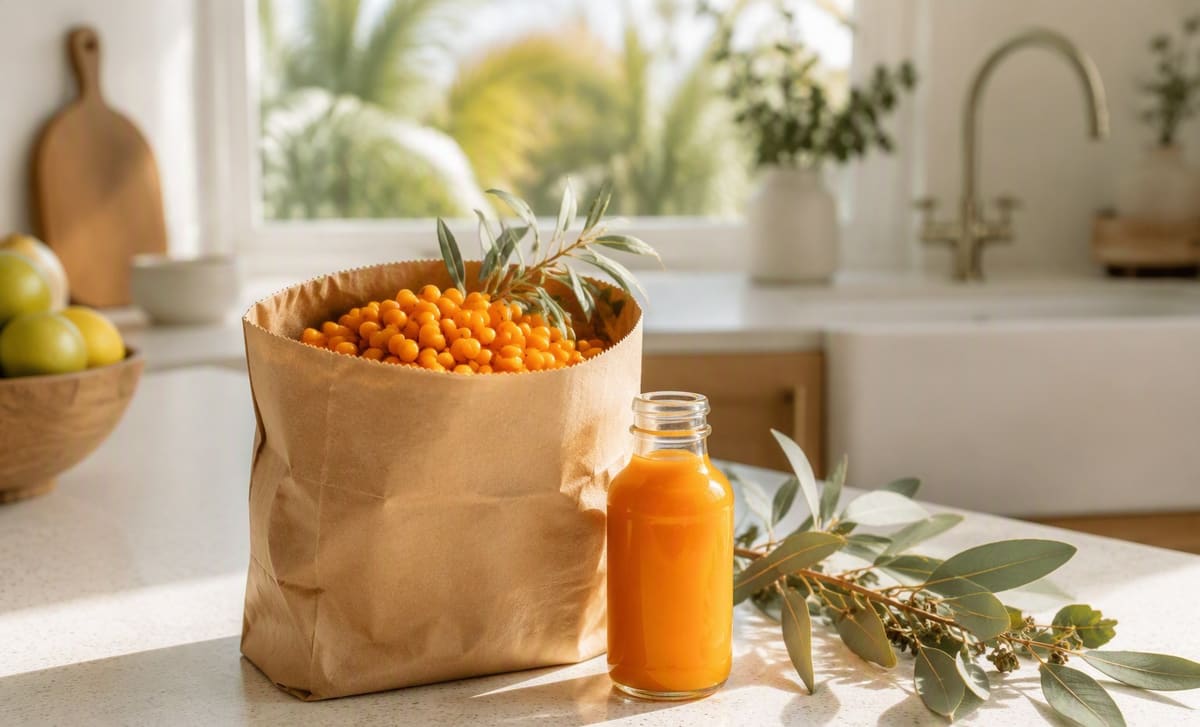
In Australia you can buy sea buckthorn oil, capsules, and juice mostly through pharmacies like Chemist Warehouse, health-food shops, Amazon AU, iHerb, and brand-direct sites, and almost all of it is imported. A supplement sold with health claims is a listed medicine and should carry an AUST L number from the TGA. That number means the product uses pre-approved ingredients and is made to Good Manufacturing Practice, though the TGA does not test each one for how well it works.
Where Australian buyers actually shop
The retail path is straightforward, even if the local growing is not. Pharmacies like Chemist Warehouse, health-food shops, and the online channels carry sea buckthorn oil and capsules: Amazon AU, iHerb, which ships to Australia, and the brands’ own stores. Juice and skincare turn up in health and beauty retailers. Because there is no real domestic harvest, expect imported origin on nearly everything, so the where to buy guide and its freshness checks matter more here, not less. The regions hub maps where those imports are grown.
The label mark that matters: AUST L
This is the most useful thing to know before you shop in Australia. Most vitamins and supplements are regulated as complementary medicines, and the low-risk ones are listed medicines that carry an AUST L number on the label. The number tells you the product is on the Australian Register of Therapeutic Goods, uses only pre-approved ingredients, sticks to permitted claims, and is made under Good Manufacturing Practice.
There is a catch worth understanding. The TGA does not individually evaluate an AUST L product for efficacy before it goes on sale. The sponsor certifies that it meets the rules, and the TGA can audit later. Higher-scrutiny products carry an AUST R number instead, but you will rarely see AUST R on a supplement. So AUST L is a real quality and safety floor, not a promise the product works. Read it as, this is made properly, and then judge the evidence for the ingredient yourself.
One honest nuance. Sea buckthorn sold purely as a food, such as a juice or frozen berries, sits under the Food Standards code, not the TGA, so it carries food labelling and no AUST L number. A skincare oil sold as a cosmetic follows different rules again. The AUST L question only applies to products sold as supplements with health claims.
| Label line | What good looks like | Why it matters |
|---|---|---|
| Regulator status | An AUST L number for a supplement making claims | It shows the product is a TGA-listed complementary medicine |
| What AUST L proves | Pre-approved ingredients, GMP manufacture | It is a safety and quality floor, not proof of efficacy |
| Plant part | Berry, seed, or blend, named | It decides which fatty acids you are buying |
| Species | Hippophae rhamnoides | The species the research actually used |
| Origin | A named region | Nearly all Australian stock is imported, so origin is worth reading |
Does it grow in Australia?
Barely, and not commercially. Sea buckthorn can be grown in cooler parts of the country, alpine Victoria and New South Wales, Tasmania, and cool-temperate corners of the south-east, where winters are cold and summers dry. What Australia does not have is an established industry, so local berries are hard to find and Australian buyers routinely come up empty when they look for a domestic grower. For now, treat almost every Australian product as imported, most often Himalayan or European in origin.
What it is called here
Australians call it sea buckthorn, with seaberry as the occasional alternative on packaging. There is no separate local trade name, so the plain English term covers it.
Before you buy
Choose plant part and dose before you compare bottles. Berry oil leans toward omega-7, seed oil toward omega-3 and 6, explained on the seed versus berry page, and the studied 2-grams-a-day amounts are on the dosage page. Run the five-point label check on the how to choose guide, then compare scored products in the oil and capsules guides.
Sizing up the other English-speaking markets? The UK, Canada, and India buying pages cover each country’s rules.
Frequently asked questions
What does AUST L mean on a supplement in Australia?
It is a listing number from the Therapeutic Goods Administration for a low-risk complementary medicine. The sponsor certifies the product is safe, of good quality, and uses pre-approved ingredients. The TGA does not assess AUST L products for how well they work before they go on sale.
Does sea buckthorn grow in Australia?
It can grow in cool areas such as Tasmania, alpine Victoria and New South Wales, and cool-temperate parts of the south-east. There is no established commercial industry, though, so buyers rarely find Australian-grown berries and almost all products are imported.
Why does the sea buckthorn juice have no AUST L number?
Because juice and berries sold as food are regulated as food under the Food Standards code, not as medicines by the TGA. Only products sold with therapeutic claims are listed medicines that carry an AUST L number, so a plain food juice will not have one.
Is it legal to import sea buckthorn supplements into Australia?
Personal importation of many supplements is allowed within limits, but products bought overseas will not carry an AUST L number and are not TGA-assessed. Buying an AUST L listed product locally is the simpler route if the regulator mark matters to you.