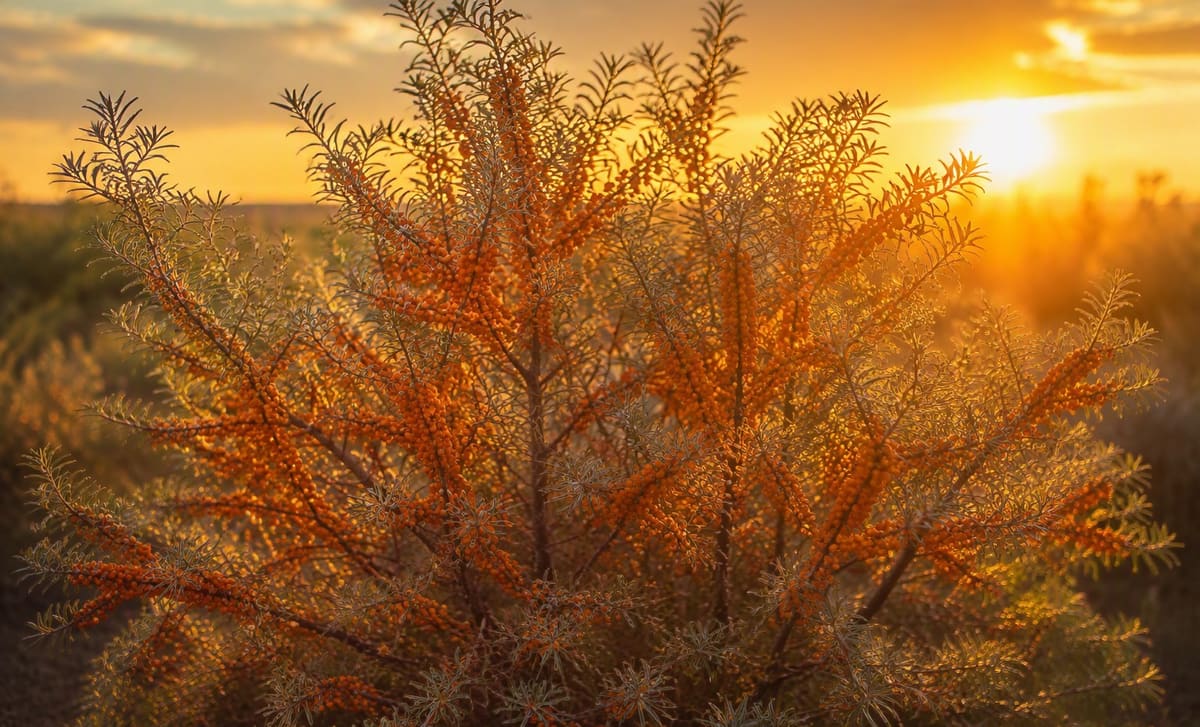
Hippophae rhamnoides is the scientific name of the sea buckthorn behind essentially every juice, oil, and capsule on the market: a thorny, silver-leaved, nitrogen-fixing shrub in the Elaeagnaceae family. The name itself is two small stories, one Greek and one botanical, and both are worth the two minutes they take.
The name, piece by piece
Hippophae builds from two Greek words: hippos, horse, and phaos, shine or gleam. The traditional account says ancient observers fed the plant to horses and admired the glossy coats that followed. Treat that as the story handed down rather than verified history, which the name origin page explains honestly. Rhamnoides is plainer Latin: resembling Rhamnus, the unrelated buckthorn genus early botanists thought it matched. You’ll also see the two words flipped to rhamnoides hippophae in search boxes and some database listings, and it points at this same shrub either way.
The family it sits in
Sea buckthorn belongs to Elaeagnaceae, a small family of tough, silver-scaled shrubs that share a useful trick: all of them host nitrogen-fixing bacteria in their roots. Its relatives include autumn olive and the buffaloberries of North America, which matters practically because those relatives are also its best lookalikes. Family resemblance is why identification needs more than a glance.
One species, many forms
H. rhamnoides ranges from European coasts to the Himalayas, and botanists divide that range into several subspecies. The European coastal plants are the original form, while the Asian populations, which supply most commercial berries, carry their own subspecies names. Wild plants vary enormously in berry size, thorniness, and chemistry, which is one reason bred cultivars exist at all. The full genus tour, relatives and all, lives on the species page.
Why this species won the market
Several Hippophae species grow wild in Asia, but H. rhamnoides is the one that took over shelves: widespread, extremely hardy, and productive enough to farm. If a label doesn’t name a species, this is the one it means. To recognize it in the wild, use the identification guide. To grow it, start with how to grow sea buckthorn. The plant hub maps the rest of the botany.
Why the chemistry varies
One consequence of that enormous range matters to buyers. The species isn’t chemically uniform. Subspecies and wild populations differ measurably in their oil. The berry oil’s omega-7 share, for instance, runs from 15 to 54 percent across documented populations, which is why honest composition pages quote ranges instead of one heroic figure, as the fatty acid profile page does. Vitamin C swings just as widely, roughly 200 to 600 mg per 100 grams of fresh berries by species and origin, as the vitamin C page records. The regions hub compares what the major origins mean in practice, and the variation is a biodiversity fact before it is a marketing point.
Meeting the plant itself
In the field, the Hippophae plant reads as attitude as much as anatomy. It grows where little else fruits, on dunes and gravel bars and raw slopes, silver-sided and thorn-armed, holding orange berries long after everything else has gone bare. Tip a leaf in the sun and the underside flashes white. Snap a berry and the pulp smears orange grease on your fingers. The glossary entry for Hippophae keeps the name straight, and the identification guide linked above turns the meeting into a method.
The name’s working life
Botanists wrote the name long before marketers found the plant, and both groups still use it, which makes it one of the few honest words in the aisle. On a supplement label, the Latin binomial is a disclosure: it names the species you are buying, and its absence is its own message. A bottle that never names the species has already failed one of the checks in our guide to spotting a fake, where the lines a label leaves out say more than the ones it prints. On seed packets and plant tags the name does the same job, because only this species carries the whole commercial story. The species page shows the relatives this name leaves out.
Frequently asked questions
What does Hippophae rhamnoides mean?
The genus name comes from Greek hippos (horse) and phaos (shine), usually read as shining horse, after an old account that the plant glossed horses' coats. Rhamnoides means resembling Rhamnus, the buckthorn genus people thought it looked like. The name origin page tells the full story and flags it as tradition, not verified history.
Is sea buckthorn related to buckthorn?
No. The true buckthorns belong to a different family, Rhamnaceae, and the shared name is a borrowed resemblance that stuck. Sea buckthorn sits in Elaeagnaceae with autumn olive and buffaloberry. The species name rhamnoides, meaning resembling Rhamnus, records the old mistake permanently.