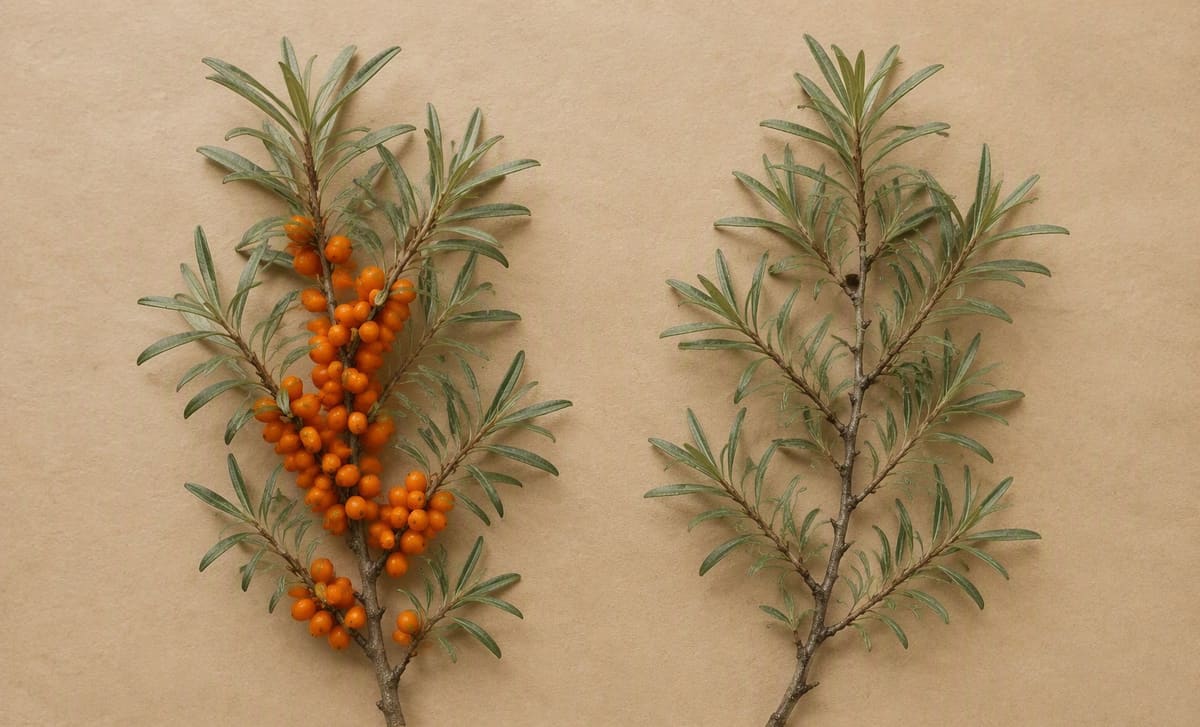
Two shrubs cause nearly every sea buckthorn misidentification: buffaloberry in North America and autumn olive across old fields and roadsides. Both wear silvery leaves and orange to red fruit. Both are separable in seconds once you know where to look. And the standing rule for any wild berry applies: when in doubt, do not eat it.
Buffaloberry, the convincing double
Buffaloberries (Shepherdia) are sea buckthorn’s own relatives, which explains the resemblance: silvery leaves, thorny branches, small orange-red berries. Two marks split them. Buffaloberry leaves sit opposite each other on the twig, while sea buckthorn leaves alternate. And buffaloberry fruit hangs on short stalks in looser clusters, while sea buckthorn berries pack directly against the wood. The taste differs too: buffaloberry is bitter-soapy, sea buckthorn cleanly and fiercely sour. The plant hub holds the full identification picture.
Autumn olive, the roadside stand-in
Autumn olive (Elaeagnus umbellata) is another silver-leaved relative, common on old fields and highway margins in eastern North America. Its berries are red, dusted with silver speckles, and hang on obvious stalks under the branches. Sea buckthorn berries are un-speckled bright orange and hug the wood. Autumn olive’s leaves are broader and egg-shaped, not narrow and willow-like.
The five-second check
Alternate narrow silver-backed leaves, thorns on gray wood, and bright orange berries welded to the branches mean sea buckthorn. Opposite leaves, stalked clusters, speckled red fruit, or egg-shaped leaves mean something else. Cross-check with the identification guide, mind the foraging rules, and see where sea buckthorn actually grows.
Habitat as the first filter
Before the leaf checks, ask where you are standing. Buffaloberry is a plant of dry open prairie and coulees in interior North America. Autumn olive owns old fields, roadsides, and forest edges, mostly in the east. Sea buckthorn in the wild means coasts and riverbanks in its native belt, and planted or naturalized stands beyond it, which the where it grows page maps. Habitat never closes an ID, but it sorts the odds before you look at a single leaf.
The minor doubles
A few other silver-leaved shrubs turn up in the same conversation. Goumi, another Elaeagnus relative planted in gardens, carries red speckled berries on stalks, the autumn olive pattern in a smaller package. Silverberry and Russian olive share the silver foliage but not the orange packed fruit. All of them fail the same core test: bright orange berries welded directly to thorny gray wood, with narrow alternate leaves flashing silver beneath. Buffaloberry remains the one that matters most, because it shares the family, the thorns, and the orange-red palette.
Buckthorn versus sea buckthorn
Drop the “sea” and you land on a different plant entirely. So what is buckthorn, plainly? The name belongs to Rhamnus, and in North America it usually means common buckthorn, Rhamnus cathartica, a Eurasian shrub or small tree that has turned into one of the region’s more aggressive woodland invaders. It is not a relative of ours in any sense. Sea buckthorn sits in Elaeagnaceae alongside buffaloberry and autumn olive, Rhamnus keeps its own family in Rhamnaceae, and the shared surname is an old resemblance guess that the name origin page unpicks.
The fruit settles it in one glance. Buckthorn berries are small, round, and dark purple to black, sitting on short stalks, on a shrub whose leaves are nearly opposite with veins that curve toward the tip. Sea buckthorn berries are bright orange and packed hard against thorny gray wood. Nobody who has seen the two side by side confuses them. The search box is where the trouble starts, because “buckthorn berries” pulls up both plants at once and a reader can land here looking for either.
One firm line, since this page exists to stop people eating the wrong thing. Rhamnus cathartica fruit is not food, and cathartica is not a decorative name. Birds eat the berries and spread the seeds, which is a large part of why the shrub travels so well, and people should not copy birds. Black berries on a thorny shrub in your yard mean you have a buckthorn problem rather than a sea buckthorn harvest, and your county extension office will tell you what it wants done about it. Our own shrub has an invasiveness question of its own, answered honestly on the is it invasive page.
What to do when unsure
The rule has a procedure. Photograph the plant: whole shrub, branch, leaf top and underside, and fruit close up. Check the marks against the identification guide, and if anything disagrees, walk away. Local extension services and native plant societies will confirm from photos, and a confirmed stand is worth the wait. The foraging guide picks up after the ID closes, and no berry is worth guessing on.
Why the doubles matter beyond safety
Mix-ups cost more than a bad taste. A forager who strips buffaloberry thinking it is sea buckthorn loses the sour, oily fruit they came for, and a gardener who plants autumn olive by mistake has planted a genuinely invasive shrub across much of eastern North America. The three-minute check protects the meal, the garden, and the local flora at once, which is a strong return on three minutes.
The season matters
Autumn is mix-up season, when every shrub in the family carries fruit and the berries do most of the talking. Do the identification in summer if you can, when the leaves are out and the arrangement check is easy, then return in autumn to a plant you already know. A stand confirmed in July is a safe harvest in October, and a stand first met in October deserves the full checklist.
Frequently asked questions
What berry looks like sea buckthorn?
Buffaloberry (Shepherdia) is the classic mix-up in North America: silvery leaves, thorny shrubs, orange-red berries. Autumn olive is the second, with silver-scaled red berries on stalks. The quickest separators are leaf arrangement and how the fruit sits on the branch. When in doubt, do not eat it.
Is buffaloberry safe to eat?
Yes, buffaloberries are edible and were eaten traditionally, though they taste bitter and soapy rather than cleanly sour. The real risk in any mix-up is sloppy identification itself: the rule stands for every wild berry, confirm the plant before you eat it.