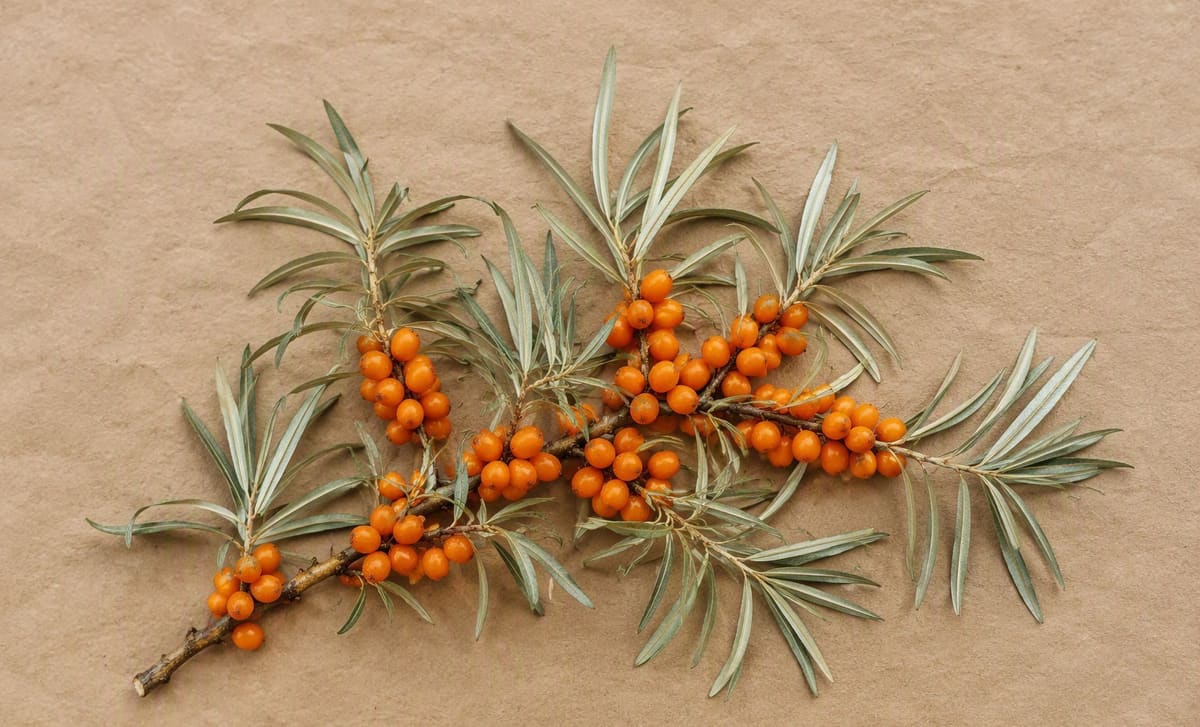
Identify sea buckthorn with three marks together: narrow willow-like leaves that flash silver underneath, gray branches armed with stiff thorns, and small orange berries packed so tight against the wood they ring the branches. One mark alone proves nothing. All three together close the case.
The marks, one by one
- Leaves: narrow and lance-shaped, alternate on the twig, dull green above and silvery white below. A breeze turns a hedge silver.
- Branches: gray-brown and thorny, with short lateral shoots tipped in spines. The thorns page introduces the hardware.
- Berries: small, oval, bright orange, sitting directly on the branch with barely a stalk, packed shoulder to shoulder. They persist deep into winter. The berry page goes close up.
- Habit: a large shrub or small tree, often wider than tall, that suckers from the roots into thickets.
Through the seasons
Spring shows tiny brown flowers on bare wood before the leaves. Summer is a silver-green shrub with green berries hidden in the foliage. Autumn colors the fruit while the leaves hold. Winter strips the leaves and leaves orange beads on gray thorny branches, which is when the plant is easiest to spot and when the birds need it most.
Where to look
Coastal dunes, riverbanks, gravel pits, and old windbreak plantings are prime ground, and the where it grows page maps the bigger picture. Before you taste anything, read the lookalikes page, because buffaloberry plays a convincing double. Foragers should then read the foraging guide. The plant hub ties it all together.
Confirming it without fruit
Summer is the hard season, when the berries are green and hidden. Three non-fruit marks carry the ID then. Flip leaves: the silvery underside flashes white, and a whole hedge turns over silver in wind. Check the leaf arrangement: alternate along the twig, narrow as a willow’s. And look at the ground plan: a shrub spreading into a thicket by root suckers, on open sunny ground, is behaving the way only this family behaves here. Add thorns and the case closes again.
The taste test, last and optional
Once the lookalikes are ruled out, one berry settles it: fierce, clean sourness with an oily pulp, nothing like the bitter soap of buffaloberry. Taste is a confirmation, never a first test, and the standing rule holds: when in doubt, do not eat it. The raw berry guide covers what the first taste is actually like.
Winter is the giveaway season
The easiest identification of the year needs no leaves at all. From late autumn onward, orange beads ring bare gray thorny branches, and no common shrub in the plant’s range matches that picture. Snow makes it louder. If you are scouting ground for a future foraging season, winter is when to map the stands, and the foraging guide governs what happens when you come back in autumn.
The common false alarms
Three everyday shrubs trigger false reports. Willows copy the leaf shape but carry no thorns and no orange fruit. Wild roses have thorns and bright hips, but the leaves are toothed and compound, never narrow and silver. And any orange-berried shrub with stalked, loosely clustered fruit fails the packed-against-the-wood test immediately. Each falls to the same three marks, which is why the marks come first.
The habit read
Step back ten paces before stepping in. The whole-plant picture narrows the possibilities fast: a wide, suckering, silver-sided thicket on open sunny ground is sea buckthorn’s signature posture. Upright single-trunk trees, climbers, and shaded understory shrubs all fail the habit read before the leaf check even begins. Habitat, habit, then hardware, in that order, is the fastest honest path to a name.
Frequently asked questions
How do you identify sea buckthorn?
Look for three marks together: narrow willow-like leaves that flash silver underneath, gray-brown branches with stiff thorns, and small orange berries packed directly against the branches so tight they ring the wood. In winter the berries persist on bare thorny branches. Check the lookalikes page before eating anything, because buffaloberry copies the look.
Does sea buckthorn always have thorns?
Wild plants do, every time, and the thorns are one of the three core field marks. Bred cultivars reduce them sharply, but even low-thorn garden lines keep some spines. A thornless lookalike with orange berries should fail your identification check until the other marks prove otherwise.