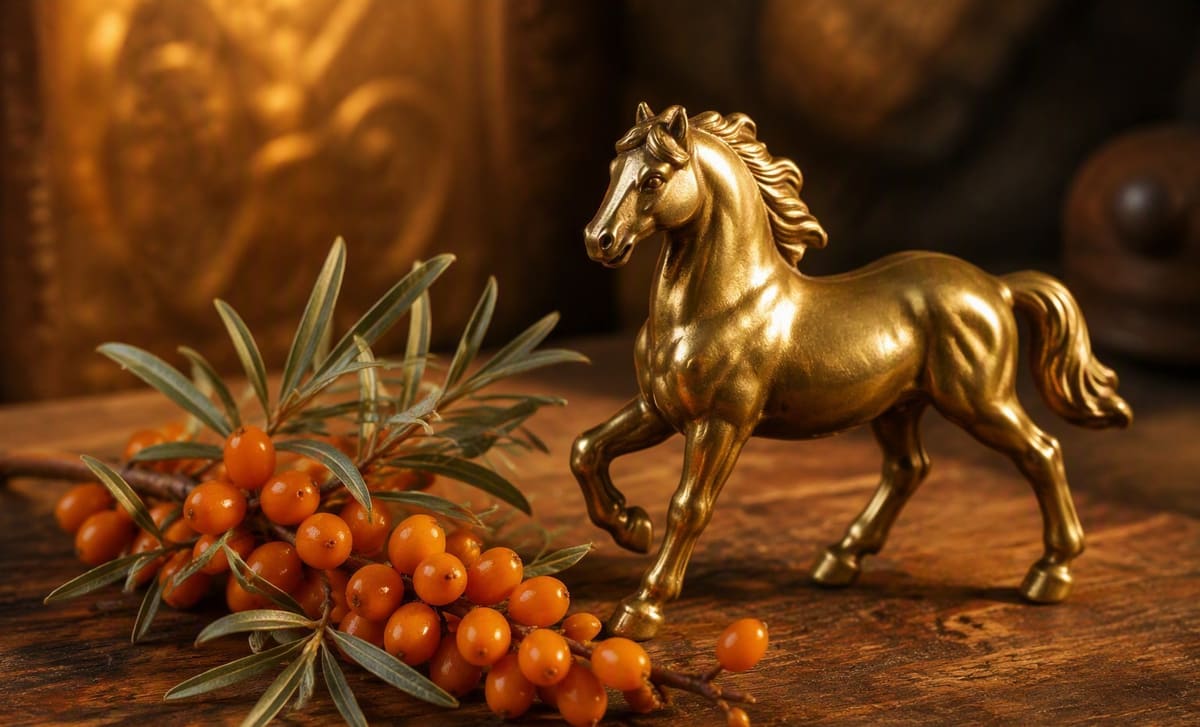
The name sea buckthorn is two borrowed parts. Sea points at the coastal dunes where Europeans knew the plant. Buckthorn came from a resemblance to an unrelated family. Its scientific name, Hippophae, is the older and better story: Greek words meaning shining horse, tied to an account that the plant made horses’ coats gleam.
The shining horse story
Hippos means horse and phaos means shine, or gleam, and the old account says Greeks fed this plant to their horses and prized the glossy coats that followed. Should you take that as history? Treat it instead as a story handed down alongside the name, not a documented record. It’s been repeated since antiquity, and nobody alive can check a two-thousand-year-old stable experiment. It’s a good story, and we label it as one.
The sea half
In Europe, sea buckthorn is a plant of the coastal dunes, shrugging off salt wind and sand where little else will fruit, as the where it grows page maps. So the sea half is honest enough. It just undersells the plant, because the same species is equally at home on mountain riverbanks thousands of kilometers inland. The coast is simply where northern Europeans ran into it first.
The buckthorn half
Early botanists looked at this thorny shrub and thought of Rhamnus, the true buckthorn genus, and that resemblance stuck in both names. The common name borrowed buckthorn outright. The species epithet rhamnoides literally means resembling Rhamnus. Here’s the catch. The plant isn’t a buckthorn at all. It belongs to Elaeagnaceae, a separate family, as the botanical name page explains. Germans skip the confusion and call it Sanddorn, sand thorn, which might be the most honest name of the lot. The wider genus story lives on the species page, the human story on the history hub, and the plant hub holds the rest.
The name in other languages
Every language named what it noticed first. German keeps the habitat with Sanddorn, sand thorn. Russian knows it as oblepiha, the word bound up with the old Siberian picking culture and the breeding programs that grew out of it, told on the cultivation history page. Finnish tyrni marks the northern edge of the range, where the Finland region page shows the plant thriving. Older English herbals reached for sallow thorn, after the willow-like leaves. Ground, leaf, or a horse: each name is a snapshot of whatever struck the people who coined it.
Why the horse story persists
Why has the horse story lasted this long? Legends that survive usually have a working part, and this one does. The leaves genuinely are fodder, browsed by stock across the native range for as long as the records run, as the leaves page notes. Picture a herder watching animals do well on that browse. You’d praise the plant too. The jump from healthy horses to gleaming coats is the storyteller’s flourish, and we keep the honest label pinned on it. The Greek origins page traces what antiquity actually wrote down.
Living with a borrowed name
That borrowed buckthorn tag causes real trouble, because the true buckthorns are an unrelated family whose berries are a completely different proposition. So we lean on the scientific name instead, and you’ll see us do it all over this site. Hippophae rhamnoides points at exactly one plant, and the glossary keeps it pinned down. The lookalikes page sorts out the confusion in the field, where names matter far less than the way the leaves sit on the stem. Common names tell stories. Latin names end arguments.
The marketing afterlife
Modern branding treats the name as raw material. Sea berry, seaberry, and the occasional sandthorn all circulate on labels, and the Himalayan trade piles on its own local names. Behind every one of them sits the same species and the same old stories. So the real label-reading skill is just recognizing the plant under whichever alias it’s wearing, a skill the what is sea buckthorn page starts you on. An aisle of aliases is really one shelf, and our product guides sort that shelf by form rather than by whichever name the marketer liked best.
Frequently asked questions
Why is it called sea buckthorn?
Two halves. Sea for the coastal dunes where Europeans met the plant. Buckthorn because people thought it resembled the unrelated buckthorn family, and the species name rhamnoides literally means resembling Rhamnus, that family's genus. The scientific name Hippophae is the older story: Greek hippos plus phaos, shining horse, from the account that the plant made horses' coats gleam.
Is the shining-horse story true?
It is the traditional account, repeated since antiquity, and nobody can verify a two-thousand-year-old stable experiment. The plausible core is real enough: the leaves are genuine fodder, and animals do thrive on good browse. The gleaming coats are the storyteller's flourish, honestly labeled as tradition.