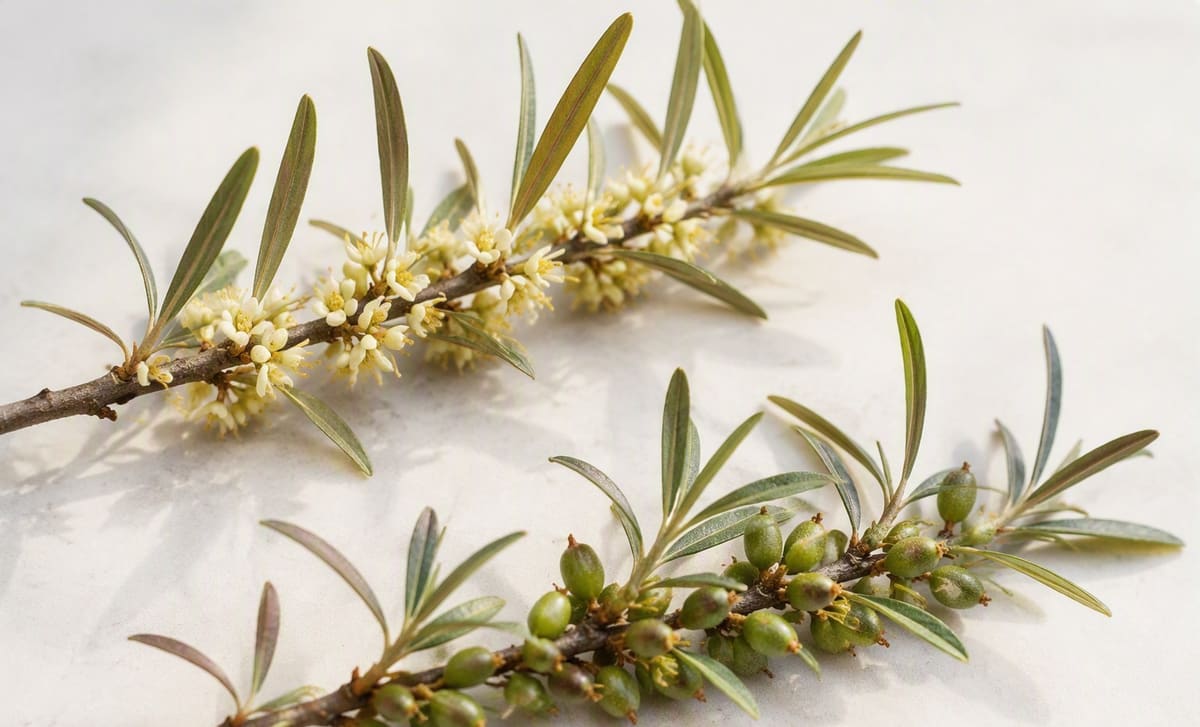
Sea buckthorn is dioecious: every plant is male or female, and only the females carry berries. Males make the pollen, females make the fruit, and you need both for a harvest. The sexes look identical all summer, but their winter buds quietly give the game away.
Reading the buds
From late autumn through winter, next year’s flower buds sit on the bare branches. Male buds are noticeably rounder and larger, plump little cones stacked with pollen flowers. Female buds are smaller and slimmer. It takes one season of practice, and the identification guide has the other field marks. Come autumn, of course, the berries settle the question on their own.
Why you cannot sex a seedling
Seed-grown plants keep their secret until their first flowering, which takes years. That is the strongest argument for cuttings: a cutting copies its parent exactly, sex included, as the from cuttings guide explains. The from seed guide covers the longer, chancier road.
The working ratio
Orchards run one male for every six to eight females, close enough for wind pollination to do the work, and named pollinizer males exist for exactly this job, as the varieties page notes. Gardeners with one lone female get flowers, hope, and no fruit. The male to female ratio guide plans the layout, and the plant hub covers the rest of the biology.
The bud trick, up close
Work the buds from late autumn to early spring, when the wood is bare. Find the short lateral shoots where flowers form. Male buds sit like tiny stacked cones, round and plump, several scales deep. Female buds are slim and pointed, half the size. Bring a hand lens the first season and compare a known fruiting plant if you can, and by the second winter the difference reads at arm’s length. The same buds double as next year’s crop forecast, since fat male buds mean pollen and clustered female buds mean fruit wood.
Watching the bloom
Spring confirms whatever the buds suggested. Male clusters puff yellow pollen when brushed, a cloud you can see in slanted light. Female flowers are subtler, single small pistils on the same bare wood, and they never dust. The bloom lasts days, not weeks, and the flowers and pollination page times the whole exchange.
The seedling lottery
Every seed-grown plant is a coin flip on sex, and the coin takes years to land. Roughly half a tray of seedlings will be male and useless for fruit, and you cannot know which until first bloom. That is the whole argument for cuttings in one sentence, and it is why serious plantings are always clonal. The from seed guide makes the longer road work when the lottery is part of the fun.
When a plant seems to change sex
Garden lore says a sea buckthorn switched sexes. The biology says no: sex is fixed genetically, and the usual truth is a root sucker of the other sex growing up beside the original, or a grafted branch maturing. What looks like a change is a second plant introducing itself. Follow the stem to the ground and the mystery ends.
Choosing your mix
The sexes are different products. Females are the crop, males are the insurance, and a lone male is also a legitimate ornamental: silver foliage, no fruit mess, no bird-spread seedlings. Breeders sell named pollinizer males for a reason, and the varieties page lists the logic. For layout and numbers the planting guide does the planning.
One shrub, both sexes
The space-tight garden has one more option beyond grafting: plant a male and a female in the same hole and let them grow as a single fused clump. It looks like one plant, pollinates like two, and asks only that pruning respects both halves. Nurseries occasionally sell pre-paired plants for exactly this job, and the planting guide covers the spacing logic behind it.
Frequently asked questions
Do I need a male and a female sea buckthorn?
Yes for fruit. The species is dioecious: each plant is male or female, and only females carry berries. The standard orchard ratio is one male for six to eight females, planted close enough for wind pollination. One female alone stays berry-less no matter how healthy she looks.
Can a male sea buckthorn turn into a female?
No. Sex is fixed genetically at the seed. Plants that seem to change are usually a root sucker of the other sex growing up beside the original, or a grafted branch maturing. Follow the suspicious stem to the ground and you will find a second plant.