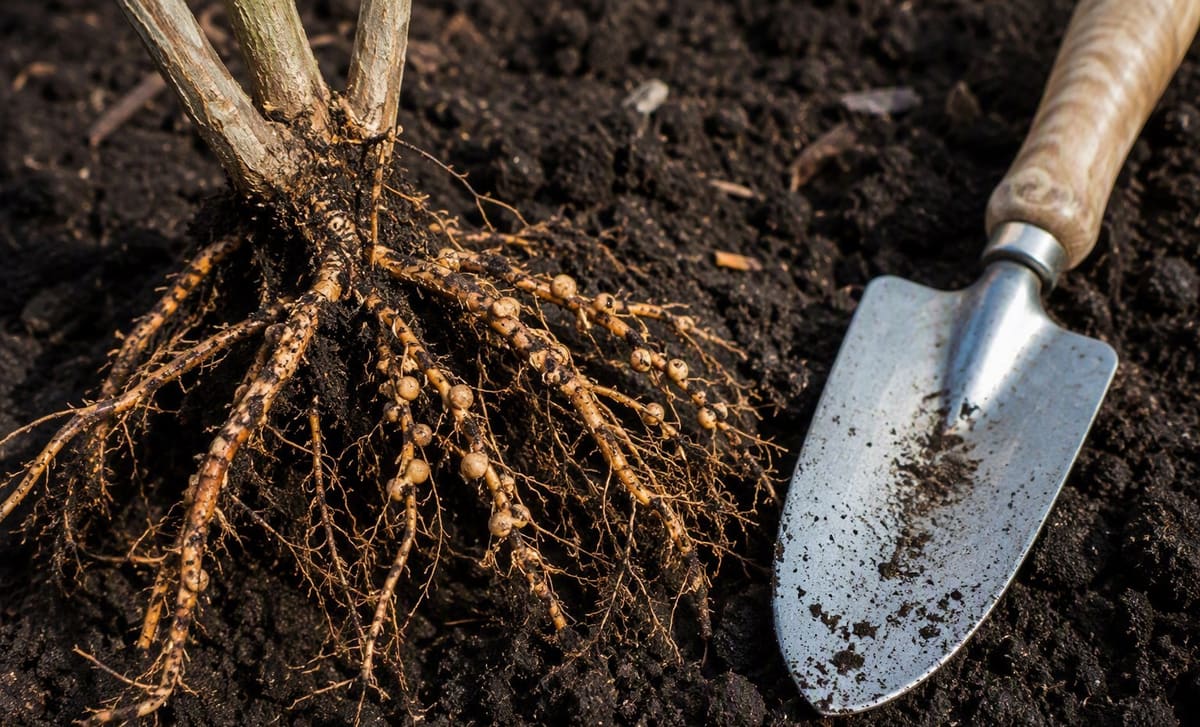
Sea buckthorn feeds itself. Its roots host Frankia, a filamentous soil bacterium, in knobbly nodules that pull nitrogen out of the air and turn it into plant food. That trick is why the shrub thrives on sand dunes, gravel, and landslide scars where other plants starve, and it is not a legume doing it.
The partner in the roots
Dig beside an established sea buckthorn and you can find the deal made physical: small coral-like clusters on the roots, and that’s where Frankia lives. The plant hands the bacteria sugars. The bacteria hand back nitrogen. Both sides come out ahead. Legumes run a similar arrangement with rhizobia, but sea buckthorn sits in a different club altogether, the actinorhizal plants, and its whole family, Elaeagnaceae, carries the same setup.
Why barren ground suits it
Nitrogen is the nutrient most soils are short of, so a shrub that builds its own can move onto ground nothing else wants. Coastal dunes. River gravel. Road cuts. Mine spoil. Governments noticed that trick, which is why eroded hillsides across China now wear sea buckthorn, as the where it grows page describes. And the giving doesn’t stop with the living plant, because fallen leaves return some of that nitrogen to the soil, so the pioneer quietly improves the ground for whatever grows next, a handoff the leaves page covers.
What gardeners should take from this
So what should you actually do with this in a garden? Two lessons. First, skip the heavy nitrogen feed, because an established plant makes its own and then sulks in rich, wet ground, which the fertilizer guide and the soil guide both underline. Second, the same vigor that thrives on poor soil is the trait that lets it sucker into thickets, and the invasive question page handles that honestly. The plant hub has the wider botany.
Finding the nodules yourself
Want to see the machinery for yourself? Pick an established plant in spring and dig gently beside the drip line, following one fine root down. The nodules look like tiny coral branches fused onto the root, firm and knobbly, a few millimeters across. They aren’t a pest. They’re part of the plant, so tuck the soil back and leave them be. On very poor new ground a plant may nodulate slowly at first, and its vigor tends to follow the nodules. Once you’ve actually seen them, the whole story stops feeling abstract, because there it is: a shrub carrying its own fertilizer factory in the dirt.
The pioneer economy
Nitrogen is the bottleneck on raw ground, and bare dunes and landslide scars start with almost none of it. That’s the whole problem. A plant that makes its own can arrive years ahead of the competition, pin the soil down with spreading roots, and then hand improved ground to whatever shows up next. Fallen leaves and spent nodules leak nitrogen into the soil bank. So the pioneer’s real legacy is a site other plants can finally use. That succession role is visible on any old stand, and it’s why governments plant this shrub for land repair, as the where it grows page describes.
Putting the trait to work
You can spend this plant’s nitrogen gift two ways. The lazy way is to give it the poorest sunny corner you’ve got and let it improve that ground for a decade. The deliberate way is to plant it as a companion that feeds its neighborhood, a role the companion planting guide plans out properly. Either way, one rule holds. The fertilizer guide spells it out. Nitrogen is the single thing this shrub never needs from you.
The legume comparison, fairly
Legumes made nitrogen fixing famous, and the actinorhizal club does the very same job by a different route. The differences are practical ones. Legumes are mostly herbs and crops, and they want decent starting soil. Actinorhizal shrubs like this one are woody pioneers, built for the worst ground on the map. Both trade sugar for nitrogen with a bacterial partner, and both leave the soil richer than they found it. Only one of them pulls it off on a sand dune in a salt wind.
Frequently asked questions
Is sea buckthorn a legume?
No. Legumes fix nitrogen with rhizobia bacteria, but sea buckthorn belongs to a different club: actinorhizal plants, which partner with Frankia, a filamentous bacterium called an actinomycete. The result is the same trick by a different route, nodules on the roots that pull nitrogen from the air and feed the plant.
Does fixing nitrogen mean sea buckthorn needs no fertilizer?
For nitrogen, essentially yes: an established plant manufactures its own and sulks in rich, wet ground. It still needs sun, drainage, and modest care, and very poor new ground can slow it until the root partnership establishes. Skip the nitrogen feed, not the site selection.