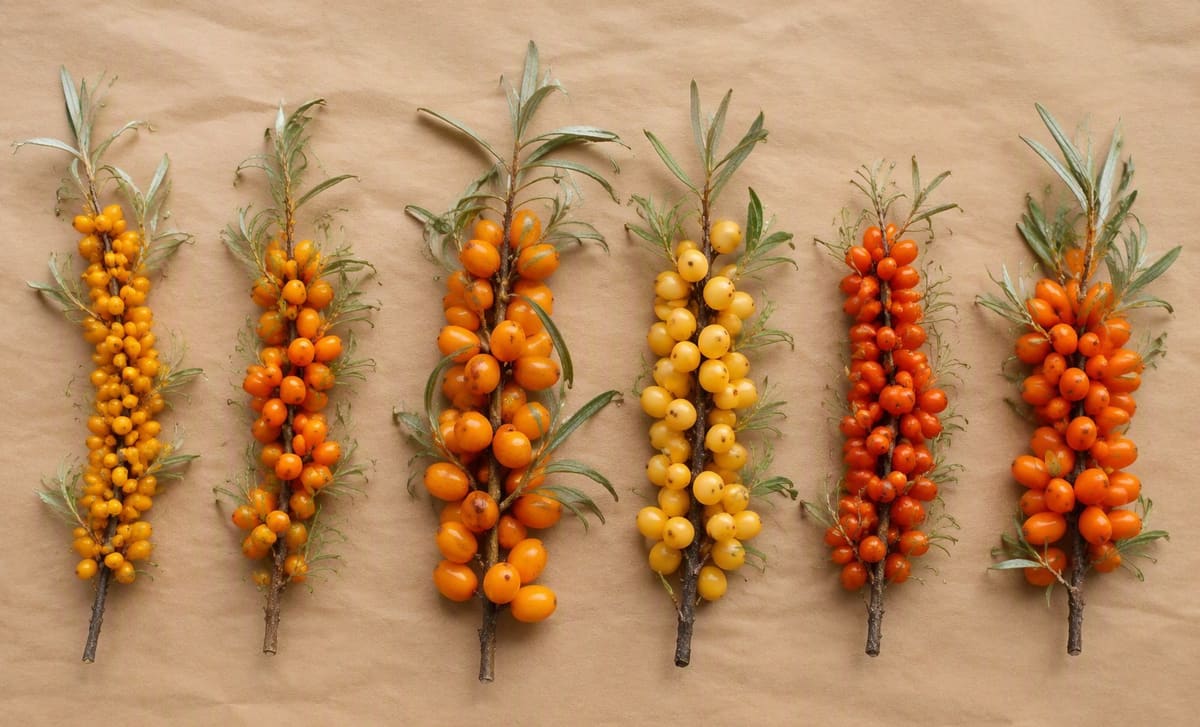
The sea buckthorn genus, Hippophae, is a small one, and its exact size is a genuine argument among botanists. One species, H. rhamnoides, supplies the world’s products. The rest are wild Asian relatives, mostly Himalayan, that most people will never meet outside a botanic garden or a mountain.
The species on your shelf
Hippophae rhamnoides spans the widest range of the genus, from European dunes to Chinese mountains, and it is the species behind commercial juice, oil, and supplements. Its thorny shrubs and orange berries are the sea buckthorn of every label, and the botanical name page unpacks what the Latin means.
The Himalayan relatives
The rest of the genus clusters in high Asia:
- H. salicifolia: the willow-leaved sea buckthorn, a taller, more tree-like species of Himalayan valleys.
- H. tibetana: a dwarf, ground-hugging species of the Tibetan Plateau.
- H. gyantsensis, H. neurocarpa, H. goniocarpa, H. litangensis: high-altitude Asian species known mainly from their native ranges, some harvested locally where they grow.
Why the count is fuzzy
Wild Hippophae populations grade into each other across mountain ranges, and botanists split or lump them differently. One author sees a species where another sees a subspecies. For a berry buyer this changes nothing: the geography, which the where it grows page maps, matters more than the count, and the regions hub explains what origins mean for oil quality.
Meeting them in the field
Outside a botanical collection, you are almost certainly looking at H. rhamnoides, and the identification guide covers its field marks. The plant hub holds the rest of the family portrait.
The relatives, a little closer
Each of the Himalayan species earns its name honestly. H. salicifolia carries long willow-like leaves and grows into a proper small tree in mountain valleys. H. tibetana went the opposite direction: a ground-hugging mat shrub of the high plateau, fruiting almost at soil level where nothing taller survives the wind. The others sit between in habit, all of them thorny, silver-backed, and orange-berried, the family uniform the genus wears from sea level to the high Himalaya. None has been domesticated at scale, and all fruit smaller than bred cultivars, as the varieties page implies.
Where the relatives grow
The map is a mountain chain. Nepal, Bhutan, and the Indian Himalayan states hold most of the wild species, and the Nepal, Bhutan, and Indian Himalayan region pages describe the local harvests, which are old, small-scale, and mostly for home use. H. rhamnoides overlaps them at lower altitudes and keeps going west all the way to European dunes, the range the where it grows page maps.
Why so many names survive
Mountain ranges isolate, and isolated shrubs diverge. A population cut off in one valley drifts from its cousins two valleys over, until a visiting botanist names it a species and a later one folds it back. That cycle, repeated across the Himalaya for a century, is why old books list more Hippophae species than new ones. The plants never changed. The filing system did.
What the diversity means for buyers
Practically, almost nothing, and that is the useful answer. Products are H. rhamnoides unless a label says otherwise, and labels almost never say otherwise. The wild relatives matter for science and for the mountain communities that pick them, and they hold genetic diversity breeders may need one day. If a rare label does name a Himalayan species, treat it as a provenance story and check the evidence like any other claim. For the shelf, the species question is already answered, which leaves the other four label lines to carry the weight, and our five-minute buyer’s checklist walks them. The regions hub is where origin actually changes the oil.
Frequently asked questions
How many sea buckthorn species are there?
It depends on the botanist. The genus Hippophae is small, and authors disagree on the count because many wild forms grade into one another. Commonly listed species include H. rhamnoides and Himalayan relatives such as H. salicifolia, H. tibetana, H. gyantsensis, H. neurocarpa, H. goniocarpa, and H. litangensis. On a product label, sea buckthorn almost always means H. rhamnoides.
Are all sea buckthorn species edible?
The genus's orange berries are used as food wherever they grow, and the Himalayan species are harvested locally like their famous relative. Products worldwide still mean H. rhamnoides. The usual wild-food rule applies to the rest: certain identification first, modest quantities, local knowledge where you can get it.