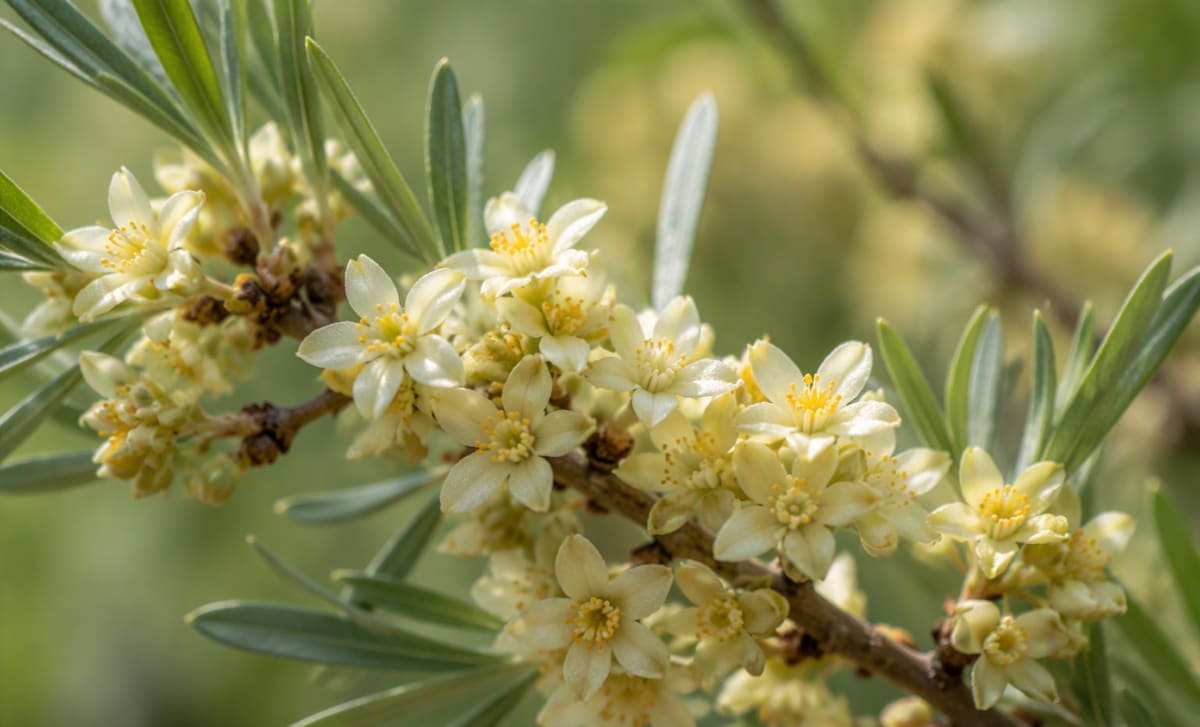
Sea buckthorn flowers are the opposite of showy: small, brown-green, petal-free clusters that open in early spring before the leaves. The plant is wind-pollinated, so no bees are required, but a male plant upwind at the right moment is. Miss that, and a healthy female gives you flowers and no berries.
Flowers built for wind
The flowers appear on bare wood in early spring, weeks before most garden shrubs bloom. Male flowers sit in small clustered catkins packed with pollen. Female flowers are tinier still, each a single pistil waiting for a grain on the wind. No petals, no nectar, no scent: everything about them says wind, and flowering before the leaves keeps the pollen’s path clear. The leaves page describes what arrives next.
The garden math
Wind pollination makes proximity the whole game. Standard practice is one male for every six to eight females, planted within easy drift of the pollen, and the male to female ratio guide covers placement and upwind thinking. A female that flowers but never fruits is usually telling you the male is missing, too far away, or flowering at a different time. The male versus female page shows how to tell your plants apart.
From flower to berry
Pollinated female flowers set fruit through late spring, swell green through summer, and color in late summer and autumn. A good pollination year rings the branches with berries, and the berry page picks up the story from there. The plant hub maps the rest.
Watching the flowering week
The bloom is easy to miss, because it happens before the leaves and lasts only days. Watch for it in early spring, often while mornings still freeze. Male clusters dust the air with yellow pollen when you brush a branch, which is the simplest field confirmation that a plant is male and on schedule. The female flowers are a magnifying-glass job: tiny pistils waiting on the same bare wood. Calm, dry weather in that window does the work. Storm weeks waste it.
Why fruit set fails
A berry-less autumn usually traces to one of four causes, in order of likelihood. No male in range. A male too far away, since wind pollen has a working radius, not an infinite one. Bloom times that miss each other, because some pairings flower a week apart. And bad weather during the bloom itself, which shrinks the window further. A healthy female covered in spring flowers and empty in autumn is almost always one of those four, and the male to female ratio guide fixes the first two.
Why wind, and not bees
Wind pollination suits a pioneer. The plant flowers before most insects fly, on exposed ground where pollinators are scarce, and nectar and petals would be wasted investment. The trade-off is waste on a grand scale: the male showers pollen indiscriminately, and only a fraction lands. It explains the flower’s total lack of showmanship, no petals, no nectar, no scent. Its relative autumn olive took the opposite route with fragrant insect-pollinated flowers, which is part of why autumn olive sets fruit almost too reliably.
The rescue: grafting a male branch
If space allows only one shrub, there is an old orchard answer: graft a male branch onto a female plant, and the shrub pollinates itself forever after. It is the same clonal logic as cuttings, covered in the from cuttings guide, and it turns the dioecy problem into a one-time afternoon of work. Male branches keep their sex permanently, as the male versus female page explains, so the fix does not fade.
What you cannot control
Weather owns the bloom week. A still, dry morning moves more pollen than any intervention, and a week of cold rain can waste a season’s flowers on a perfectly planted orchard. It is the one variable no guide fixes, and it is why experienced growers plant a second male of a different line as insurance: two bloom clocks running at once widens the window the wind gets to work with.
Frequently asked questions
Does sea buckthorn need bees?
No. Sea buckthorn is wind-pollinated. The small inconspicuous flowers open before the leaves in early spring, and pollen travels on the wind from male to female plants. What it needs is not insects but proximity: a male close enough, upwind often enough, in the same flowering window.
Why does my sea buckthorn flower but not fruit?
Almost always a pollination gap. The usual causes, in order: no male plant in range, a male too far for wind drift, bloom times that miss each other, or rough weather during the short flowering week. A healthy female with spring flowers and an empty autumn is telling you to fix the male side of the planting.