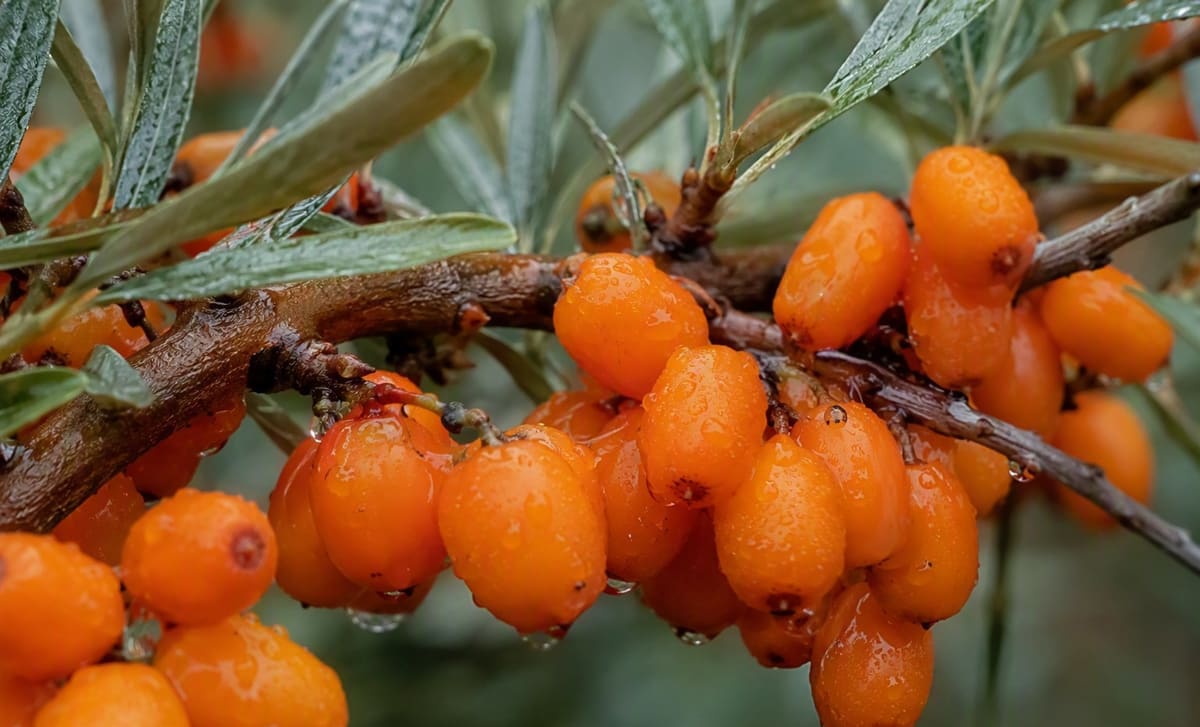
The sea buckthorn berry is a small, drupe-like fruit packed tight against thorny branches: intensely sour, oily for a fruit, stained with carotenoids, and carrying several times an orange’s vitamin C by weight. Everything the products promise starts inside this orange bead, and so do most of the practical headaches.
The fruit itself
Each berry is a soft, oval bead about the size of a small pea, growing in dense clusters directly on the branches. Botanically it behaves like a drupe: thin skin, juicy pulp, one seed in the middle. Both the pulp and the seed carry oil, and they are different oils with different fatty acid profiles, which is why products specify berry oil or seed oil. The nutrition hub breaks down that distinction, and the plant hub has the wider botany.
The names and spellings
One fruit, several spellings. You will see it run together as seabuck berry where a brand clipped its own name, and plain buckthorn berry or buckthorn berries where somebody dropped the sea. All of it points at this same orange bead. The one alias worth a second look is bare buckthorn, because true buckthorns are Rhamnus, an unrelated group with dark, mildly toxic berries and none of this chemistry. If the Latin reads Hippophae rhamnoides you have the right berry, and the lookalikes page sorts the rest.
The taste
Sour first, and seriously sour. Malic, quinic, and citric acids do the work, and under the acid sits a tropical note people compare to pineapple or passion fruit. Almost nobody eats them by the handful raw. Nearly every traditional use involves dilution, sweetness, or blending, which is worth remembering when a recipe blog suggests otherwise. That same acidity is why the safety hub advises diluting the juice and rinsing your mouth after.
What is inside
- Vitamin C: roughly 200 to 600 mg per 100 grams of fresh berries, varying by species and origin, putting the berry several times above oranges by weight.
- Carotenoids: the source of the traffic-light orange, and the reason the pulp oil stains skin and fabric.
- Oily pulp: unusual for a fruit, the pulp carries the palmitoleic acid (omega-7) that built the supplement category.
- Flavonoids and plant sterols: quercetin and relatives, present in amounts that make the berry genuinely nutrient-dense food.
Harvest realities
Three facts explain why fresh sea buckthorn berries rarely appear in stores. The branches are thorny, so picking means gloves and patience. The berries are soft, so they burst and stain everything they touch, including hands and clothing. And they hold tight to the branch while being fragile, so many growers harvest by freezing the branches and shaking the berries off, or by pruning whole fruiting branches. That is also why the fruit reaches most kitchens frozen rather than fresh, and freezing costs the berry less than you would think. The growing hub covers the gardener’s version.
The season and the ripeness test
Berries color from late summer into autumn, and color is the test: fully orange, still firm, and fiercely sour means ready. They do not ripen meaningfully off the branch, so pale berries stay pale. Birds are the other clock. When the flock starts working the hedge, the fruit is telling you the same thing. Berries left alone hang on deep into winter, softening and sweetening only slightly with frost, which is why the shrub doubles as emergency bird food.
Handling the harvest at home
Freeze the day’s catch on trays before bagging, and the berries pour like beads instead of freezing into a brick. Rinse just before use, not before storage. And respect the stain from the first minute: the carotenoids that make the pulp valuable also mark skin, fabric, and countertops, a hazard the orange stain page covers for skin and the raw berry guide for first-timers. If the raw sour is too much, the juice guide shows the dilution that makes the harvest drinkable.
Why the pulp oil matters here
Squeeze a berry and you meet the plant’s oddity: the juice is acidic and watery, yet the pulp is oily to the touch. That pulp oil carries the omega-7 the supplement industry is built on, and it is the reason crushed berries leave a greasy orange smear rather than a clean juice stain. Whole-berry products keep both fractions, which the seed versus berry oil page maps, and the vitamin C numbers behind the berry’s reputation live on the vitamin C page.
Frequently asked questions
What do sea buckthorn berries taste like?
Intensely sour first, from malic, quinic, and citric acids, with a tropical undertone often compared to pineapple or passion fruit. The sourness is why almost every berry product is diluted, sweetened, or blended. Fresh berries off the branch are an experience few people repeat by the handful.
Can you eat sea buckthorn berries raw?
You can, and the first one is a shock: fiercely sour with an oily finish, with a hard seed in the middle. Most people manage a few berries and then reach for dilution or honey, which is what nearly every traditional preparation does. Raw is a tasting experience, not a snacking strategy.