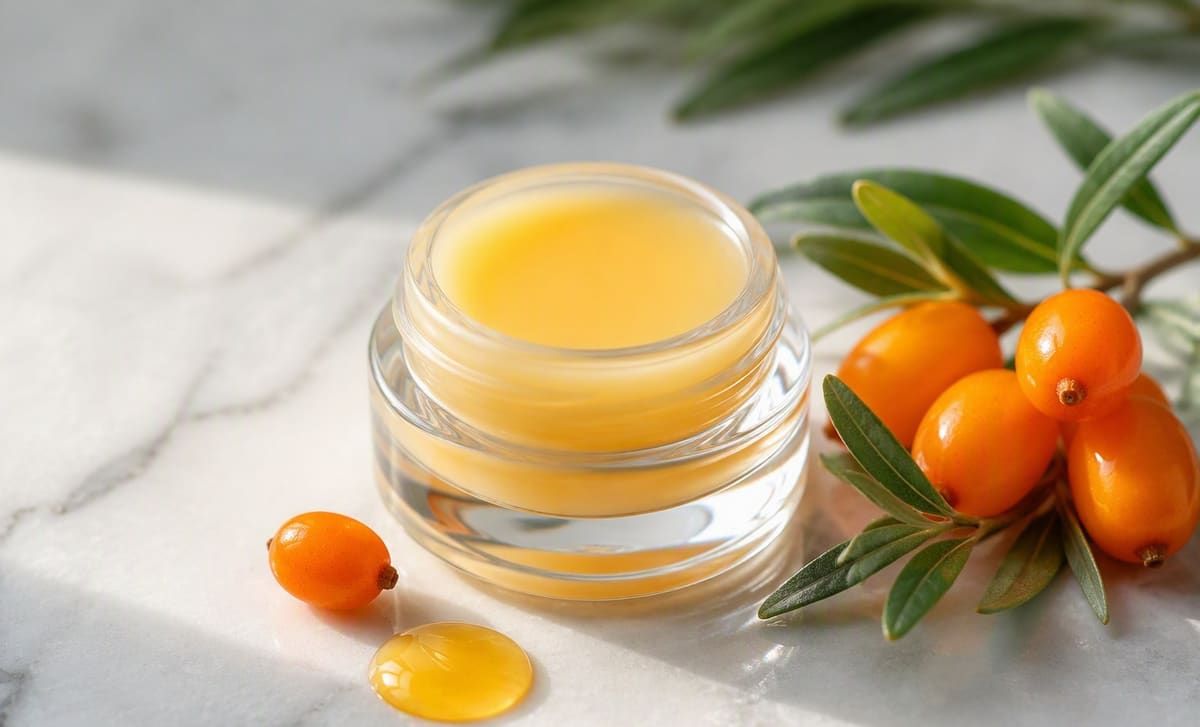
Lips are sea buckthorn’s best topical fit, and the reason is mechanical, not mystical. Lips cannot oil themselves, so any good occlusive oil softens them, and sea buckthorn does that job well. The berry oil adds a warm natural tint some people genuinely like. The catch: eating, drinking, and licking remove it within the hour.
Why lips are different
Lip skin is thin, hairless, and has no oil glands. Everywhere else, skin seals itself. Lips depend on what you put on them and how often you lick them, which is why they chap first in winter and heal fast when sealed. No trial has tested sea buckthorn on lips, and none needs to: occlusion is physics, and the fatty-acid profile (palmitoleic in the berry, linoleic in the seed) makes a fine sealant. That is a rare thing on the skin hub, where most claims need a trial to settle them.
The water-loss side deserves a sentence too. The lip surface is a thin, permeable barrier that leaks moisture far faster than cheek skin, and wind and indoor heating accelerate the leak. Saliva makes it worse: it wets, then evaporates, carrying lip moisture with it, and its digestive enzymes irritate the thin skin on the way through. This is also why lips show dehydration first: the rest of your face has sebum buying time, lips have nothing in reserve. An occlusive layer interrupts the whole leak at once, which is the entire mechanism of every lip product that has ever worked.
The tint feature, honestly framed
Berry oil is orange, and on lips that reads as a sheer warm stain, closer to a tinted balm than to the face-tint problem described on the orange stain page. Some people buy it for exactly this. If you are not one of them, the seed oil is pale and invisible, same softness, no color. The tint also fades faster on lips than on cheek skin, because lips get wiped, licked, and washed all day. Expect an hour or two of sheer color per application, not a lip stain that survives lunch.
Seed oil or berry oil on lips
Both seal well, because both are fatty-acid oils and the seal is the job. The differences are cosmetic and chemical. Berry oil carries palmitoleic acid (typically 30 to 40 percent of its fatty acids) plus the carotenoid pigment, so it feels richer and leaves the warm tint. Seed oil leans on linoleic acid with no pigment, so it absorbs faster and disappears. Daytime, under a mask or in a meeting, seed. Night, or “I want the tint,” berry. The seed vs berry breakdown covers the chemistry in full.
The licking problem
Every lip oil loses to the tongue. Licking removes the seal and wicks moisture out as it evaporates, which is how lips get drier under a product than without one. The fix is boring: reapply after meals, apply before bed when you cannot lick, and notice whether you lick more when a product tastes interesting.
Why night is the main event
The overnight application does most of the real work, because eight lick-free hours let the seal stay put while the lip barrier repairs. People who apply diligently all day and skip the night layer are doing the easy part and missing the effective one. If you change one habit, make it the bedside bottle.
Common mistakes
- Sealing in dryness. Oil traps what is underneath, so oil over dry flakes gives you moisturized flakes. Dampen lips first, then seal.
- Chasing the chap with flavored balms. Sweet, minty, or fruity products invite licking, which undoes the product within minutes.
- Matte lipstick on cracked lips. Matte formulas are drying by design. Heal first, then color.
- Expecting one application to last the day. Lips shed product faster than any other skin you own, so the reapply habit is the product.
When chapped lips are not a lip problem
Ordinary chapping heals within days of consistent sealing. Chapping that ignores every product for weeks, a scaly border that will not settle, or corner cracks that keep reopening can have causes no oil addresses, from yeast to deficiencies to irritation from your toothpaste. Weather-chapped, wind-chapped, and lick-chapped lips are this page’s territory. A symptom with a diagnosis behind it belongs to a doctor.
The sensible routine
- One drop of oil, or a sea buckthorn lip balm, on clean lips.
- Before bed, a thicker layer as the overnight seal.
- In wind and winter, reapply like you mean it.
- Cracks at the mouth corners that keep returning deserve a doctor, not a thicker oil.
- Dampen lips slightly before the drop, because oil seals moisture in rather than adding it.
One more practical note: lip oils live in pockets and cars, and heat and light degrade the carotenoids that make the berry oil special. A small bottle replaced fresh beats a big bottle kept warm, per the storage guide. Ready-made balms are scored on the lip balm page, and if you would rather use a plain drop of oil, our face oil picks are the pure, single-ingredient bottles that suit lips as well as cheeks.
Frequently asked questions
Is sea buckthorn oil good for chapped lips?
Yes, mechanically: lips dry out because they cannot make their own oil, and a drop of sea buckthorn oil seals moisture in the way any good occlusive does. The berry oil adds a warm natural tint some people love. Reapply after eating and drinking, because lips shed oil fast.
Can I wear sea buckthorn lip oil under lipstick?
Yes, with a blot. Press in one drop, give it a few minutes, then blot before applying color, or the lipstick will slide. Berry oil under a nude shade adds warmth on its own. At night, skip the blot and let a thicker layer work as the overnight seal.