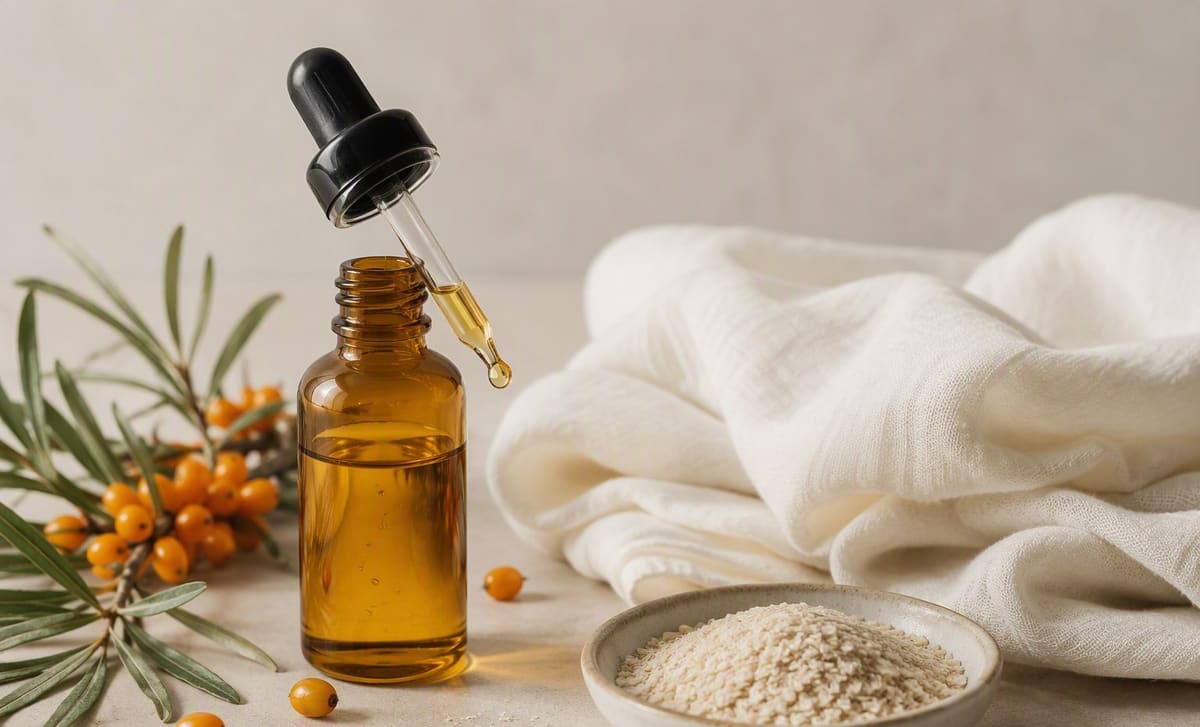
The direct answer: no verified human trial has tested sea buckthorn for eczema. What exists is a sound fatty-acid rationale and decent hydration data in people without eczema. That makes the oil a reasonable moisturizer to try next to your treatment plan, never instead of it. Steroid questions belong to your dermatologist.
Atopic dermatitis is eczema. It’s the clinical name for the most common form of the same condition, so this page answers both words with one evidence file, because there is only one evidence file to answer with.
The evidence file, opened
Our research file tracks one old atopic-dermatitis seed-oil trial from around 1999 that we have not been able to verify against the original paper. Until we do, it does not count. What we can verify: two oral-oil trials in women without eczema found better hydration (about 49% over three months in the uncontrolled 2009 study, 8% against placebo in 2024). Neither enrolled eczematous skin, so neither answers the eczema question, and the skin hub grades them accordingly.
Why the idea is not crazy
Eczema skin has a leaky barrier, and barriers are built from lipids. Linoleic acid is one of the structural ones, and sea buckthorn seed oil is roughly 30 to 40% linoleic acid. The berry oil adds palmitoleic acid, a fatty acid human skin makes naturally. Feeding a broken barrier the lipids it runs on is coherent. Coherent is the ceiling, because eczema is an immune-driven inflammatory disease and lipids do not switch immunity off.
Realistic use, if your doctor agrees
- A few drops of seed oil on damp skin after bathing, sealed with your regular emollient.
- Patch test first on a small calm area, because eczema skin reacts more.
- Keep it off broken, weeping, or infected patches entirely.
- Stop if stinging or redness shows up, and say so at your next appointment.
The routine matters more than the brand, but if you want a starting point, we scored the topical shelf on what is actually in each bottle, which is the check that matters most on skin that reacts.
What an eczema flare actually is
A flare starts when something gets through the leaky barrier, an irritant, an allergen, a microbe, and the immune system answers with inflammation: redness, heat, swelling, and the itch that defines the condition. Scratching feels like relief and works like damage, tearing the barrier further and inviting the next round. The itch-scratch cycle is why eczema management is really two jobs: repairing the barrier daily, and breaking flares fast with the treatments that have trial data.
Why the barrier leaks in the first place is often inherited. Many people with atopic dermatitis carry differences in the proteins that seal skin cells together, so water escapes and irritants get in before any flare begins. Underneath that, the immune system overreacts to whatever gets through. Two problems braided together, one of them written into the skin from birth, which is why eczema is a management condition rather than a cure condition. Promising composition data is exactly why caution rather than enthusiasm should lead here.
What sea buckthorn could and could not do
The could-not list is longer, and honesty requires it first. Sea buckthorn cannot break an active flare, cannot replace a steroid when one is prescribed, and cannot prevent the next flare, because nothing in its file touches the immune side of the cycle. No verified trial has tested it on eczematous skin at all. The could list is real but modest: on calm skin, its linoleic-rich seed oil is a coherent moisturizer candidate, and its general hydration data, gathered on people without eczema, suggests it is more likely to help than to harm. The skin studies page keeps that evidence list visible and short.
The calm-skin protocol, step by step
- Wait for calm: no active flare, no broken skin, ideally two quiet weeks.
- Patch test plain seed oil on the inner arm for seven days, then a small area near the usual flare zone for another week. The dilute oil guide shows how to buffer further if your skin is reactive.
- Apply a few drops to damp skin within three minutes of bathing, then seal with your regular emollient.
- Log stinging, redness, and itch nightly. Two calm weeks earns a place in the routine. Any worsening means stop, and mention it at your next appointment.
- Reassess with your dermatologist before you try the oral route, which gets weighed on its own below.
Common mistakes
- Panic-applying during a flare. Flare skin stings at things calm skin accepts, and a flare-time reaction tells you nothing useful.
- Swapping the emollient for oil alone. Oil seals in water, it does not supply it. Damp skin first, then oil, then emollient.
- Chasing the flare with hot water. Hot showers strip the barrier lipids you are trying to rebuild. Lukewarm is the rule.
The timeline question
No honest timeline exists, because the eczema experiment has never been run. On calm skin, a moisturizer that suits you shows itself within two to four weeks of steady use. The healthy-skin hydration trials needed twelve. Plan in weeks, log nightly, and let your dermatologist see the log at the next visit.
The oral route, weighed honestly
Swallowing the oil is the route the two hydration trials measured, so it is tempting to call it the evidence-based choice for atopic skin. It is not. Those trials enrolled women without eczema, and eczematous skin’s barrier and immune problems are a different biological situation. Oral oil at 1 to 2 grams daily is well tolerated in the studied populations, per the safety review, and that is all that can honestly be said. If you want to try it alongside your dermatologist’s plan, treat it as a general skin-comfort experiment, give it the 12-week trial frame, and keep expectations at moisturizer level. If you do run it, the oral picks that match what those trials used are scored on oil per softgel, which is the only number that decides whether you actually reach the dose the researchers gave people.
What treats eczema
Steroid creams, calcineurin inhibitors, and the newer biologics carry the trial evidence. Stepping steroids up or down is a conversation for your dermatologist, full stop. If a flare is spreading, weeping, or wrecking your sleep, that is an appointment, not a supplement decision. The quiet helpers deserve mention too: gentle cleansers, fragrance-free laundry habits, and trigger tracking do work no oil can do. The dry skin page has the trial-matched hydration routine, the acne page covers a different inflamed-skin question with the same honesty, the psoriasis page applies the same comfort-not-treatment logic to plaque psoriasis, and is it safe has the general tolerability picture.
Frequently asked questions
Is sea buckthorn oil good for eczema?
No verified human trial has tested sea buckthorn for eczema, so no honest page can promise relief, and nothing cures eczema in any case. Its seed oil is rich in linoleic acid, a barrier lipid, which makes it a reasonable moisturizer to try alongside medical care. Patch test first, and keep steroid decisions with your dermatologist.
Is atopic dermatitis the same as eczema?
Yes. Atopic dermatitis is the clinical name for the most common form of eczema, so everything on this page applies to both words. If a product markets itself for one and not the other, that is vocabulary, not a difference in what was tested. Nothing has been tested here either way.
Is sea buckthorn oil safe on eczema-prone skin?
Usually, with care. Patch test on a small area first, since reactive skin is more likely to sting or redden, and keep oil away from broken or weeping patches. Berry oil can stain fabric orange, so the pale seed oil is the easier choice on bedding. Any worsening means stop and ask your dermatologist.
Is oral sea buckthorn oil better than topical for atopic skin?
Unknown. The two hydration trials used oral oil, but they enrolled people without eczema, so they cannot answer the atopic question either way. Topical use is a moisturizer decision, oral use is a supplement decision, and neither has been tested on inflamed atopic skin. If you want to try either route, bring it to your dermatologist first.
Can I use sea buckthorn oil instead of steroid cream?
No. Steroid creams have decades of trial data in eczema, and sea buckthorn has none. Using oil in place of prescribed treatment risks an uncontrolled flare. It can sit alongside your routine as a moisturizer if your doctor agrees.
Can children with eczema use sea buckthorn oil?
This is a pediatric dermatologist question, not a webpage question. Sea buckthorn oil is unstudied in children, and young eczema skin is reactive in ways adult skin is not. If your child's doctor approves a moisturizer trial, the patch-test rules get stricter: tiny area, plain seed oil, and a stop at the first sign of stinging.