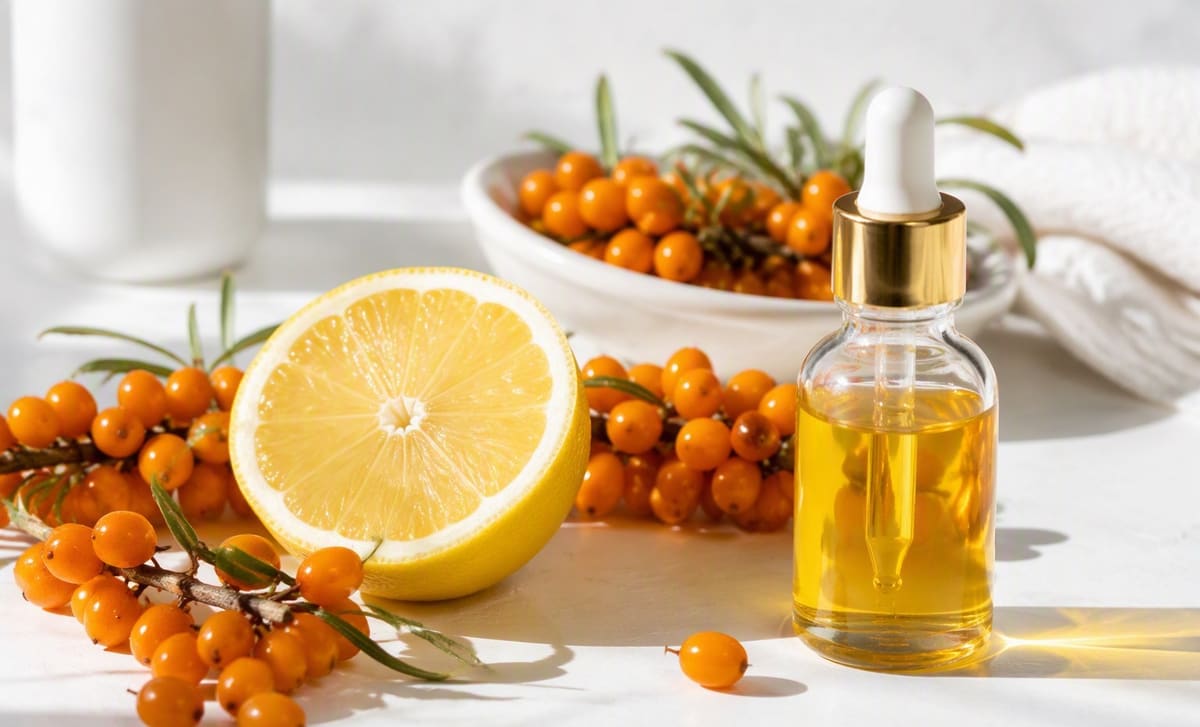
No trial has tested sea buckthorn for dark spots or uneven tone. The vitamin C story is plausible on paper and unproven in the bottle, and berry oil carries a small irony: its orange pigments can temporarily tint skin, the opposite direction from fading. Daily sunscreen is the intervention with real evidence behind it.
Where the brightening claim comes from
Two facts, loosely stitched. Sea buckthorn berries are rich in vitamin C, and vitamin C does have a legitimate role in skin: it is a cofactor in collagen synthesis and an antioxidant. From those facts, marketing leaps to “fades dark spots.” The gap in the leap is that studied brightening products use stabilized vitamin C at controlled percentages, tested directly on pigmentation. Sea buckthorn oil is not that product, no trial has run the experiment, and the skin hub grades the claim on exactly that.
The honest irony
Berry oil is orange because it is dense in carotenoids, and carotenoids transfer to skin. Used generously on a fair face, the “brightening” oil leaves a warm tint for a few hours. It washes off and it is not pigment in any real sense, but anyone shopping for a more even tone should know the jar can deliver the opposite effect on application day.
What a dark spot actually is
A dark spot is melanin, the skin’s pigment, produced in excess at one address. Sun spots come from years of UV. Post-inflammatory marks follow a healed pimple or scratch, more common and longer-lived on deeper skin tones. Melasma is hormone-linked patching, famously stubborn. In every case the pigment sits in or below the epidermis, made by cells that respond to UV, hormones, and inflammation. Under-eye dark circles are the common exception, more shadow and thin skin than true pigment. Anything that fades a spot has to slow those cells or speed the clearing of what they made, and that is a serious pharmacological ask for a bottle of fruit oil.
What sea buckthorn could and could not do
Could not, on the current file: inhibit pigment production in any measured human way, fade melasma, or claim a single trial for uneven tone. Could, within honest limits: moisturize, which improves how evenly skin reflects light, and supply the oral hydration gains the trials measured, which make skin look fresher without touching a single spot. The vitamin C page explains why the vitamin story is real nutrition and unproven skincare, and the vitamin C serum comparison grades the products that do have a pigment case.
The realistic protocol, if you try it anyway
- Sunscreen first, daily, reapplied. This is the non-negotiable the whole strategy hangs on.
- Keep proven actives in the main lane: azelaic acid or retinoids, via a pharmacist or doctor.
- If you want sea buckthorn in the routine, use the pale seed oil as your moisturizer step. Skip the berry oil for this goal, since its tint fights the look you are chasing.
- Photograph the spot monthly in the same light. Pigment fades on a three-to-six-month clock when it fades at all.
- Melasma, sudden new spots, or anything changing shape belongs to a dermatologist, not a routine.
Common mistakes
- Treating berry oil as sun protection. Carotenoids are not sunscreen, and UV is the engine behind most spots. The skin studies page lists what the oil has been measured for, and sun protection is not on it.
- Expecting a moisturizer to fade pigment. Hydration brightens the surface. It does not reach the cells making the melanin.
- Starting five new products at once. Spots plus a reaction is a combination nobody wants, and with five suspects you will never find the culprit.
- Spot-treating with pure berry oil. Undiluted berry oil on a dark spot concentrates orange pigment exactly where you least want warmth. Diluted seed oil is the sensible form for this goal.
What actually fades dark spots
- Sunscreen, daily, reapplied. UV drives melanin production, and every fading strategy fails without this step. It is the closest thing this topic has to a proven move.
- Azelaic acid and retinoids, with trial data, via a doctor or pharmacist.
- Dermatology procedures for stubborn melasma or deep spots, where the stakes justify the clinic.
Where sea buckthorn can sensibly fit
As a moisturizer inside a routine that takes sun protection seriously. Well-hydrated skin reflects light more evenly and looks brighter in the ordinary sense, and the oral-oil trials measured real hydration gains over 12 weeks. Note the route: those gains came from swallowing oil at gram doses, which puts topical brightening claims even further from the data. That is glow, not spot-fading, and the glow page grades it precisely. For the tint question in detail, see the orange stain guide.
Frequently asked questions
Can sea buckthorn oil fade dark spots?
No trial supports it. The vitamin C connection is plausible on paper, but vitamin C serums that show results use stabilized forms at studied percentages, which sea buckthorn products are not. Daily sunscreen does more for dark spots than any oil, and azelaic acid or retinoids via a dermatologist do more still.
Will sea buckthorn oil brighten my skin?
It can add a temporary warm glow from its orange carotenoid pigments, which is tint, not brightening, and it washes off. Genuine brightening means fading excess pigment, and no sea buckthorn product has trial evidence for that.
Is sea buckthorn oil safe to wear in the sun?
There is no documented photosensitizing problem with sea buckthorn oil, but the important word is different: it is not sun protection. Its carotenoids are not a sunscreen, and UV exposure is the main driver of the dark spots people hope to fade. Wear the oil if you like, and wear real sunscreen over it every single day.