Elasticity is one of the few skin claims with an instrument reading behind it. In a 2009 trial, 2 grams of oral sea buckthorn oil daily raised measured elasticity about 16% at one month and 26% at three months. The design has holes (no oral placebo, branded oil), and a 2024 controlled trial points the same direction more modestly. Real signal, honest caveats.
What the 2009 trial measured
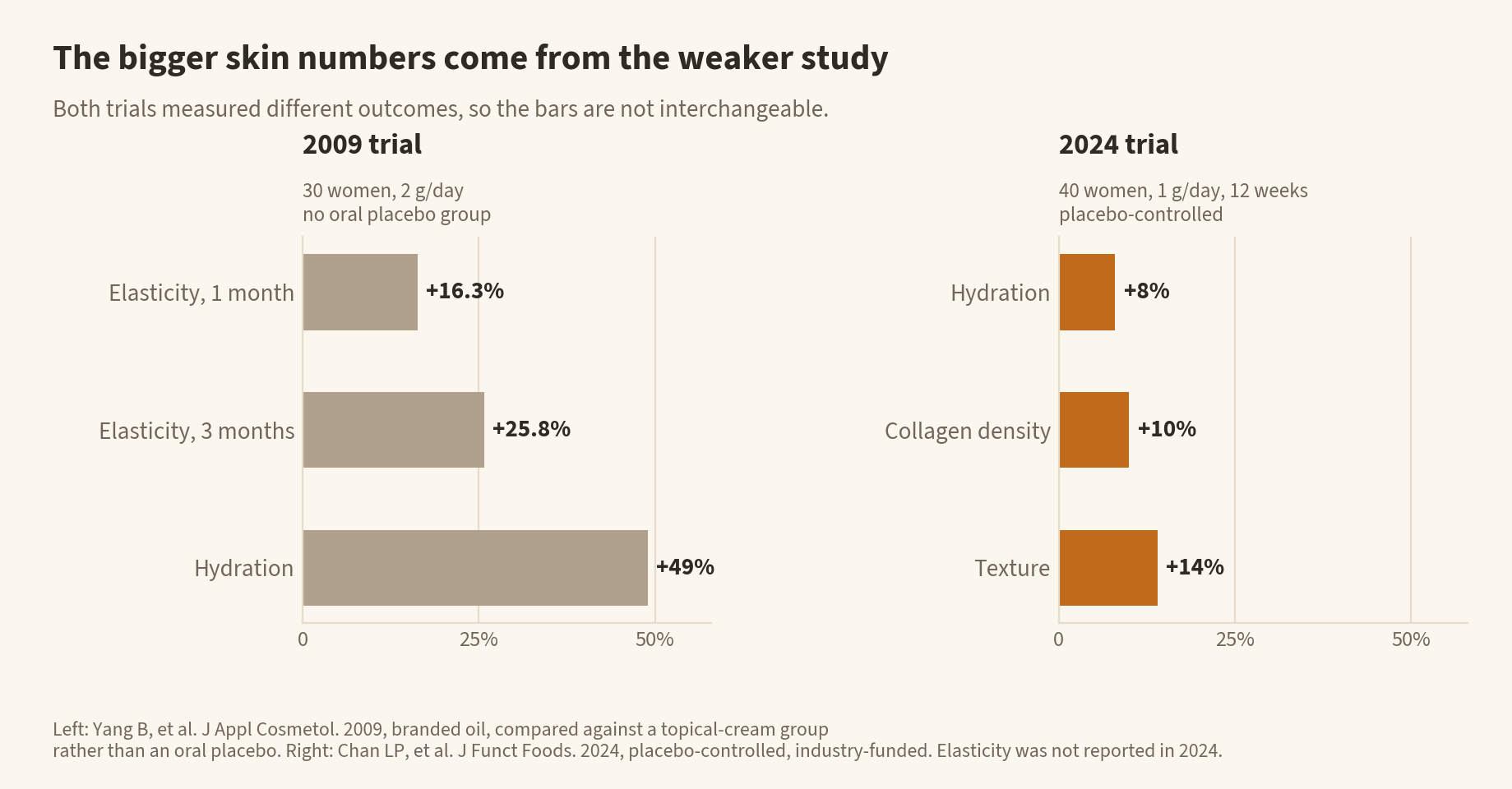
Thirty women aged 50 to 70 took 2 grams of CO2-extracted sea buckthorn oil daily. Researchers tracked skin with a Cutometer, an instrument that sucks the skin and times its snap-back, so these are machine readings, not self-reports. Elasticity rose about 16.3% at one month and 25.8% at three months, alongside hydration up about 49%.
The caveats travel with the numbers. The oral group was compared against a topical-cream group, not against a placebo, so expectation and season can share the credit. The oil was a branded product, an industry link worth knowing. Grade: promising, not definitive, on the same scale the skin hub applies everywhere.
What the 2024 trial adds
The modern placebo-controlled trial gave 40 women 1 gram daily for 12 weeks and measured collagen density up about 10%, hydration up 8%, texture up 14%. It did not report elasticity directly, but collagen density is the structural cousin of firmness, and the direction agrees. Industry-funded, small, and controlled: a useful counterweight to the bigger, looser 2009 numbers.
See the data behind this chart
| Trial | Design | Outcome | Change |
|---|---|---|---|
| 2009 | 30 women, 2 g/day, no oral placebo | Hydration | +49% |
| 2009 | 30 women, 2 g/day, no oral placebo | Elasticity at 3 months | +25.8% |
| 2009 | 30 women, 2 g/day, no oral placebo | Elasticity at 1 month | +16.3% |
| 2024 | 40 women, 1 g/day, 12 weeks, placebo-controlled | Texture | +14% |
| 2024 | 40 women, 1 g/day, 12 weeks, placebo-controlled | Collagen density | +10% |
| 2024 | 40 women, 1 g/day, 12 weeks, placebo-controlled | Hydration | +8% |
What elasticity gains actually look like
A 26% instrument gain is not a facelift and not visible tightening in photos. It is skin that rebounds a bit faster and holds moisture a bit better, the kind of change you notice as texture and bounce rather than lift. Deep sagging and jowls are structural, and no oral oil reaches them.
What elasticity actually is
Elasticity is the skin’s snap-back: pinch it, and the speed of recovery reflects the state of the elastin and collagen network underneath. That network thins and frays with age, and ultraviolet exposure does most of the fraying, which is why forearm skin tests older than shoulder skin on the same body. Instruments like the Cutometer measure the snap objectively. The mirror measures it subjectively, weeks late, and with a strong bias toward whatever lighting you own.
The plausible mechanism stack
Three rungs, different solidity. Proven: vitamin C is a required cofactor for building collagen, part of the scaffolding that elasticity rests on, and sea buckthorn berries are rich in it. Measured once: the two oral-oil trials on this page, small and caveated. Speculation: carotenoid antioxidant protection and omega-7 membrane effects, interesting chemistry without skin outcome data. The vitamin C page covers the proven rung, and the skin studies page keeps the measured rung honest.
The topical question
Both elasticity-adjacent measurements came from people swallowing oil. No instrument has tracked what topical sea buckthorn does to skin snap-back, so a face cream carrying an elasticity claim is borrowing the oral trials’ credibility. Topical oil is a fine moisturizer. As a firmness strategy it is unmeasured, and the two roles should not share a price tag.
Common mistakes
- Expecting lift. A faster snap-back is bounce, not architecture. Jowls and deep folds are structural, beyond any oil, and so is the dimpling behind cellulite.
- Judging at two weeks. The instruments moved at week four and kept moving to week twelve. Skin’s rebuild clock runs in months.
- Skipping the multiplier that matters most. UV breaks down the elastin network daily. An oil chasing elasticity without daily sun protection is bailing a boat with the hole open. The collagen comparison grades the other popular bottle in this lane by the same rules.
Who the trials leave out
Both studies enrolled women, mostly around midlife, and neither ran longer than three months. What that means for men, for younger skin, for deeper skin tones, or for year-long use is unmeasured. The direction of the finding is plausible across groups, because the biology of collagen and elastin is shared, but plausible is all it is. A larger independent trial would change this picture. Until then, the claim stays promising, not proven. The dry skin page covers the hydration side of the same two trials, with the same caveats applying.
The routine that matches the studies
- Oral oil, not face cream: both trials fed people the oil. Dose was 1 to 2 grams daily with food.
- Twelve weeks minimum: the instruments moved at week 4 and kept moving to week 12.
- The boring multipliers: sun protection daily, no smoking, enough protein. These decide more than any oil.
For the wider wrinkle picture read the wrinkles page, for hydration the dry skin page has the numbers.
Frequently asked questions
Does sea buckthorn improve skin elasticity?
One human trial measured it: 2 grams of oral sea buckthorn oil daily raised elasticity about 16% at one month and 26% at three months in 30 women. The catch is design: the oral arm had no placebo group and used a branded oil. A 2024 placebo-controlled trial supports the direction with collagen density up 10%, so the claim is plausible with caveats, not proven.
How long until sea buckthorn affects skin firmness?
On the trial schedule, changes were measurable at one month and larger at three months of daily oral oil. Expect the study timeline, 12 weeks of consistent use, before judging anything in the mirror.
Is sea buckthorn better than collagen supplements for firmness?
Nobody knows, because the two have never been compared head to head. Collagen peptides have their own small-trial literature for skin elasticity, and sea buckthorn has the 2009 and 2024 oil trials. Both files are early-stage. Chasing firmness with either one works best inside a routine that handles sun protection and protein first.