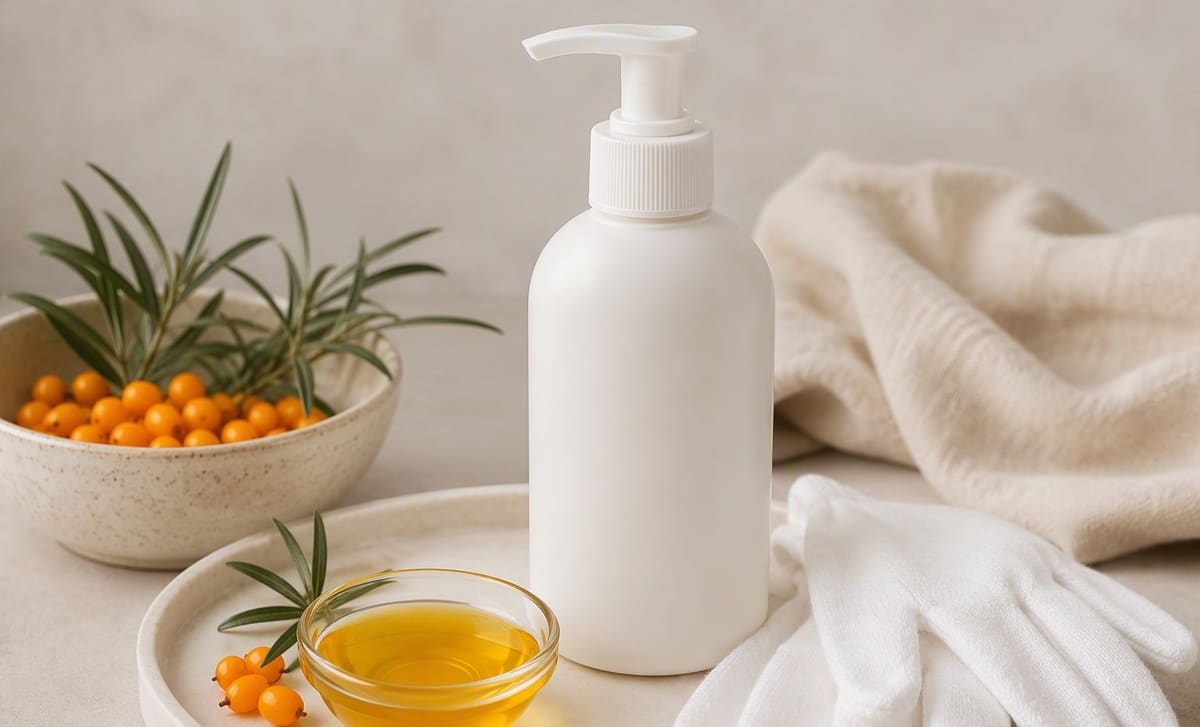
Dermatitis is an umbrella term, not a diagnosis, and the umbrella covers conditions with opposite rules. With active dermatitis of any stripe, the sequence flips from the usual: doctor first, experiments later. Sea buckthorn oil can join a settled routine as a moisturizer, with a patch test. It never goes on broken or weeping skin.
Three different conditions under one word
- Contact dermatitis: your skin reacting to something it touched. The fix is finding and removing the trigger, and a new oil during the detective work only muddies the suspect list.
- Atopic dermatitis (eczema): the chronic, immune-driven condition, covered in full on our eczema and atopic dermatitis page. No verified human trial for sea buckthorn here either.
- Seborrheic dermatitis: yeast-linked flaking around the scalp, brows, and nose. Medicated washes are the evidence-backed route, and heavy oils can feed the problem rather than calm it.
One look-alike sits outside this list. Psoriasis is a separate autoimmune condition, not a dermatitis, though it is often mistaken for the seborrheic type on the scalp. It runs by its own rules, covered on the psoriasis page.
The flipped patch-test logic
On healthy skin, patch testing is how you check a product. On active dermatitis, the experiment itself is the risk: inflamed, barrier-broken skin stings, absorbs unpredictably, and flares on provocation. That is why the rule inverts. Get the flare diagnosed and settled first, then, with your doctor’s knowledge, introduce one new thing at a time. The skin hub grades every condition page in this collection, and this one is the most cautious of them.
What inflamed skin is doing
Whatever the type, dermatitis means the same two failures at the surface. The barrier is leaking, so water escapes and the outside world gets in. And the immune system is activated, flooding the area with the signals that produce redness, heat, and itch. Inflamed skin also absorbs substances unpredictably and reacts to concentrations that calm skin shrugs off. This is why “it is just an oil” does not apply during a flare. On broken skin, everything is a suspect.
What sea buckthorn could and could not do
Could not, with certainty: calm an active flare, replace a medicated treatment, or claim any trial in any dermatitis type. Not one study has enrolled dermatitis skin for sea buckthorn, oral or topical. Could, within limits: serve as a well-tolerated moisturizer for some people once skin is calm, based on a barrier-lipid rationale and hydration trials that enrolled people without dermatitis. The skin studies page shows the full measured list, and the gap where dermatitis would go is visible. The safety review covers general tolerability.
The reintroduction protocol, once calm
- Wait until skin has been calm for at least two weeks. Flare recovery is not the moment for experiments.
- Patch test on the inner arm for seven days, then on a small area near (not on) the previously affected zone for another week.
- Choose the plain seed oil: light, pale, and free of the berry oil’s tint and richness.
- Introduce it as the only new variable, a few drops on damp skin, sealed with your regular emollient.
- Keep a simple log. Two calm weeks earns a place in the routine. Any stinging or redness ends the experiment, noted for your next appointment.
Common mistakes
- Testing during a flare. Inflamed skin rejects things calm skin accepts, so a flare-time reaction proves nothing except bad timing.
- Assuming natural means non-reactive. Botanical oils are complex mixtures, and any of them can trigger a response in a sensitized person. The patch test exists for exactly this reason.
- Using oil as the only moisturizer on healing skin. Oil seals in water but supplies none. Damp skin first, emollient on top, as the dry skin page routine details.
The oral question
If topical experiments feel too risky on your skin, is swallowing the oil a safer route? The two skin trials used oral oil and measured better hydration in people without dermatitis, and general tolerability at 1 to 2 grams daily is good in the studied populations, per the safety review. That makes oral oil a reasonable general skin-comfort experiment for most adults. It does not make it a dermatitis treatment, because dermatitis skin has never been in the trial room. Discuss it with your doctor if your condition is chronic, and treat any benefit as a bonus, not a plan.
Where the oil can fit afterward
Once skin is calm, sea buckthorn seed oil is a reasonable moisturizer candidate: linoleic-rich, light, and free of the berry oil’s tint. The two oral-oil skin trials measured hydration gains in people without dermatitis, which is the honest extent of the evidence. A cream instead of a straight oil is often the easier format here, because an emulsion carries water as well as oil and dermatitis-prone skin usually wants both. Broken, weeping, or infected skin never gets either one, regardless of how calm the rest looks.
If a flare is spreading, weeping, or costing you sleep, that is an appointment this week, not a product decision. Once skin is settled and your doctor is on board, our skincare picks cover the gentle formats worth patch testing, seed oil and emulsions rather than the heavy orange berry oil.
Frequently asked questions
Can I use sea buckthorn oil on dermatitis?
Not during an active flare, and not before a doctor has named the dermatitis. Contact, atopic, and seborrheic dermatitis have different causes and different rules. Once a flare is settled and your doctor agrees, a patch-tested seed oil can join as a moisturizer. Oil on broken or weeping skin is never the move.
Can sea buckthorn oil itself cause contact dermatitis?
Any botanical oil can trigger a reaction in a sensitized person, and sea buckthorn has no documented widespread reaction signal, which is not the same as zero risk. This is exactly what patch testing is for: a small area, seven days, no other new products. Redness, itching, or bumps during the test means this oil is not for your skin.