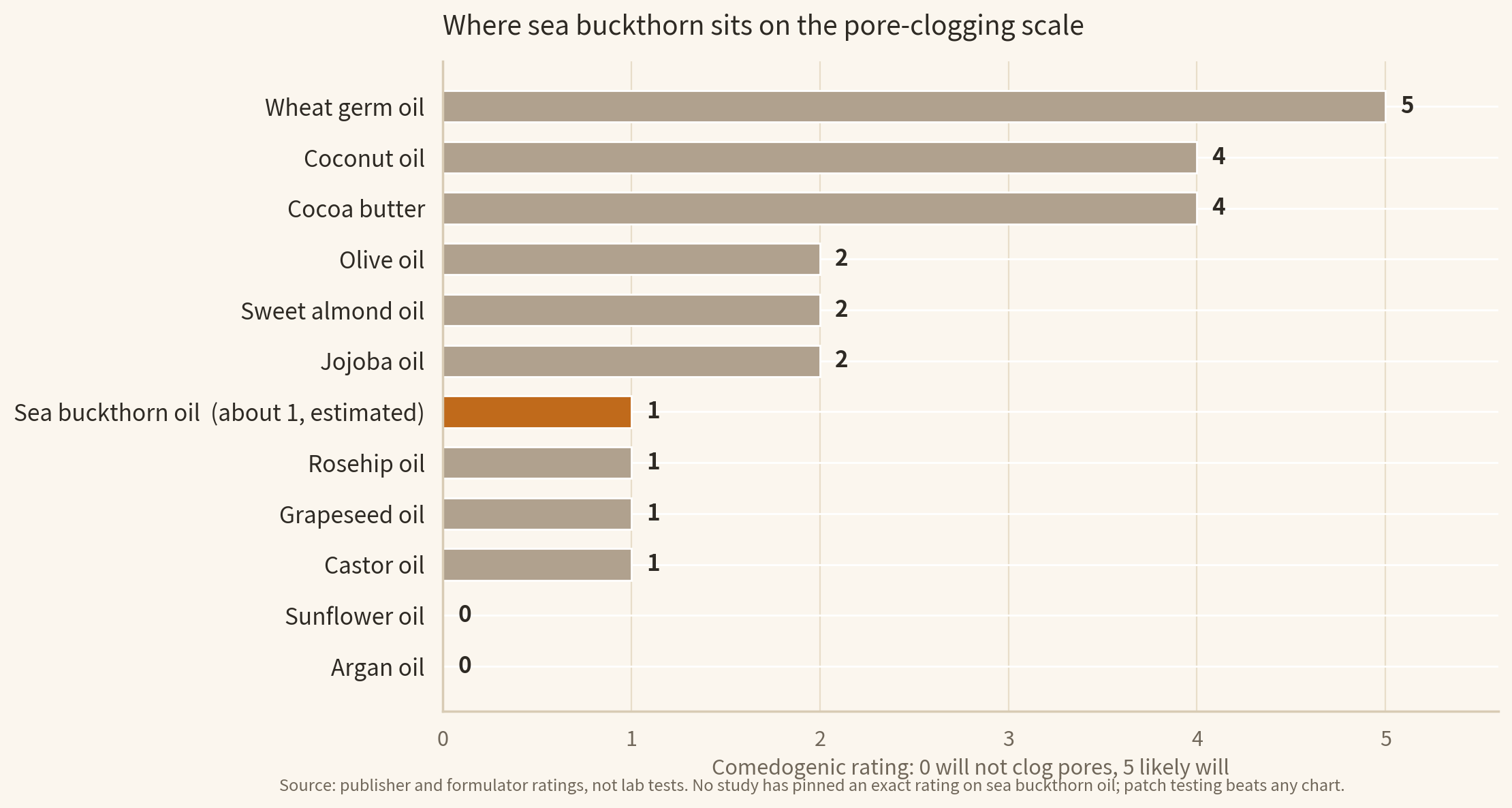
Sea buckthorn oil sits at the low end of the comedogenic scale, often quoted around 1 out of 5. Know where that number comes from: publisher and formulator ratings, not a lab test. No study has pinned an exact rating on the oil. The fatty-acid profile supports the low estimate, and a patch test on your own face settles what no table can.
What the comedogenic scale actually is
The 0 to 5 scale rates how likely an ingredient is to clog pores, from 0 (won’t) to 5 (will). It grew out of rabbit-ear assays decades ago, and rabbit ears are not human faces. Modern dermatology treats the scale as a rough guide, not a verdict, which is why the same ingredient gets slightly different ratings from different publishers. The skin hub treats it the same way.
See the data behind this chart
| Oil | Comedogenic rating (0 to 5, estimated) |
|---|---|
| Wheat germ oil | 5 |
| Coconut oil | 4 |
| Cocoa butter | 4 |
| Olive oil | 2 |
| Sweet almond oil | 2 |
| Jojoba oil | 2 |
| Sea buckthorn oil | about 1 |
| Rosehip oil | 1 |
| Grapeseed oil | 1 |
| Castor oil | 1 |
| Sunflower oil | 0 |
| Argan oil | 0 |
Where the “1 out of 5” claim comes from
Publisher and formulator ratings place sea buckthorn oil at the low end of the comedogenic scale, though no lab study has pinned an exact number on it. That sentence is the whole story. The rating is an informed estimate repeated across ingredient databases, not a measurement. Our research standards require lab data for a firm number, and for this oil that data does not exist yet.
The fatty-acid logic behind the low estimate
The estimate is not baseless. Comedogenicity tracks loosely with fatty-acid profile: oils dominated by heavy saturated fats clog more, light oils high in unsaturated fatty acids clog less. Coconut oil is the heavy-saturated example near the top of the chart above, and the sea buckthorn versus coconut oil comparison walks through the clogging lore for both. Sea buckthorn seed oil runs roughly 30 to 40% linoleic acid with a big alpha-linolenic share, which is a light, fast-absorbing profile. Berry oil is richer and thicker, still mostly unsaturated. Chemistry says low-clog. Chemistry is a prior, not a trial.
Why ratings disagree between sites
Search any oil’s rating across five sites and you will collect at least three numbers. The reasons are structural. The original assays were rabbit-ear tests, and different labs ran them differently. Modern publishers mostly copy each other, so an estimate from 1989 gets reprinted as if it were five independent findings. And the rating applies to a pure ingredient, while the bottle in your hand is often a blend whose heaviest component sets the real clog risk. This is why our comedogenic glossary entry treats every number as a starting estimate, yours to verify.
Berry oil versus seed oil on the clog question
The two sea buckthorn oils deserve separate guesses. The seed oil is built on linoleic and alpha-linolenic acids, light polyunsaturated fats that absorb fast, the profile least associated with clogging. The berry oil is richer: palmitic acid makes up roughly a quarter to a third of its fatty acids, a saturated share that puts it closer to the heavy creams in feel. Neither has been tested. On profile logic alone, breakout-prone skin should start with the seed oil, and dry skin that never breaks out can consider the berry at night.
How to run your own two-week test
- Pick one small test zone, the side of the jaw works well, and change nothing else in your routine.
- Apply two drops of the oil to damp skin there nightly for a week, then daily the second week if all is calm.
- Watch for closed comedones, the small flesh-colored bumps that signal early clogging. They appear within days to two weeks when an oil disagrees with you.
- Any bumps, redness, or itch means stop. Calm skin at day 14 means the oil suits your face, which is a better answer than any table gives.
Common mistakes
- Testing five new products at once. A reaction then has five suspects. One variable at a time is the whole method.
- Confusing irritation with clogging. Stinging and redness are irritation, immediate. Clogged pores are bumps, delayed. Different problems, different responses.
- Trusting the blend’s label. A serum is only as low-clog as its heaviest ingredient, so read the full list, not the hero oil on the front. The rosehip comparison applies the same skepticism to another popular face oil.
What this means for your face
- Breakout-prone: choose seed oil, the lighter of the two, and start with two drops on damp skin.
- Patch test properly: a small area along the jaw for a week. Clogged pores announce themselves in days, not months.
- Blends change the math. A serum is only as low-clog as its heaviest ingredient, so read the full list, not the hero on the label.
- Ratings describe ingredients, not faces. Your skin is the final assay.
For the acne angle, the acne page applies this same logic to breakouts. The oil-on-face guide has the step-by-step technique, tested bottles live in the face oil buying guide.
Frequently asked questions
What is sea buckthorn oil's comedogenic rating?
Publisher and formulator ratings place it at the low end of the 0 to 5 scale, often quoted around 1, but no lab study has pinned an exact number on it. Treat the rating as an informed estimate, patch test on your own skin, and let your face settle the question.
Will sea buckthorn oil clog my pores?
Probably not, based on its fatty-acid profile: light oils high in unsaturated fatty acids, like this one, are the kind that rarely clog pores. Seed oil is the lighter of the two types and the safer pick for breakout-prone skin. Individual skin varies, so a week of patch testing beats any rating.
Is sea buckthorn seed oil or berry oil less likely to clog pores?
On fatty-acid logic, the seed oil: it is lighter, faster-absorbing, and built on linoleic and alpha-linolenic acids, while the berry oil is richer with a bigger saturated share. Neither has a lab-tested clogging score, so this is chemistry-informed judgment, not measurement. For breakout-prone skin, seed oil is the sensible starting bottle.