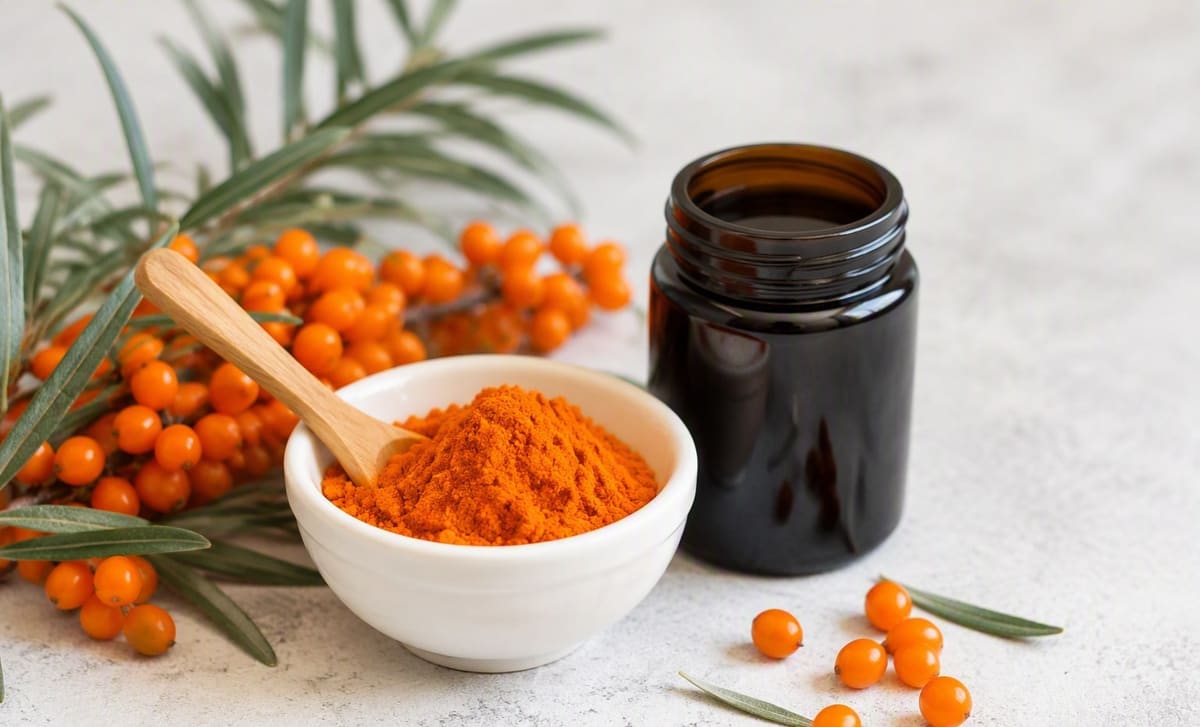
The best sea buckthorn powder is a single-ingredient, organic, whole-berry powder with no fillers, and Erbology’s is the one we verified. Set your expectations at food, not supplement: powder keeps fiber and flavonoids but loses a chunk of the fresh berry’s vitamin C in drying, and no human trial has dosed powder for a health outcome.
One pick only in this category, because one is what we could verify. Scores follow the published rubric in our editorial policy.
The pick at a glance
| Product | Best for | What is inside | Our score |
|---|---|---|---|
| Erbology Organic Sea Buckthorn Powder | Smoothies and yogurt | 100% organic milled berries, nothing else | 8.0 |
1. Erbology Organic Sea Buckthorn Powder: the verified pick
Erbology Organic Sea Buckthorn Powder
Best verified pickWhy it wins. The ingredient list has one line: organic sea buckthorn berries. That sounds like the bare minimum, and in this category it is the exception. Competing powders we checked padded with maltodextrin, led with cheaper fruit powders, or declined to say how much sea buckthorn was actually inside. A clean single-ingredient powder from a brand that answers sourcing questions earns the slot.
What we do not love. Premium pricing for what is fundamentally a smoothie ingredient, and no powder can dodge the vitamin C losses that come with drying. If you want the berry’s oil benefits, this is the wrong product entirely.
Best for: kitchen people adding tart berry powder to smoothies, yogurt, or oatmeal a few times a week.
We may earn a commission at no cost to you.
What drying does to the berry
Fresh sea buckthorn berries carry roughly 200 to 600 mg of vitamin C per 100 g, varying by variety and origin. Vitamin C is fragile against heat, oxygen, and time, and drying applies all three. Published analyses of processed sea buckthorn products show how steep the drop can be, so treat any powder label quoting fresh-berry vitamin C numbers as marketing, not chemistry.
What survives drying better: the fiber, the flavonoids, and the organic acids behind the tartness. That is a real food value, and it is the honest reason to buy powder.
What powder is not
Powder is not the supplement form. The trials behind the dry-eye, skin, and vaginal-health claims dosed the berry’s oil in grams per day. Whole-berry powder contains very little oil, and no human trial has dosed powder for any outcome. If a powder’s marketing page promises the oil study results, it is borrowing evidence for a product that was never tested, and the forms comparison shows exactly which forms carry the research.
The four-line label check for any powder
- One ingredient. Sea buckthorn berries, full stop. Maltodextrin, rice flour, or “fruit blend” anywhere on the list is a point deduction.
- Organic certification with a named certifier.
- The species. Hippophae rhamnoides is the one the composition research covers.
- A production or best-by date you can see, because the fragile compounds fade with shelf time.
Cost math for the jar
Powder is a food, so judge it like one: price per 100 g, not price per promised benefit. There is no studied daily dose to divide by, because no trial dosed powder. A jar used at 1 to 2 teaspoons a day lasts months, which makes even premium jars cheap per serving. The real cost question is freshness: a huge bargain tub that takes a year to finish delivers a year of declining vitamin C, so buy the size you will empty in a couple of months. The powder uses page has five daily ways to work through a jar.
Who should skip powder entirely
- Anyone here for the oil trial results. Wrong product, full stop. The capsules guide and oil guide are your pages.
- Frozen-berry buyers with freezer space. Frozen berries keep more vitamin C and cost less per serving, per the frozen berries explainer.
- Anyone who dislikes sour. Powder is concentrated tartness, and no honey swirl fully hides it.
Common buying mistakes
- Buying the front of the bag. “Made with sea buckthorn” can mean 5 percent. The ingredient list is the only truth.
- Trusting fresh-berry vitamin C numbers on a dried product. The drying loss is the whole point of the section above.
- Stockpiling. The fragile compounds fade with shelf time even sealed, and faster once opened.
- Expecting supplement effects from a food. Smoothie habits are lovely, and they are not the 2-gram oil trials.
Whole-berry powder vs juice powder
Two different products share the word powder. Whole-berry powder is the entire fruit dried and milled: fiber, acids, skin, and all. Juice powder is pressed juice spray-dried onto a carrier, usually maltodextrin, which keeps the water-soluble side and drops the fiber. The label tells them apart instantly: whole-berry lists one ingredient, while juice powder often leads with its carrier. Neither is a scam, but they are not the same jar, and only one of them is pure sea buckthorn.
What a serving actually delivers
One to two teaspoons (roughly 3 to 6 g) gives you fiber, the berry’s tart organic acids, some flavonoids, and a modest, declining amount of vitamin C. What it does not give you is the oil: a spoonful carries a small fraction of a gram, against the 1 to 3 g the trials dosed. That is the arithmetic behind every claim on this page.
The 60-second decision path
- Goal check: kitchen ingredient, or studied benefits? Kitchen stays here, benefits go to the oil guides.
- One ingredient on the list? Yes continues, no stops.
- Organic certifier named, species named, date visible? Three yeses means buy.
- Size check: the smallest jar you will finish in two months.
Storage after opening
Airtight jar, dark cupboard, a dry spoon every time, and the bag clipped tight inside if it came in one. Moisture clumps powder and accelerates the fade. The full form-by-form rules live on the storage page.
Powder is a food, so the supplement cautions mostly do not apply. If you also take sea buckthorn oil supplements alongside blood thinners, or you are pregnant or nursing, read our safety notes and talk to your doctor first. For the other end of the spectrum, the capsules guide covers the form the studies actually used, and the recipes hub has ideas for using the powder well.
Frequently asked questions
Is sea buckthorn powder as nutritious as fresh berries?
Partly. Powder keeps the fiber, the flavonoids, and much of the tart character, but vitamin C is fragile and drying with heat, oxygen, and time destroys a meaningful share of it. Think of powder as a convenient food, not a fresh-berry replacement and not a supplement.
Is sea buckthorn powder the same as sea buckthorn capsules?
No. Supplement capsules usually contain the berry's oil, the form behind the dry-eye, skin, and vaginal-health trials. Powder is the dried, milled whole berry and contains very little oil. Different product, different purpose.
How much sea buckthorn powder should I use a day?
One to two teaspoons is the typical food-level serving, stirred into something you already eat. No studied therapeutic dose exists for powder, because the human trials dosed the oil. More powder mostly means more sour, so let taste set the amount.