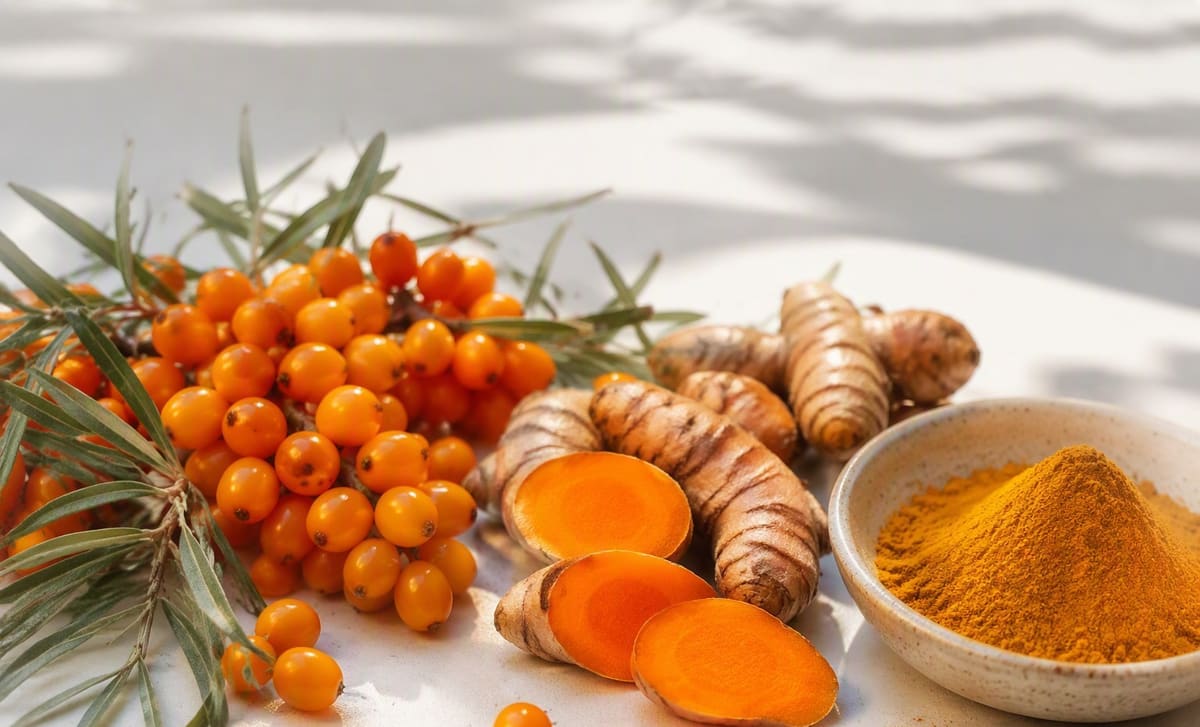
Turmeric’s evidence lives in the joint and inflammation lane, where its curcumin has been studied for decades, with poor absorption as the eternal catch. Sea buckthorn’s evidence lives in different lanes entirely: blood lipids, dry eyes, skin, and vaginal dryness. This is a rare comparison where the honest answer is not “which wins” but “they do different jobs, and can share a shelf.”
The comparison
| Sea buckthorn | Turmeric / curcumin | |
|---|---|---|
| Active story | Whole oils: omega-7, carotenoids, flavonoids | Curcumin, 2-5% of the root |
| Research lane | Lipids, dry eyes, skin, vaginal dryness | Joint comfort, inflammation markers |
| Human evidence | Small RCTs plus two lipid meta-analyses | Large but mostly small-trial literature |
| Famous catch | Small trials, short durations | Poor bioavailability without enhancers |
| Kitchen role | Sour berries, juice, oil | Daily spice across cuisines |
| Antiplatelet note | High-dose berry oil (one small study) | High-dose curcumin (standard caution) |
| Typical form | Oil softgels, juice, powder | Standardized curcumin capsules, spice |
Turmeric’s deal, respected
Curcumin is one of the most-studied natural compounds on earth, and its reputation for joint comfort and inflammation markers is backed by a real, if mostly small-trial, literature. Its weakness is pharmacokinetics: on its own, curcumin absorbs poorly, which is why products pair it with piperine or use lipid formulations, and why culinary turmeric (a few percent curcumin by weight) is a food, not a dose.
The kitchen angle is worth keeping too. Turmeric as a daily spice in curries, eggs, and rice is a pleasant, cheap habit with centuries of use behind it, and nobody needs a clinical trial to justify dinner. The supplement question only starts when capsules promise what the spice cannot deliver. The dose gap is real: a generous teaspoon of turmeric carries perhaps 60 to 100 mg of curcumin, while joint trials typically use 500 mg and up of enhanced extracts.
Sea buckthorn has no comparable joint literature, and we do not pretend otherwise. Its inflammation-adjacent finding is narrower: in one berry trial, the inflammation marker CRP decreased while cold rates stayed flat, as our research hub records.
The absorption problem, stated honestly
Curcumin’s famous catch deserves its own section, because it shapes every buying decision in this lane. On its own, curcumin is absorbed poorly, metabolized fast, and excreted quickly, so a plain turmeric capsule often delivers little active compound to the bloodstream. The industry’s fixes are piperine (a black pepper extract that raises absorption sharply), lipid-based formulations, and phytosome complexes. None of this is scandalous, it is pharmacology, but it means two products at identical labeled milligrams can perform wildly differently. It also explains why curcumin trials use such varied doses: researchers are compensating for a molecule the body barely lets in. Sea buckthorn oil has no equivalent problem, because its actives are fatty acids and fat-soluble compounds delivered in their own oil, absorbed the way dietary fat is absorbed.
Sea buckthorn’s lanes, equally respected
The sea buckthorn human trials target outcomes turmeric never touched. Pooled lipid trials found improved cholesterol markers in people with abnormal levels, covered on the cholesterol page: a 2022 meta-analysis of 15 randomized trials, with an 11-trial analysis from 2017 reaching the same conclusion. A 100-person placebo-controlled trial found oral oil eased dry-eye measures over three winter months, detailed on the dry-eye page. Skin and vaginal dryness round out the list, the vaginal trial reporting roughly triple the odds of epithelial improvement at 3 grams daily. Curcumin has no trials in any of these lanes.
What “anti-inflammatory” means on each label
Inflammation is where marketing blurs these two together, so it is worth splitting cleanly. Curcumin’s joint literature is the real thing in its lane: dozens of small trials on comfort and stiffness scores. Sea buckthorn’s inflammation data is thinner: a lower CRP reading in one berry trial and plausible fatty-acid mechanisms. If your goal is a joint-comfort supplement, curcumin has the deeper file. If your goal is lipids, dry eyes, or mucosal dryness, turmeric has no file at all. Buying either for the other’s lane is how supplement cabinets fill with disappointments.
Two kinds of kitchen credibility
Both plants have genuine food histories, which matters because daily food use is the oldest safety data there is. Turmeric’s is savory: centuries of curries, rice, and golden milk across South Asia, a few percent curcumin by weight, eaten most days. Sea buckthorn’s is sour: berries pressed into juice, cooked into jams, and blended into smoothies across northern Europe and Asia, with a vitamin C load of 200 to 600 mg per 100 g fresh. Neither tradition proves a supplement works, but both say the plant itself is food, not a lab invention. Golden milk and sea buckthorn juice can absolutely share a refrigerator. The food traditions also double as a taste test nobody mentions: turmeric disappears into dinner, while sea buckthorn announces itself loudly, so pick the form your palate will not sabotage within a week.
The one genuine overlap
Both plants carry a mild antiplatelet caution at supplement doses. For sea buckthorn it comes from the 5-gram berry-oil study, for curcumin it is a standard textbook caution. Alone, each is a footnote for most people. Together with blood-thinner medication, they become a conversation for your doctor, per the blood-thinner page. Bring the full supplement list to that conversation, doses included, because interactions are judged on the whole stack, not one bottle at a time.
Choose turmeric if
- Joint comfort and the inflammation-marker lane are your targets, and you accept small-trial evidence.
- You will choose a formulation that addresses absorption, or simply enjoy the spice as food.
- You want the cheapest credible entry in this series: a spice jar first, a capsule only if the lane proves itself to you.
Choose sea buckthorn if
- Abnormal lipids, dry eyes, skin, or vaginal dryness are the goal, at the studied doses on the study dosages page.
- You want an oil-based supplement whose trials used the whole plant oil, not an isolated molecule.
- You already eat well and want a targeted supplement for a specific lane rather than a broad one.
More matchups live on the comparisons hub, including sea buckthorn vs black seed oil, another traditional remedy sold on one signature compound.
Frequently asked questions
Is sea buckthorn or turmeric better for inflammation?
They address inflammation in different research languages. Turmeric's curcumin has a large, mostly small-trial literature for joint comfort and inflammation markers, limited by poor absorption. Sea buckthorn's human trials target dry eyes, skin, vaginal dryness, and blood lipids, with a mild inflammation-marker signal (lower CRP) in one berry trial. Neither replaces medical care for inflammatory conditions.
Can you take sea buckthorn and turmeric together?
Yes, and many people do, since their claim families barely overlap: curcumin for the joint and inflammation lane, sea buckthorn oil for the lipid and mucosal-dryness lane. One shared caution applies: both can have mild antiplatelet effects at supplement doses, so if you take blood thinners, bring the full list to your doctor.
Can I cook with sea buckthorn the way I cook with turmeric?
Not the same way. Turmeric is a daily savory spice that disappears into curries, eggs, and rice. Sea buckthorn is intensely sour, so its kitchen role is juice, smoothies, jams, and sharp dressings, used in small amounts. Both plants work as food first and supplement second, but turmeric owns the savory kitchen by a wide margin while sea buckthorn owns the sour one.