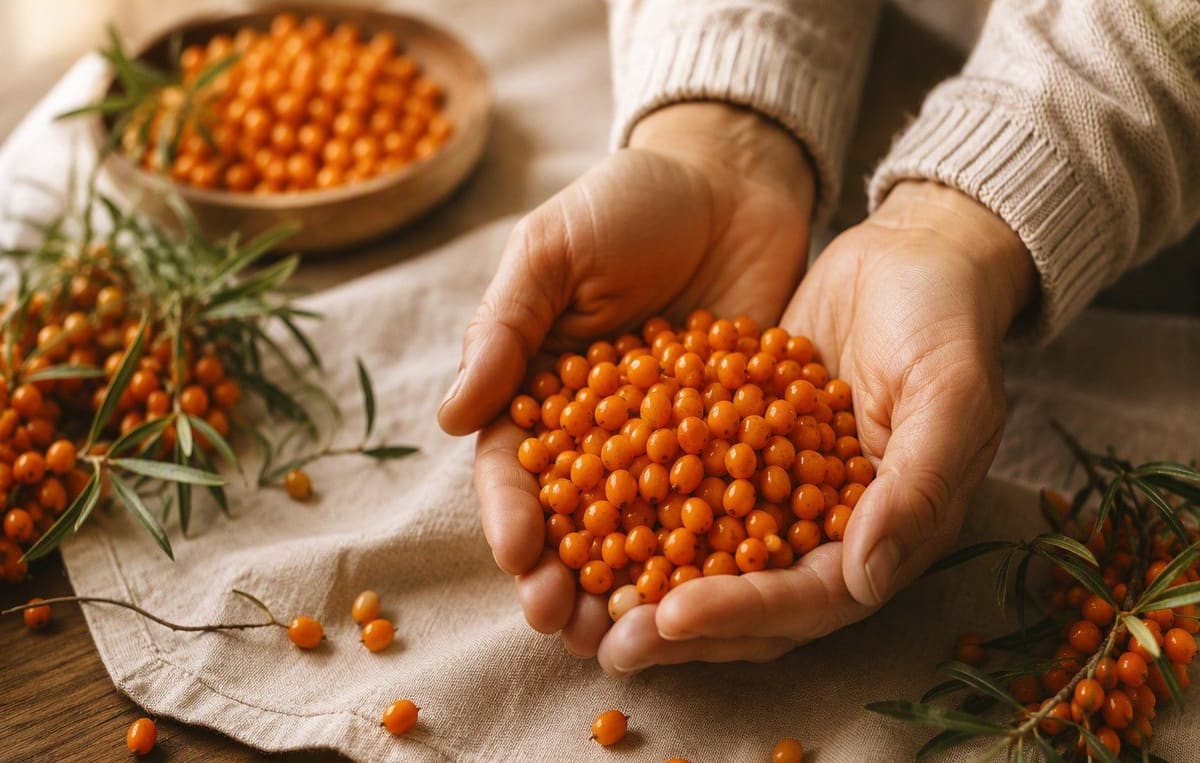
Polyphenols are the umbrella family of plant compounds that includes flavonoids, phenolic acids, and their many relatives. Sea buckthorn berries are rich in them, concentrated on the water side of the plant: juice, puree, and powder rather than oil.
What they are
Thousands of related molecules built on phenol rings, grouped into families. The flavonoids (quercetin, isorhamnetin, kaempferol) are the sea buckthorn branch you will meet most often. Plants make polyphenols to manage sunlight, pests, and stress, and they end up doing chemistry in us too. Beyond the flavonoid branch sit phenolic acids like caffeic and ferulic acid, quieter members that show up in composition tables but rarely in marketing. The leaves carry plenty of the family too, which is why sea buckthorn tea exists at all.
How they show up on labels
Mostly as vague richness claims, because labels almost never print polyphenol measurements. The useful rule is structural: polyphenols lean water-soluble, so the food forms carry them and the oil largely does not. A berry powder or juice delivers this family. A softgel does not, and does not need to, because its job is fatty acids.
The vagueness tax
“Polyphenol-rich” is atmosphere: it costs nothing to print, describes nearly every berry product ever sold, and commits to nothing a lab could check. The family is real and the berry genuinely carries it, but the phrase itself does no work.
Concrete example: one juice prints “polyphenols 400 mg per liter,” another says “rich in polyphenols.” The first gives you a number you can compare across brands and batches. The second gives you a mood. When a brand knows the number, it prints the number. The few brands that do test usually print a gallic-acid equivalent, the standard lab yardstick for this family, which makes two bottles comparable at last.
The honest caveat
Absorption is the weak link. Polyphenols are often poorly absorbed and rapidly metabolized, so blood levels after a serving are frequently tiny compared with the amounts that impress in test tubes. That is why “high in polyphenols” is a chemistry description, not a promised outcome, the same honesty tier as antioxidants. Content also drifts, because heat, light, and time in storage chip away at these compounds, so a juice tested at bottling and a juice opened months later are not quite the same product. The detail lives on the polyphenols nutrition page, and the glossary hub defines the rest of the vocabulary.
Where you meet it on this site
The juice explainer covers the form that carries the most of this family, the powder explainer shows the concentrated version, and the flavonoids nutrition page zooms into the branch you will meet most often.
Related terms: flavonoids, isorhamnetin, antioxidants.
Frequently asked questions
Does sea buckthorn oil contain polyphenols?
Very little. Polyphenols lean water-soluble, so they concentrate in the parts of the berry that are not oil: the juice, puree, and powder, plus the leaves used for tea. The oil's headline compounds are fatty acids and carotenoids instead.
Which has more polyphenols, sea buckthorn juice or oil?
The juice, by a wide margin. Polyphenols lean water-soluble, so they concentrate in the juice, puree, and powder, while the oil carries very little. The oil's strengths are fatty acids and carotenoids instead, which is why the two forms are not interchangeable.