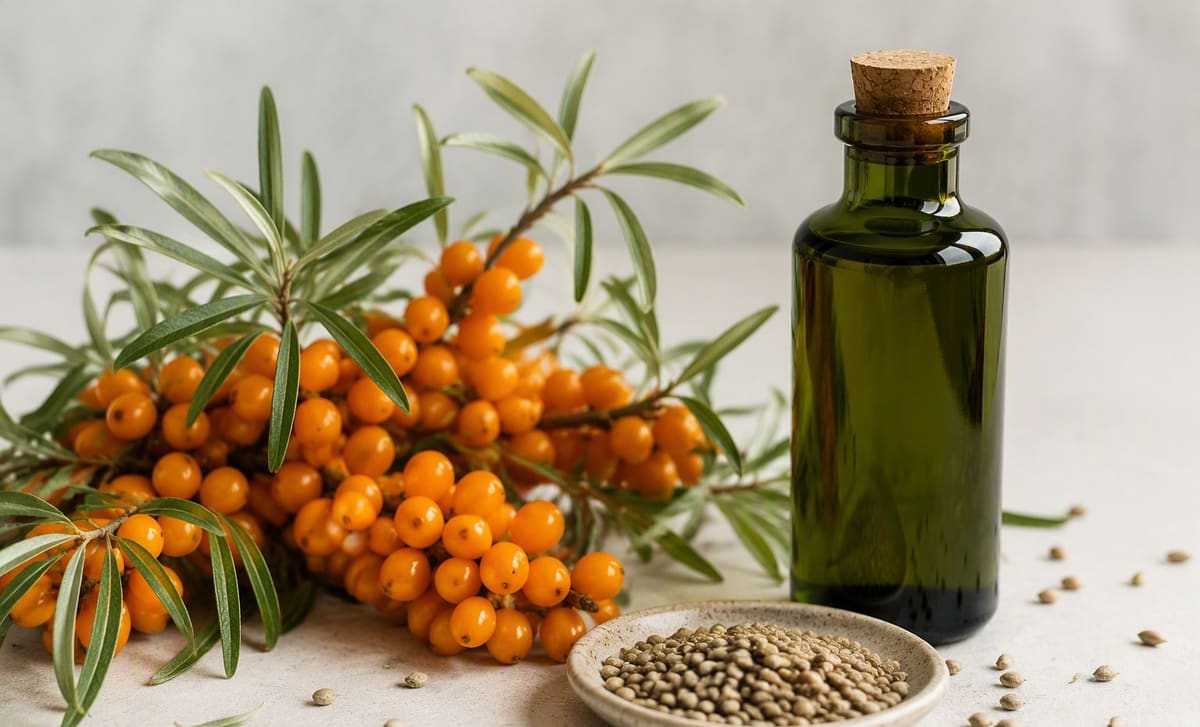
The fair fight is seed oil against seed oil. Hemp seed oil is a pleasant, nutty everyday oil with omega-6 and omega-3 in a roughly 3:1 ratio plus a little GLA. Sea buckthorn seed oil runs the same two omegas near 1:1 with more vitamin E, and its berry-oil sibling carries the omega-7 and the human trials hemp cannot match. Culinary daily oil: hemp. Researched benefits: sea buckthorn.
The comparison
| Sea buckthorn (seed / berry oil) | Hemp seed oil | |
|---|---|---|
| Omega-6 | 30-40% / 2-10% | Around 55% |
| Omega-3 (ALA) | 20-35% / 1-3% | Around 15-20% |
| Ratio 6:3 | Near 1:1 (seed) | About 3:1, reputation for balance |
| GLA | Not significant | Present in small amounts |
| Omega-7 | Trace / 15-54% | None |
| Vitamin E | Higher in seed oil | Moderate |
| Human trials | Oil blends: dry eyes, skin, vaginal dryness, lipids | Nutrition composition; no major condition RCTs |
| CBD content | None | None meaningful (CBD lives in flowers, not seeds) |
Hemp’s honest strengths
Hemp seed oil is a good everyday oil with an unfair marketing problem. The good: a balanced omega ratio (about 3:1 omega-6 to omega-3, which is why it earned its near-ideal reputation), small amounts of GLA, a pleasant nutty taste, and a fair price. The problem: the CBD confusion. Hemp seed oil is pressed from seeds, and CBD concentrates in the plant’s flowers and leaves, so a culinary bottle contains no meaningful CBD whatever the label hints. Hemp oil is food, and good food, not a cannabinoid supplement.
In the kitchen it earns shelf space easily: nutty enough for salad dressings, mild enough for drizzling, and happy anywhere you would use a finishing oil. Keep it out of the frying pan, because its unsaturated fats dislike high heat.
Sea buckthorn’s two-oil answer
Sea buckthorn seed oil is the direct counterpart: omega-6 and omega-3 in a near 1:1 ratio that hemp’s 3:1 cannot match, with vitamin E especially concentrated in the seed fraction. The full profile is on the fatty acid profile page.
Then the sibling changes the conversation. Sea buckthorn berry oil carries omega-7 at 15 to 54 percent of fatty acids plus the carotenoids, and the human trials (dry eyes, skin, vaginal dryness, lipids in abnormal ranges) used berry oil or seed-plus-berry blends, documented in the clinical trials catalog. Hemp has no comparable trial file for any condition.
The evidence, side by side
Hemp seed oil’s human evidence is compositional: its fatty acid ratio is well characterized, and that is nearly the whole file. Small studies exist on skin and lipids, but there is no condition where hemp oil is the tested, measured answer. It earns its place as a good culinary oil, not as a treatment.
Sea buckthorn’s file is the site’s standard set: a 15-trial lipid meta-analysis finding benefits concentrated in people with abnormal levels, the 100-person placebo-controlled dry-eye trial covered on the dry-eye trial page, and smaller skin and vaginal studies. One trial each in most lanes, honest caveats throughout, and still more controlled human data than hemp oil has accumulated. The skin studies page breaks down the two instrument-measured skin trials, including what they did not find.
The GLA footnote
Hemp’s small GLA content is a genuine point of interest, since gamma-linolenic acid is rare in common oils. But the amounts are modest, a few percent of fatty acids, far below evening primrose oil, and no human trial has tested hemp oil for the claims GLA usually carries. The omega family glossary keeps GLA, ALA, and the marine omegas straight for readers sorting the alphabet.
Cost and availability, honestly
Hemp seed oil is cheap to mid-priced and sits in ordinary supermarkets next to the flax. Sea buckthorn seed oil is mid-priced and mostly online, and the berry oil runs premium because the berries yield little oil. If the goal is a balanced everyday culinary oil, hemp wins on price without argument. If the goal is a tested supplement, hemp does not have a candidate in the race.
The lane question
Hemp oil is kitchen lane: salad dressings, drizzling, finishing, always off the heat. It has a minor cosmetic lane as a light facial oil. Sea buckthorn is supplement lane for the softgels and topical lane for the berry oil at night. The seed oil vs berry oil page is required reading before buying, because the two sea buckthorn oils share a name and little else.
The vitamin E angle
One quiet difference deserves a line. Sea buckthorn seed oil is notably rich in tocopherols, the vitamin E family, which partly explains its stability for an unsaturated oil, per the vitamin E page. Hemp oil carries vitamin E too, at more modest levels. Neither oil should be bought as a vitamin E supplement, since food covers that need for most people, but the antioxidant load helps the bottle survive its time on your shelf.
Choose hemp seed oil if
- You want a tasty, balanced everyday oil for salads and finishing, at a fair price.
- The 3:1 ratio plus a little GLA fits your routine.
- You were never chasing CBD in the first place, and now know the seed oil never had it.
Choose sea buckthorn if
- You want the seed oil with the tighter omega ratio and more vitamin E.
- Dry eyes, skin, vaginal dryness, or abnormal lipids are the goal, at the studied doses on the study dosages page.
- The omega-7 berry-oil story is the point, per the seed vs berry breakdown.
More matchups live on the comparisons hub.
Frequently asked questions
Is hemp seed oil or sea buckthorn oil better?
First, compare seed oil to seed oil, because sea buckthorn's berry oil is a different product. Hemp seed oil offers omega-6 and omega-3 in a roughly 3:1 ratio with some GLA, a pleasant everyday oil. Sea buckthorn seed oil offers omega-6 and omega-3 near 1:1 with vitamin E, and its sibling berry oil adds the omega-7 and the human trials for dry eyes, skin, and lipids. For a daily culinary oil, hemp. For the researched benefits, sea buckthorn.
Does hemp seed oil contain CBD?
No meaningful amount. CBD concentrates in the hemp plant's flowers and leaves, not the seeds, so culinary hemp seed oil is not a CBD product regardless of what packaging implies. Sea buckthorn oil contains no cannabinoids at all. If you want CBD, that is a different product category entirely, with its own regulations.
Is hemp oil or sea buckthorn oil better for skin?
Hemp seed oil is a pleasant light facial oil, but its skin case rests on composition, not trials. Sea buckthorn has the measured file: oral oil improved hydration and elasticity in small randomized studies, and the berry oil is an established rich topical. For a light everyday facial oil, hemp works. For the evidence-led route, sea buckthorn.