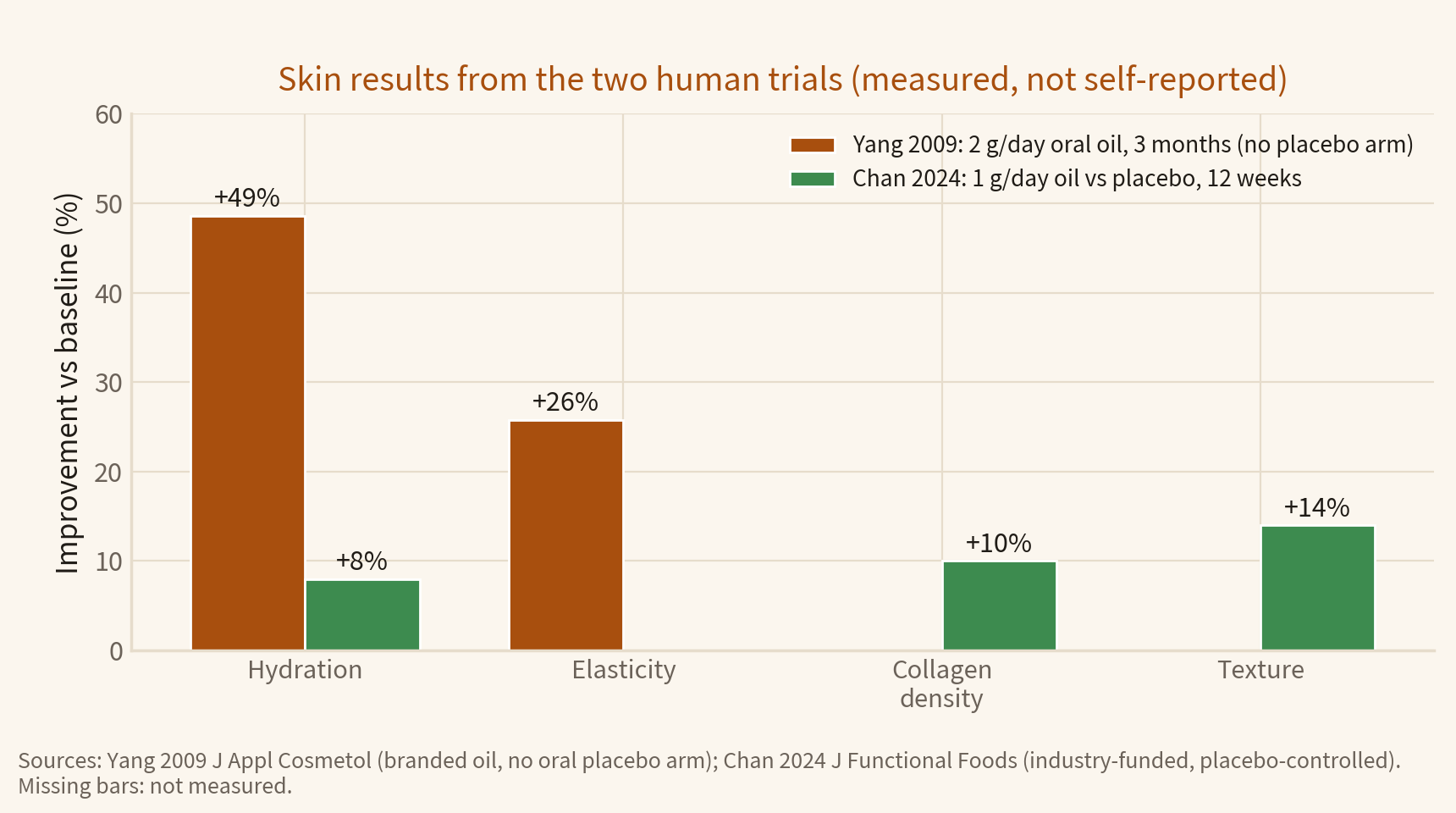
Sea buckthorn’s skin evidence is exactly two human trials of oral oil. Yang 2009 found big instrument-measured gains with no oral placebo arm. Chan 2024 found smaller gains against a proper placebo, with industry funding. Read together they suggest a real, modest benefit over 8 to 12 weeks. Read separately, each one misleads in a different direction.
See the data behind this chart
| Measure | Yang 2009 (2 g/day, 3 mo) | Chan 2024 (1 g/day, 12 wk) |
|---|---|---|
| Hydration | +48.6% | +8% |
| Elasticity | +25.8% | not reported |
| Collagen density | not measured | +10% |
| Texture | not measured | +14% |
Yang 2009: the big numbers, the missing placebo
Both trials sit at a moderate grade on our study hub, and the first one shows why the grade is not higher. Sixty women aged 50 to 70 were randomized into two arms of 30: one took 2 grams of oral sea buckthorn oil daily, the other applied a topical seed-oil cream, for three months. Skin was measured with instruments, not questionnaires: a Corneometer for hydration, a Cutometer for elasticity, image analysis for roughness.
The oral arm’s results made the marketing rounds for years: hydration up 33.6 percent at one month and 48.6 percent at three, elasticity up 16.3 and then 25.8 percent, surface roughness down.
The caveats decide how much of that to believe. The oral group was compared against a topical cream, not against a placebo, so expectation, attention, and seasonal effects had room to inflate the numbers. And the oil was SBA24, a branded ingredient from the company connected to the research. Real measurements, weak controls, interested money.
One more caveat deserves its own paragraph: the journal. Yang 2009 appeared in the Journal of Applied Cosmetology, which sits outside the PubMed index, so the paper skipped the indexing layer of quality control most of the corpus passed through. That does not make the measurements fake. It means one fewer independent screen stood between the data and you, and the reading-studies page treats that screen as its own check.
Chan 2024: the smaller, stricter answer
Forty healthy women, mean age about 52, took 1 gram of sea buckthorn oil or a placebo daily for 12 weeks, measured with VISIA imaging and DermaLab instruments, with blood markers alongside.
The imaging instruments matter here. VISIA and DermaLab measure skin the way a blood test measures cholesterol, by instrument rather than opinion, which is what makes an 8 percent finding worth printing at all.
The results were quieter: hydration up 8 percent, collagen density up 10 percent, texture up 14 percent, pore count down 15 percent. Blood work showed catalase up 82.8 percent, TNF-alpha down 23 percent, and HDL cholesterol up 14.8 percent. Most participants also reported ocular and vaginal symptom relief, the self-reported soft spot of the paper.
This trial was placebo-controlled and recent, which is what good looks like. It was also industry-funded and small, which is what caution looks like.
The blood markers need their own caution label. An 82.8 percent rise in catalase sounds dramatic, and it was a secondary endpoint in 40 people, where one or two strong responders can bend an average. Secondary markers in small trials are hypothesis fuel, not findings, and the skin numbers, the trial’s actual job, were the modest ones.
The effect-size reality check
Put the two hydration numbers side by side: 48.6 percent against 8 percent. The instinct is to average them, and the discipline is to weight them. Yang’s number came from the 30 women in its oral arm, out of 60 enrolled and split against a topical cream, with no placebo arm, where expectation and attention leak into every measurement. Chan’s came from a placebo-controlled design, the stricter instrument, and stricter instruments almost always find smaller effects. An 8 percent hydration rise on a Corneometer is real and subtle: your skin holds measurably more water, and nobody across a room will notice. Plan for the strict number, and treat the loose one as the ceiling of the possible.
The elasticity and collagen numbers obey the same gravity. Yang’s 25.8 percent elasticity gain came from the loose design. Chan’s 10 percent collagen density gain came from the strict one. When a label quotes the big number, it is quoting the design with the weaker controls, and now you can see it. Both trials also measured at their final timepoint, so both are silent about when the shift began and how long it survives the last capsule.
What a definitive trial would need
- Size: hundreds of participants, not 30 to 40 per arm, so modest effects stop wobbling.
- Independence: no branded oil, no manufacturer funding, replication by a lab with nothing to sell.
- A real placebo matched for color and taste, because an orange oil is hard to blind.
- Duration past 12 weeks, plus follow-up after stopping, to see whether gains persist or fade.
- Pre-registered endpoints, so the reported measures were chosen before the results arrived.
The independence bullet carries a price tag, which is why it stays a wish. A trial like that costs real money, academic grants rarely fund cosmetics-adjacent questions, and the companies with the budget are the companies whose funding discounts the result. The safety review notes the same trials define the tolerability record, and the study dosages page holds the exact grams behind each arm.
Until that trial exists, the fair summary is: two trials, same direction, different magnitudes, and the stricter one found the smaller effect. For practical use, the skin hub maps which skin claims this supports and which it does not, and the clinical trials catalog places these two studies among all the human evidence.
Oral oil versus cream, the question buyers actually ask
Yang’s design accidentally poses the question everyone asks: the trial compared swallowing the oil against spreading it on the face, in separate arms. That makes the two routes sound interchangeable, and they are not. The oral arm fed skin from the bloodstream, the cream arm worked the surface, and neither arm tells you anything about combining them or about which suits your skin. The human evidence for skin is an oral-oil file, the dry skin page and the wrinkles page both grade it that way, and topical products sit outside what either trial measured. So if you are buying to match the studied route, reach for an oral oil like the oils we scored highest, not a face cream the trials never tested.
Frequently asked questions
Is sea buckthorn oil clinically proven for skin?
Two human trials exist, both positive, both caveated. Yang 2009 measured hydration up about 49 percent and elasticity up about 26 percent at 2 grams daily over 3 months, but the oral arm had no placebo group. Chan 2024 measured more modest gains (hydration up 8 percent, collagen density up 10 percent at 1 gram daily over 12 weeks) against a real placebo, with industry funding. Promising, not proven.
Which sea buckthorn skin study is more trustworthy?
They answer different questions. Yang 2009 shows the size of what might be possible, with weaker controls. Chan 2024 shows a smaller effect with a proper placebo, which is usually closer to the truth. Read together, the honest expectation is a modest, real hydration and elasticity benefit over 8 to 12 weeks, measured on instruments, not a transformation.
Should I take the oil orally or apply it to skin?
The human trials answered the oral question, not the topical one. Both skin studies dosed oil by mouth, and Yang's topical cream arm was a comparator, not a validated treatment. If you want the studied route, it is 1 to 2 grams daily by mouth for 8 to 12 weeks. Topical use has tradition and cosmetic logic behind it, and no human trial on this site grades it.