The human trials dosed between 1 and 5 grams a day, always with food, usually split across meals, and never longer than 3 months. This reference table records every trial’s exact dose, form, split, and duration, so label claims can be checked against what was actually tested rather than what sounds good. One row, the 0.75 ml blood-pressure trial, was retracted in 2026 and stays in the table only as a marker.
The dose-by-trial table
Every trial in the table below carries an evidence grade in our research file. This page just lines those same studies up by dose.
| Trial | Daily dose | Form | Split | Duration |
|---|---|---|---|---|
| Larmo 2010 (dry eye) | 2 g | Seed+berry oil blend | 1 g twice daily with meals | 3 months |
| Jarvinen 2011 (mechanism) | 2 g | Same cohort, same oil | 1 g twice daily with meals | 3 months |
| Yang 2009 (skin) | 2 g | SBA24 oil, oral arm | Not specified | 3 months |
| Chan 2024 (skin) | 1 g | Omegia oil vs placebo | Not specified | 12 weeks |
| Larmo 2014 (vaginal) | 3 g | Oil blend vs placebo | Not specified | 3 months |
| Larmo 2008 (infections) | 28 g | Whole berries (food dose) | With daily diet | 3 months |
| Morone 2026 (constipation) | 500 mg | Concentrated fruit extract vs placebo, not an oil | One capsule daily | 28 days |
| Vashishtha 2017 (hypertension). RETRACTED 2026, not usable as evidence | 0.75 ml | Seed oil | Single daily dose | 30 days |
| Johansson 2000 (platelets) | 5 g | Berry oil, 10x 500 mg capsules | Across the day | 4 weeks |
| Geng 2022 (lipid meta) | Typically 1.5-3 g | Varied across 15 trials | Varied | 4-12 weeks |
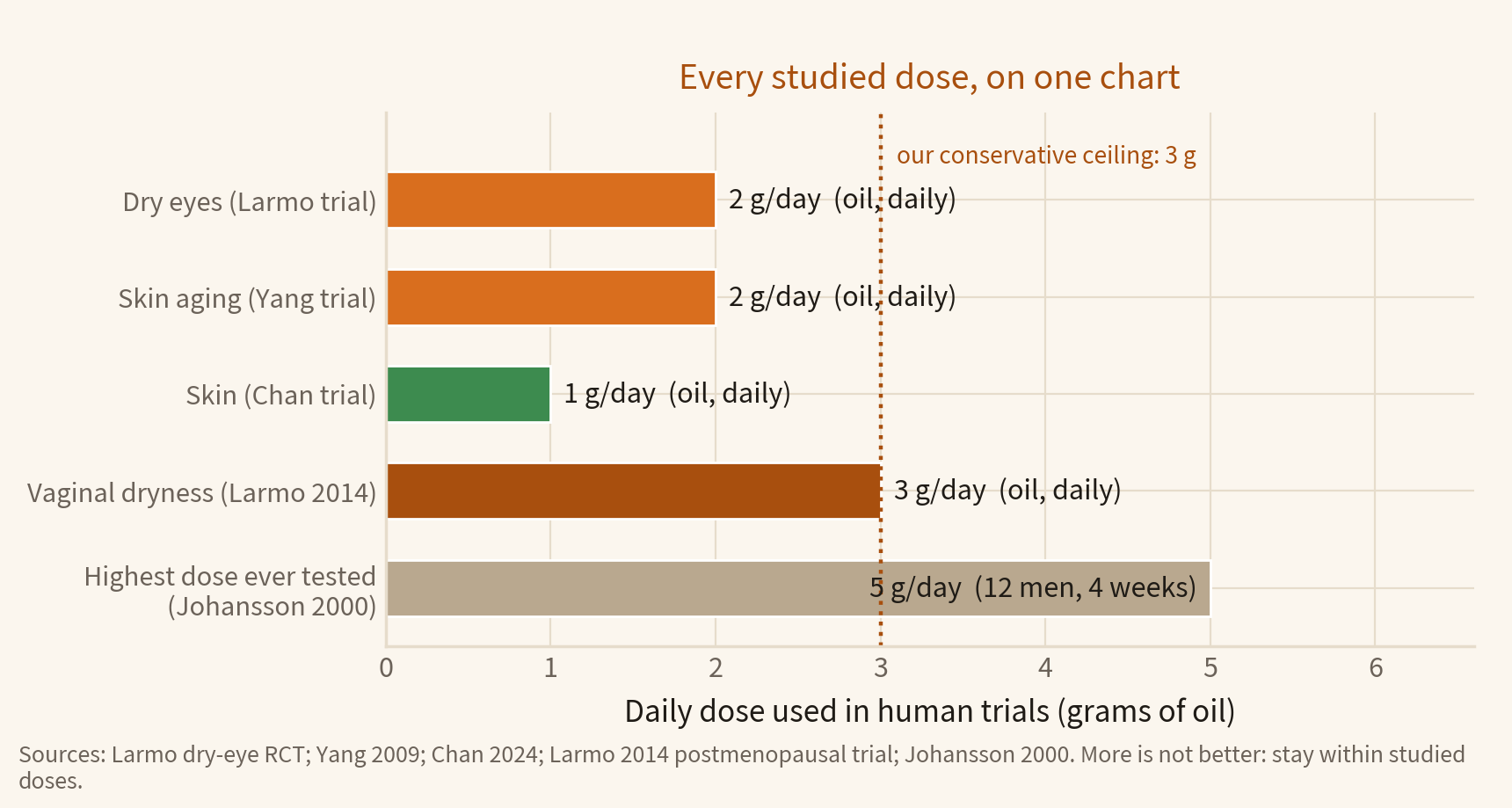
See the data behind this chart
| Trial / goal | Daily dose |
|---|---|
| Dry eyes (Larmo) | 2 g oil |
| Skin aging (Yang 2009) | 2 g oil |
| Skin (Chan 2024) | 1 g oil |
| Vaginal dryness (Larmo 2014) | 3 g oil |
| Highest tested (Johansson 2000) | 5 g oil, 12 men, 4 weeks |
Reading the splits and forms
Two details in the table deserve a second look. First, the split: the dry-eye trial divided its 2 grams into two 1-gram servings with meals, and the lipid trials mostly did the same. Splitting keeps blood levels steadier and puts each dose next to dietary fat for absorption, which is why we recommend the same pattern on the practical pages.
Second, the form: every oil trial used a defined product, a blend, a branded oil, or straight berry oil, dosed in grams. The berry trial used actual fruit at food quantity. When a label cites “clinical doses,” this table is the yardstick: 1 to 3 grams of named oil, not a sprinkle of powder in a proprietary blend.
Third, the ceiling shape: nothing above 5 grams has been tested in humans, and the 5-gram test lasted four weeks in 12 healthy men. Doses beyond the table are not bold, they are unmapped.
The dose ladder, in everyday terms
Grams of oil are abstract, so translate them before you shop. One gram is two standard 500 mg softgels, and that is now the smallest dose any standing trial used, in the 2024 skin study. The old floor, the 0.75 ml of seed oil in the blood-pressure trial, worked out to about half a teaspoon, but that paper was retracted in 2026 and no longer sets anything. Two grams, the dry-eye dose, is four softgels or a scant half teaspoon of liquid. Three grams, the top of the benefit range, is six softgels. Five grams, the highest dose ever tested, is ten softgels a day, and it produced the platelet effect the blood-thinner page is built around. The 28 grams of berries in the infection trial is two heaped tablespoons of puree, a small handful of fruit: food, not a capsule.
Three rules the table teaches
The effective range is 1 to 3 grams. Every benefit trial landed there, which is why the dosage page and the how much daily guide both steer you into that window and no higher.
Five grams is a ceiling marker, not a target. The only 5-gram study produced a measurable antiplatelet effect in 12 healthy men. It exists to mark the boundary, not to invite anyone near it.
With food, always. Fat-soluble carotenoids, vitamin E, and the fatty acids themselves absorb with a meal. The dry-eye trial dosed twice daily with meals by design, and a dose on an empty stomach wastes part of what you paid for.
Duration is part of the dose. Three months is not a minimum course, it is the longest anyone has formally watched. The dry-eye trial measured its effect at the end of winter, not after week one, so expect the studied timeline rather than an overnight change, and treat anything past three months as personal experiment rather than evidence.
Why no trial went past three months
The 3-month ceiling is not a finding. It is a budget line. Academic trials run on grants sized in semesters, not years, and every added month costs participants, capsules, and lab work. Safety caution pulls the same direction: review boards approve longer exposures only after shorter ones look clean, and sea buckthorn’s shorter trials finished barely a decade ago. The practical consequence belongs to you: everything this site says about benefits and safety lives inside 12 weeks of daily use. What happens in month six, or year six, nobody has measured, and any page that implies otherwise is guessing on your behalf.
The dose a label implies versus the dose tested
The commonest label trick is dose theater: a capsule that contains sea buckthorn somewhere in a proprietary blend, at a fraction of a gram, borrowing the credibility of trials that dosed grams. The blend lists the ingredient, the front panel implies the benefit, and the dose that produced the benefit never appears. The audit takes one question: how many grams of named sea buckthorn oil per day, and does that number appear in the table above? If the label will not say, the answer is closer to a few drops than to the 2-gram row. The reading-studies page counts dose realism as one of its six checks for exactly this reason.
What would settle dosing
The missing trial is a dose-ranging study: the same oil at 1, 2, and 4 grams a day, about 90 people per arm, six months, one primary outcome. That single experiment would answer whether 2 grams beats 1, whether 4 grams beats 2 or just costs more, and where benefit flattens against the platelet signal the 5-gram study found. Until it exists, the table on this page is the whole dosing map, and the cholesterol meta-analysis page shows why even the pooled lipid doses are ranges rather than points.
Using this table as a lie detector
When a product implies benefit at one softgel a day, check the table: every positive trial used 2 to 6 softgels’ worth of oil, and the capsules that match these grams are the ones whose label math survives that check. When a protocol suggests mega-dosing, check the ceiling row. The full trial context behind each row lives in the clinical trials catalog, and the safety synthesis is on the safety review page.
The same table disciplines expectations in the other direction. If you take 1 gram a day and feel nothing at week two, the trials say that proves nothing, because none of them measured week two. If you take 3 grams for three months and your lipids were normal to begin with, the pooled data says the likely change is also nothing, because the effects concentrate in abnormal baselines. Dose, duration, and starting point are the three dials every row in the table sets.
Frequently asked questions
What doses did the sea buckthorn studies use?
The dry-eye and skin trials used 1 to 2 grams of oil daily, the vaginal trial used 3 grams, the lipid trials typically ran 1.5 to 3 grams, and the highest dose ever tested was 5 grams of berry oil daily for 4 weeks, which produced a measurable antiplatelet effect. The 2026 constipation trial is the odd one out at 500 mg of a concentrated fruit extract, which does not convert into an oil dose. The practical ceiling for daily oil use is 3 grams, matching the best-studied range.
How do the studied doses convert to softgels?
At 500 mg per softgel, 1 gram is 2 softgels, 2 grams is 4, and 3 grams is 6. The dry-eye trial split its 2 grams as 1 gram twice daily with meals. One level teaspoon of liquid oil is about 4.5 grams, above the studied range, so measure with a real spoon and take it with food.
Is more than 3 grams a day unsafe?
Unstudied is the honest word, not unsafe. The 5-gram study found good short-term tolerability in 12 healthy men alongside a measurable platelet effect, so the space between 3 and 5 grams is mapped only at its edges. The practical ceiling stays at 3 grams because that is where the benefit trials lived and because nobody has watched higher doses for longer than four weeks.