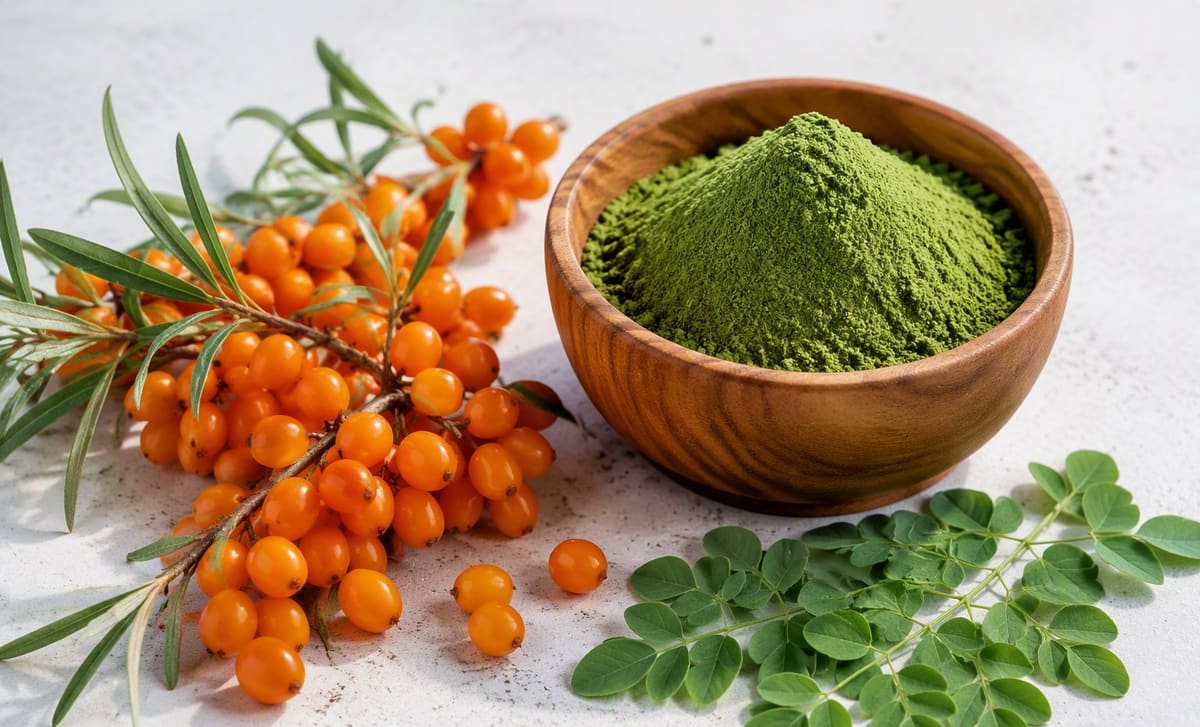
Moringa and sea buckthorn are both “miracle trees” with nutrient-dense parts, ancient traditions, and marketing that sprints ahead of the science. Moringa’s strength is its leaf: a green, mineral-rich food powder. Sea buckthorn’s is its berry and oil: very high vitamin C plus the omega-7 fraction with actual randomized human trials. They overlap in hype far more than in nutrition.
The comparison
| Sea buckthorn | Moringa | |
|---|---|---|
| Used part | Berries and their oils | Leaves, as powder or tea |
| Tradition | Tibetan and Mongolian medicine | Ayurveda and South Asian food |
| Nutrition claim | Vitamin C 200-600 mg per 100 g berries; omega-7 oil | Green-leaf density: vitamins, minerals, some protein |
| Human evidence | RCTs: dry eyes, skin, vaginal dryness, lipids | Small and early; mostly pilot studies |
| Main form | Oil softgels, juice, powder | Leaf powder, capsules, tea |
| Taste | Intensely sour | Green, earthy, matcha-adjacent |
| Marketing inflation | High | High |
The honest mirror
Hold these two plants side by side and the similarity is structural, not nutritional. Both are tough trees from harsh climates. Both carry centuries of traditional medicine, Ayurveda for moringa, Tibetan and Mongolian practice for sea buckthorn. And both get sold with the same vocabulary: miracle, ancient, nutrient density, detox.
The difference is what happens when you check. Sea buckthorn’s human file includes randomized placebo-controlled trials with instrument measurements, covered in our clinical trials catalog. Moringa’s human file is thinner: small pilot studies, promising directions, nothing yet that would survive the grading we apply on this site. Tradition is real knowledge, and it is also not the same as measured trials, a point our amla comparison makes from the Ayurvedic side.
What each one is actually good for
Moringa leaf powder is a legitimate green food: it adds vitamins, minerals, and a little protein to smoothies and soups at a low price, and in food-insecure regions it is a genuine nutritional asset. As a supplement claiming to treat conditions, the evidence is early.
The daily habit is easy to build, which matters more than the label. A teaspoon of moringa in a smoothie or stirred into dal disappears into the meal, costs pennies, and asks nothing else of you. That is the honest pitch, and it is enough.
Sea buckthorn plays two different positions. The berry is a vitamin C and flavonoid food, extremely sour. The oil is the supplement with trials behind dry eyes, skin hydration, vaginal dryness, and lipids in abnormal ranges, doses tabulated on the study dosages page.
What a daily serving actually delivers
A teaspoon of moringa leaf powder, about 5 grams, adds modest amounts of vitamin A precursors, calcium, iron, and a gram or so of protein to whatever it lands in. Respectable for a green powder at food doses, and far short of the multivitamin replacement the ads describe. Its real value is cumulative: a cheap green habit sustained for years.
Sea buckthorn’s food form is the sour berry: 200 to 600 mg of vitamin C per 100 g fresh, flavonoids including quercetin and isorhamnetin, and sharp organic acids, per the nutrition hub. Its supplement form is the oil. Nothing about sea buckthorn is a quiet daily teaspoon, which is moringa’s genuine advantage.
The evidence, side by side
Moringa’s human file is early: small pilot studies on blood markers and milk production, promising directions, small samples, short durations. Nothing wrong with the research. It simply has not matured into controlled trials with measured outcomes.
Sea buckthorn’s oil has that next stage: a 15-trial lipid meta-analysis finding benefits concentrated in abnormal ranges, the 100-person dry-eye trial, and smaller skin and vaginal studies, kept in the clinical trials catalog. Early-stage versus moderate-stage, and the difference is what the word measured means. The how to read studies page is the toolkit for grading both files yourself.
Cost and availability, honestly
Moringa powder is one of the cheapest supplements on the shelf, sold in bulk bags at food prices, and its low price also means less incentive to fake it, which is its own form of quality control. Sea buckthorn oil is a mid to premium supplement, and the juice and powder are mid-priced imports. Per dollar, moringa delivers more daily nutrition. Per tested outcome, sea buckthorn is the only one with outcomes tested, and the price guide keeps its real cost honest.
The lane question
Moringa is kitchen lane: a green powder for smoothies, soups, and dal. It also wins the travel test, since a bag of powder survives a suitcase better than a bottle of oil. Sea buckthorn is supplement lane for the oil and specialty-kitchen lane for the sour forms. Neither plant is a multivitamin, and households buying either as one should expect the gap. The spirulina comparison grades another green powder by the same standard, and the acai comparison does it for the berry-hype side.
Choose moringa if
- You want a cheap daily green powder for food-level nutrition.
- The Ayurvedic tradition is the one your household already trusts.
- You accept early human evidence for what it is and skip the cure claims.
Choose sea buckthorn if
- You want the trial-backed lanes: dry eyes, skin, vaginal dryness, or abnormal lipids, per the cholesterol page.
- A vitamin C fruit source appeals, with the vitamin C page numbers in mind.
- You prefer measured (if small) trials over a larger traditional literature.
More matchups live on the comparisons hub.
Frequently asked questions
Is moringa or sea buckthorn better?
Better for what is the whole answer. Moringa leaf powder is a nutrient-dense green food: vitamins, minerals, and protein at food doses, with early-stage human research. Sea buckthorn brings berries with very high vitamin C plus an oil with randomized human trials for dry eyes, skin, and blood lipids in abnormal ranges. For daily green nutrition, moringa. For the trial-backed oil benefits, sea buckthorn.
Can I take moringa and sea buckthorn together?
Yes, and they complement rather than duplicate each other: a green leaf powder and a berry oil share almost no nutrients. At food-level doses there is no known conflict. As with any supplement stack, tell your doctor what you take, especially if you use medications, since both plants have traditional uses that outrun their human evidence.
Which has more vitamin C, moringa or sea buckthorn?
Sea buckthorn berries, decisively. Fresh sea buckthorn carries roughly 200 to 600 mg of vitamin C per 100 g. Moringa leaves contain respectable vitamin C for a leafy green, but drying and storage cut it, and powder servings are small. Moringa's strength is broad green-leaf nutrition at food doses, not a single headline vitamin.