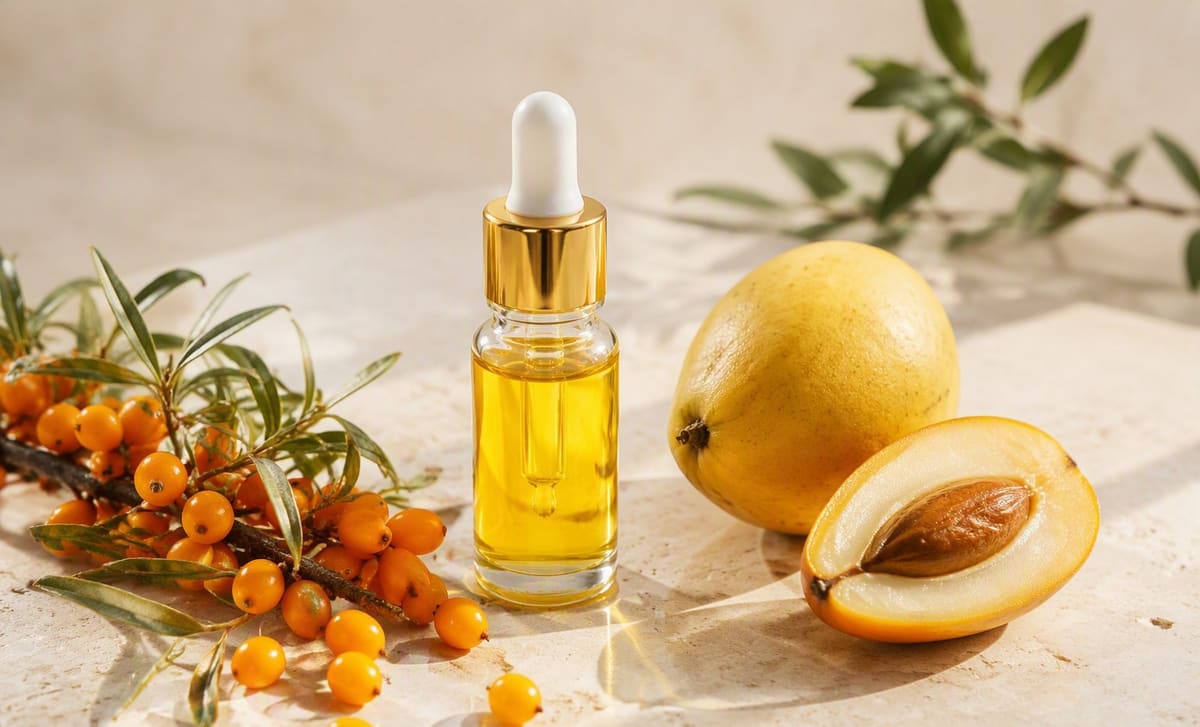
Marula is the polished one: an oleic-heavy African oil that absorbs fast, feels elegant, and never stains anything. Sea buckthorn berry oil is the intense one: omega-7, deep orange carotenoids, and human skin trials behind the oral form. Daily lightweight face oil goes to marula. Rich night treatment and the researched inside-out route go to sea buckthorn.
The comparison
| Sea buckthorn (berry oil) | Marula oil | |
|---|---|---|
| Source | Berry pulp of a cold-climate shrub | Kernels of the African marula fruit |
| Signature fat | Palmitoleic omega-7 (15-54%) | Oleic omega-9 (dominant share) |
| Feel | Rich, slow-absorbing | Light for its richness, fast-absorbing |
| Pigment | Deep orange, tints skin and fabric | None |
| Skin evidence | Oral-oil RCTs: hydration, elasticity, collagen density | Cosmetic tradition; no major human skin RCTs |
| Stability | Fairly stable; carotenoids fade in light | Notably stable for a cosmetic oil |
| Best slot | Night treatment, diluted into cream | Daily facial oil, morning included |
Marula’s case: elegance and stability
Marula oil is mostly oleic acid, the same forgiving fat that dominates olive oil, which is why it feels rich without greasiness and absorbs faster than almost any luxury oil. It is also notably stable on the shelf. For a daily facial oil, morning included, under sunscreen and makeup, marula behaves better than almost everything in its price band. Its evidence is cosmetic tradition and chemistry, not human trials, and at the daily-moisture job that is often enough.
Sea buckthorn’s case: pigment with a purpose
The berry oil’s orange is carotenoids at work, and its omega-7 content (15 to 54 percent of fatty acids) is rare in the plant world. The deeper argument is the oral route: human trials measured improved skin hydration, elasticity, and collagen density at 1 to 2 grams of oil daily over 8 to 12 weeks, dissected on the skin studies page. No facial oil, marula included, has that file.
The management cost is real: tint on skin, stains on fabric, and a richer feel that belongs at night, diluted into cream, per the face oil technique. The pale seed oil dodges the pigment for daytime use.
The clogging question, hedged as always
Comedogenic numbers for marula and sea buckthorn found online are publisher and formulator lore, not lab measurements. No standardized clogging score exists for either. Marula’s lighter feel suits more skin types, and the patch-test rule (small area, one to two weeks) applies to both.
What each oil actually contains
Marula is an oleic showcase: omega-9 dominates, the same forgiving fat as olive oil, with a supporting cast of linoleic and saturated fats and a little vitamin E. Simple, stable, predictable. That simplicity is the product.
Sea buckthorn berry oil is the complicated one: palmitoleic omega-7 at 15 to 54 percent, palmitic around a quarter to a third, oleic in support, plus carotenoids dense enough to tint skin, per the fatty acid profile page. Complicated chemistry, complicated management, and the reason it works at night.
The evidence, side by side
Marula’s skin evidence is chemistry and cosmetic tradition: an oleic-rich oil behaves predictably on skin, and formulators have decades of experience with it. Human trials measuring skin outcomes from marula, oral or topical, essentially do not exist. For a daily moisturizer that is an acceptable evidence tier, as long as the price does not pretend otherwise.
Sea buckthorn’s file is the oral route: small randomized trials where 1 to 2 grams of oil daily for 8 to 12 weeks improved instrument-measured hydration, with elasticity and collagen density improving in one trial each, all dissected on the skin studies page. Small trials, industry funding in places, no large independent replications. Still the only file of its kind between the two.
The day-night split
The most practical sentence in this comparison is the routine: marula in the morning, sea buckthorn at night. Marula absorbs fast, sits well under sunscreen and makeup, and leaves nothing on the pillow. Sea buckthorn berry oil does its richer, pigmented work while you sleep, diluted into a night cream so the tint stays where you want it. Owning both is not indecision. It is using each oil in the slot it was built for.
Cost and availability, honestly
Marula sits in the mid to premium cosmetic band, and the price spread mostly reflects packaging and brand rather than the oil itself, since the chemistry is well standardized. Sea buckthorn berry oil runs mid to premium too, with a wider honesty problem: dilution with carrier oils is common enough that the fake oil guide exists. Per milliliter of verified oil, both cost real money. Marula at least never stains your pillowcase for it.
The lane question
Both oils live in the topical lane, and marula lives nowhere else. Sea buckthorn adds the supplement lane, which is where its trials point. The sensible routines respect that split: marula as the elegant daily facial oil, sea buckthorn berry oil as the night treatment, and sea buckthorn softgels for the inside-out route, with product tiers scored in the face oil guide. Readers still choosing between antioxidant facial oils can add the pomegranate oil comparison to the list.
Choose marula oil if
- You want one elegant daily facial oil with zero tint management.
- Stability and feel outrank trial data for you.
- Your skin is normal to oily and prefers lighter oils.
Choose sea buckthorn if
- You want the richer night treatment and will manage the orange.
- The oral skin route with human trials appeals, at the studied doses on the study dosages page.
- You have compared the other face oils via sea buckthorn vs argan oil and sea buckthorn vs rosehip oil and want the evidence tier.
More matchups live on the comparisons hub.
Frequently asked questions
Is marula oil or sea buckthorn oil better for your face?
For a lightweight, elegant daily facial oil, marula: it is oleic-rich, absorbs fast, and leaves no tint. For a rich night treatment or the inside-out skin benefits with human trials behind them, sea buckthorn: oral oil improved measured hydration, elasticity, and collagen density in small studies, and the berry oil's omega-7 is its signature. Many routines use marula by day and sea buckthorn at night.
Does marula oil clog pores?
The comedogenic ratings for marula (and for sea buckthorn) circulating online are publisher and formulator lore, not lab measurements. No standardized, lab-tested clogging score exists for either oil. Marula's light, oleic profile suits most skin types, but the honest advice is the same for every oil: patch test on a small area for a week or two before full-face use.
Can marula oil and sea buckthorn oil be used in the same routine?
Yes, and they split the day naturally. Marula in the morning under sunscreen, since it absorbs fast and leaves no tint. Sea buckthorn berry oil at night, diluted into cream, when the pigment and richness do not matter. Introduce one at a time, patch test each, and give any new oil two weeks before judging it.