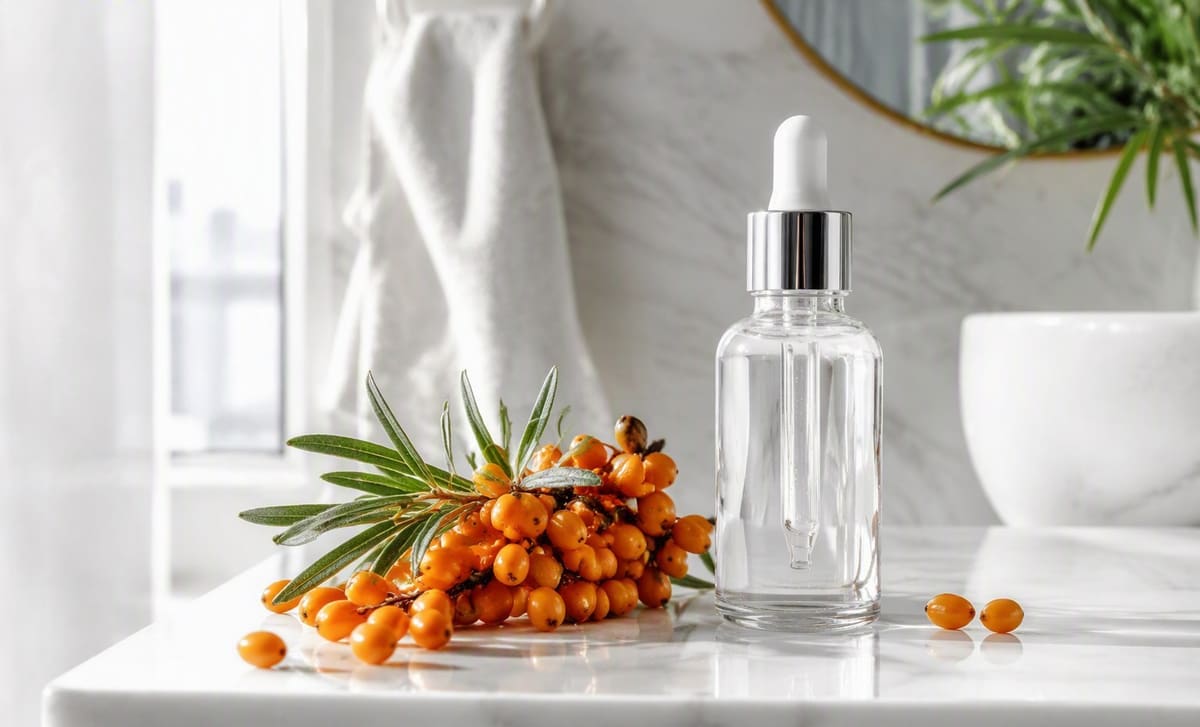
Hyaluronic acid hydrates from the outside in: a topical humectant that binds water in the skin’s surface and plumps within minutes, then fades within about a day. Sea buckthorn oil works from the inside out: oral oil in human trials measured improved skin hydration and dry-eye relief over 8 to 12 weeks. Minutes versus weeks. These two stack far better than they compete.
The comparison
| Sea buckthorn oil (oral) | Hyaluronic acid (topical) | |
|---|---|---|
| Direction | Inside out: absorbed, systemic | Outside in: sits on the surface |
| Mechanism | Fatty acids support skin barrier and tear film | Humectant: binds many times its weight in water |
| Speed | Weeks. Trials measured at 4 and 12 | Minutes, visibly plumps on application |
| Duration | Persists while you take it | Fades within about a day |
| Evidence | Human RCTs: skin hydration, elasticity, dry-eye relief | Decades of cosmetic science; instant cosmetic effect |
| Also reaches | Dry eyes, vaginal dryness (separate trials) | Nothing below the surface |
| Weakness | Slow; requires daily habit and cost | Temporary; needs an occlusive layer to lock in |
What hyaluronic acid does, without the marketing
Hyaluronic acid is a sugar molecule your skin already makes, famous in cosmetic chemistry for binding up to about 1,000 times its weight in water. Applied as a serum, it draws moisture into the skin’s outer layers and visibly plumps fine lines within minutes. That effect is real, and it is also temporary: the molecule sits near the surface and the plumping fades within about a day.
Two practical rules make it work. Apply it to damp skin, because a humectant needs water to grab. Then seal it with an oil or cream, because without an occlusive layer on top, the water it pulled in evaporates back out.
Labels love molecular-weight talk: big molecules sit on the surface, smaller fragments claim deeper reach. The differences are real but modest. Formula quality and the seal-it-in step matter more than the number on the box, and a serum listing five molecular weights is not five times better, just five times the label copy.
One clarification worth making: injectable hyaluronic acid fillers are a different product category entirely, placed by clinicians under the skin. Nothing on this page applies to needles.
The damp-skin protocol, step by step
The routine that makes a humectant earn its keep takes under two minutes. Cleanse, leave the skin slightly damp, apply the serum, give it a minute, then seal with your cream or a few drops of oil. Morning versions end in sunscreen, always. Skip the damp-skin step and the humectant can grab water from deeper skin instead of the surface, which leaves you drier than you started. Skip the seal and the water you pulled in evaporates within the hour. The molecule is cheap and effective, but it is strictly a team player.
What the oral route actually showed
Oral sea buckthorn oil plays the long game, and it has receipts. Three lanes have human data, and each is a job a topical serum cannot do:
- Skin hydration. In a 2009 trial of 60 women, the 30 in the oral arm taking 2 grams daily measured about 49 percent better hydration at three months, though the study had no placebo group. A 2024 placebo-controlled trial at 1 gram daily measured a more modest 8 percent. Numbers and caveats are on our dry-skin page.
- Dry eyes. A 100-person randomized trial found 2 grams daily eased tear-film measures and symptom scores over three winter months, detailed on the dry-eye page.
- Vaginal dryness. A 116-woman placebo-controlled trial at 3 grams daily found roughly triple the odds of improved vaginal epithelial integrity over three months, through a non-estrogenic mechanism, per the clinical trials catalog.
No topical humectant attempts any of those jobs, because a serum cannot reach tear films or systemic skin hydration. That is the honest difference: not better or worse, but different organs of reach.
The stacking protocol that actually makes sense
The dermatology-sound routine uses both clocks at once. Morning: humectant serum on damp skin, cream, sunscreen. Night: the same serum if you like, sealed this time with a few drops of sea buckthorn berry oil as the occlusive layer, tint management included. Baseline: oral sea buckthorn oil daily, in the 1 to 2 gram range the skin trials used, for the hydration changes that build over weeks. Each layer does the job it is good at, and no layer is asked to impersonate another.
Cost and commitment, honestly
A basic hyaluronic serum is one of the cheapest steps in skincare, often under twenty dollars for months of use. Oral sea buckthorn oil runs closer to a dollar a day at studied doses. The bigger difference is the judging window: the serum proves itself within a week, while the oil asks for 8 to 12 weeks before a fair verdict. Many people reasonably own both, which makes the stacking section above the practical takeaway.
One more expectation check: neither product touches deep wrinkles or structural sagging, and any page claiming otherwise is overselling. Surface dryness and systemic dryness are the honest territories here.
Choose hyaluronic acid if
- You want visible surface plumping today: smoother fine lines before an event, calmer tight-feeling skin this week.
- Your budget prefers a cheap serum over a daily supplement.
- You will actually follow the damp-skin-plus-occlusive routine. Used wrong, it does little.
- You want a makeup-friendly step that sits invisibly under everything else.
Choose sea buckthorn if
- Your dryness is chronic and systemic: dry eyes, dry skin that no serum fixes, or vaginal dryness, the lanes with human trial data.
- You can commit to 8 to 12 weeks of daily oil before judging. Studied products are in our oil guide, and the dosage page maps the amounts.
- You want the two to work together: serum for the surface, oil for everything underneath.
- You are already covered on the surface and want the layer no serum reaches: tear films and whole-body hydration.
That last option is the one dermatology logic actually supports. Humectant in the morning, occlusive over it, oral oil as the daily baseline. More matchups live on the comparisons hub, including sea buckthorn vs rosehip oil for choosing the occlusive layer itself.
Frequently asked questions
Is sea buckthorn or hyaluronic acid better for dry skin?
They answer different clocks. Hyaluronic acid is a topical humectant that binds water in the skin's surface within minutes, a fast cosmetic effect that fades within about a day. Oral sea buckthorn oil was tested over 8 to 12 weeks: one trial measured skin hydration up about 49 percent (no placebo group), another about 8 percent against placebo. Use the serum for today, the oil for the season, or both.
Can I use hyaluronic acid and sea buckthorn together?
Yes, and the pairing is logical. Apply the hyaluronic acid serum to damp skin first, then seal it with a few drops of sea buckthorn oil or your cream. The humectant pulls water in, the oil slows its escape. Oral sea buckthorn oil runs on a separate track entirely and stacks with any topical routine.
Which works faster, hyaluronic acid or sea buckthorn?
Hyaluronic acid, by far, but temporarily. A serum plumps the surface within minutes by binding water, and the effect fades within hours to a day. Sea buckthorn's oral trials measured hydration changes after 4 to 12 weeks of daily oil, with gains that persist while the habit continues. Think of the serum as the instant cosmetic fix and the oil as the slow maintenance program.