The dry-eye trial is sea buckthorn’s best single study: randomized, double-blind, placebo-controlled, about 100 adults, 2 grams of oil daily for three winter months. It found a smaller seasonal rise in tear film osmolarity and far fewer worst-symptom days for redness and burning. It also found 23 symptoms with no difference, and its own follow-up failed to explain the mechanism. Both halves deserve your attention.
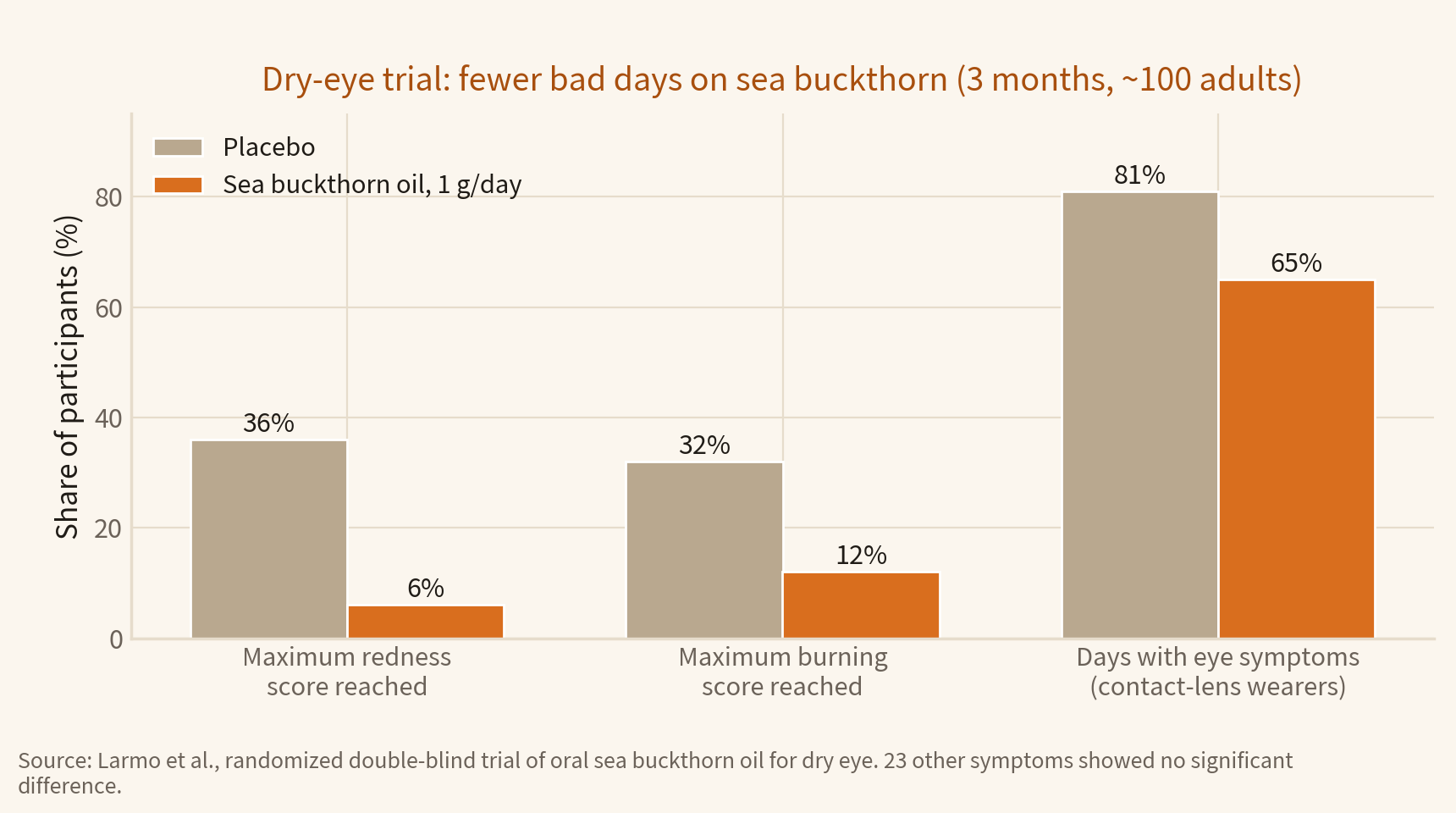
See the data behind this chart
| Outcome | Placebo | Sea buckthorn oil |
|---|---|---|
| Maximum redness score | 36% | 6% |
| Maximum burning score | 32% | 12% |
| Symptom days (contact-lens wearers) | 81% | 65% |
The design, and why it is the good kind
Participants aged 20 to 75 with dry-eye symptoms were randomized to 2 grams of sea buckthorn oil (1 gram twice daily with meals) or placebo for three months, run through winter, the season that punishes dry eyes hardest. The oil was a blend of seed and berry oil. Double-blinding meant neither participants nor measurers knew who got what. It is the best-designed study on the research desk.
That design is why this trial anchors the whole dry-eye claim. Randomization kills selection bias, blinding kills expectation effects, and winter timing gave the outcome room to actually happen.
The winter choice deserves a second look, because it is the quiet strength of the design. Dry eyes worsen in cold, dry air, so a three-month winter run is a three-month stress test: osmolarity will rise in almost everyone, and the question becomes who rises less. Run the same trial in a mild summer and both groups might drift nowhere, leaving nothing to measure. The season was the intervention’s sparring partner.
The results, including the fussy parts
Tear film osmolarity rose in both groups as winter bit, but the rise was significantly smaller in the sea buckthorn group. The detail worth printing: the effect was P=0.04 on intention-to-treat analysis (everyone randomized, compliant or not) and P=0.02 per-protocol (only the compliers). ITT is the stricter, more honest lens, and the effect survived it, if narrowly.
The two analyses answer two different questions. Per-protocol asks what the oil did in people who actually took it. Intention-to-treat asks what happened to everyone assigned to it, including the people who skipped doses, which is the question a real-world buyer is really asking. A result that only survives per-protocol lives or dies on perfect compliance. This one survived both, with more room to spare in the compliers.
Maximum redness score: 6 percent of the oil group hit the top score, versus 36 percent on placebo (P=0.04). Maximum burning: 12 versus 32 percent, and this is the one number people quote too confidently. In the intention-to-treat analysis it came in at P=0.05, which is not significant. The 0.04 usually attached to it belongs to the per-protocol analysis alone. Contact-lens wearers reported symptom days of 65 versus 81 percent.
The other 23 measured symptoms: no significant difference. Most sites quoting this trial omit that sentence. We keep it, because it tells you the benefit was real but targeted, worst days and a lab measure, not a cure for every sensation of dry eye. The practical version lives on our dry-eye page.
The numbers in everyday terms
Percentages from trials need translating before they mean anything. Of every 100 people on placebo, 36 had a day where redness hit the worst score. Of every 100 on the oil, 6 did. That is a large relative drop and also a statement about the worst days, not an average day, and not a promise that your eyes will feel 30 points better. The burning numbers read the same way, 32 of 100 placebo users hitting the top score against 12 of 100 on oil, with the extra asterisk that the gap did not clear significance once everyone assigned to the oil was counted. The 23 quiet symptoms are the other half of the picture: on most measures, most days, the groups looked alike.
The follow-up that complicated the story
In 2011 the same team analyzed tear-film fatty acids from the trial cohort, expecting the oil’s fatty acids to show up in the tears and explain the benefit. They did not. Tear-film fatty acid composition was the same in both groups, which means the benefit works through some other pathway, or indirectly, and nobody currently knows which. An honest mechanism is a question mark, and we print the question mark.
That failure-to-find matters more than it looks. The team had every incentive to confirm their own theory, access to the actual trial samples, and a published prediction riding on the outcome. When they reported the fatty acids had not moved, they spent their own credibility on a null. It is the single best reason to trust the positive results from the same lab: this group prints its question marks.
The replication status, stated plainly
One team ran this trial, and the same team ran the follow-up. No independent group has repeated it in the years since, which cuts both ways and only those two ways. The result has not been refuted: no trial has come back with a different answer. It has also not been confirmed by fresh hands, and single-lab findings carry single-lab risk. The grade on the grade sits at moderate precisely because of this paragraph, and the mechanisms page shows the same team honestly reporting the pathway they failed to find.
What replication would need
- An independent lab, ideally in a different climate, because one team’s result is a lead until someone else finds it too.
- More participants, since P=0.04 on the primary measure leaves little margin.
- All seasons, to separate the winter-specific effect from a general one.
- Mechanism endpoints that test routes beyond tear fatty acids.
One adjacent question rides along: whether people whose dry eyes come from an autoimmune condition would respond the same way. A small pilot in that population circulates in the literature, but it has not cleared our verification bar, so it appears nowhere in our grading. The safety review covers what three months at this dose meant for tolerability across the cohort.
Until then: one strong trial, moderate grade, and the studied 2-gram dose on the study dosages page. Two grams a day with meals works out to four 500 mg softgels, so the count on the label matters more than the brand on it. That count is the first thing our best sea buckthorn softgels roundup checks. The full trial inventory is in the clinical trials catalog.
Frequently asked questions
What did the sea buckthorn dry-eye study find?
In a randomized, double-blind, placebo-controlled trial of about 100 adults, 2 grams of sea buckthorn oil daily for 3 winter months blunted the seasonal rise in tear film osmolarity (P=0.04 intention-to-treat, P=0.02 per-protocol). The worst redness days hit 6 percent of the oil group versus 36 percent on placebo (P=0.04). Burning ran 12 versus 32 percent, but that one missed significance in the intention-to-treat analysis (P=0.05) and only reached P=0.04 per-protocol. The other 23 measured symptoms showed no significant difference.
Has the dry-eye trial been replicated?
Not by an independent group. The same research team ran a 2011 follow-up on tear-film fatty acids, which found no difference between groups, meaning the mechanism is still unexplained. One well-designed trial from one lab is a strong lead, not a settled fact, which is why we grade dry eyes as moderate evidence rather than strong.
How long until the oil helps dry eyes?
The trial ran three months before measuring, so three months is the only honest answer the evidence gives. It also ran through winter on purpose, when dry eyes worsen, which means the benefit showed up as a smaller seasonal decline rather than an overnight fix. Nobody has measured week two, and any product promising instant relief is ahead of the data.