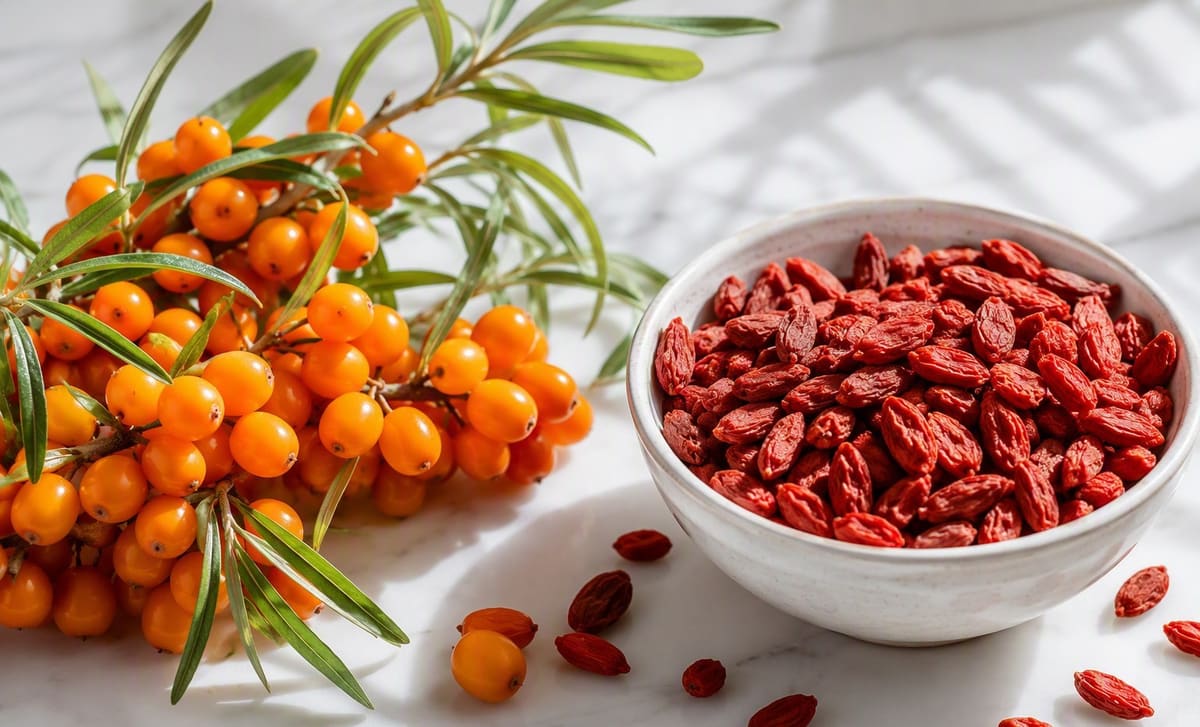
Goji and sea buckthorn are both orange berries with ancient traditions, and that is where the resemblance ends. Goji is the sweet one: a chewy, zeaxanthin-rich snack from Chinese medicine that works as food first. Sea buckthorn is the sour one: a vitamin C heavyweight whose oil carries the human trials. Snack versus supplement, with complementary strengths.
The comparison
| Sea buckthorn | Goji berry | |
|---|---|---|
| Taste | Intensely sour, acid-led | Sweet, mildly tart, chewy |
| Signature nutrient | Vitamin C 200-600 mg per 100 g fresh | Zeaxanthin (eye-health carotenoid) |
| Tradition | Tibetan and Mongolian medicine | Traditional Chinese medicine |
| Research strength | Oil RCTs: dry eyes, skin, vaginal dryness, lipids | Smaller human studies, nutrition first |
| Natural role | Supplement (oil) plus acid ingredient | Daily food: snacks, teas, soups |
| Sugar watch | Low in the fresh berry | Dried goji is sweet by nature |
Goji’s genuine charm
Dried goji berries earned their place: pleasant to eat straight, rich in zeaxanthin (the carotenoid concentrated in the retina), and versatile in teas, soups, and trail mix. The human research is smaller than the marketing suggests, but goji barely needs trials to justify itself, because it works as food. A daily handful is a reasonable habit by any nutrition standard.
The caution is the form: dried goji is naturally sweet, sweetened versions more so, and portion creep is easy with anything that tastes like candy.
Sea buckthorn’s different game
Nobody snacks on sea buckthorn for pleasure. The fresh berry is a burst of malic and quinic acid, as our juice nutrition page warns, and its vitamin C content (200 to 600 mg per 100 g fresh, variety dependent) dwarfs what goji offers. Its serious claims live in the oil: randomized trials for dry eyes, skin hydration, vaginal dryness, and blood lipids in abnormal ranges, all catalogued in the clinical trials catalog.
So the split is clean. Goji is the berry you eat. Sea buckthorn is the berry whose oil you take, and whose juice you dilute.
The tradition comparison
Both berries carry centuries of traditional medicine, goji in Chinese practice, sea buckthorn in Tibetan and Mongolian. Tradition tells you what generations found useful, and it does not tell you dose or proof. On that standard, goji’s food role is validated by everyday use, while sea buckthorn’s supplement role is validated by the small but controlled trial set, a pattern our amla comparison explores from the Ayurvedic side.
The kitchen test separates them daily. Goji slots into oatmeal, trail mix, and tea without a recipe, which is why people actually keep eating it. Sea buckthorn’s sour berries demand dilution, sweetening, or a capsule, and that friction is exactly why its serious use runs through measured supplement doses rather than handfuls.
What a daily handful actually delivers
A 20-gram handful of dried goji gives a little fiber, a little sugar, and a meaningful dose of zeaxanthin, the carotenoid concentrated in the retina, as the carotenoids page explains. It is a reasonable snack with an eye-health angle, no more and no less.
Sea buckthorn as food means the sour berry: 200 to 600 mg of vitamin C per 100 g fresh, flavonoids like quercetin and isorhamnetin, and organic acids sharp enough to demand dilution, covered on the juice nutrition page. As a supplement it means the oil. The two goji equivalents, snack and tea, simply do not exist for sea buckthorn in pleasant form.
The evidence, side by side
Goji’s human research is small: a handful of short studies on well-being, eye markers, and antioxidant status, mostly in older adults, mostly positive, none definitive. It is the classic profile of a traditional food with encouraging early data and no large trials.
Sea buckthorn’s oil file is the usual one on this site: a 15-trial lipid meta-analysis with benefits concentrated in abnormal ranges, the 100-person dry-eye trial, and smaller skin and vaginal studies, kept current in the clinical trials catalog. Neither berry has evidence for the sweeping claims in its marketing. One has more controlled measurements behind narrower claims.
Cost and availability, honestly
Dried goji is cheap to mid-priced and sold everywhere from supermarkets to bulk bins. Sea buckthorn’s retail forms are pricier: juice concentrates and dried berries are mid-priced imports, the oil is mid to premium, and fresh berries are a farmers-market rarity outside growing regions, as the fresh vs dried vs powder page maps out. Goji is the cheaper daily habit by far.
The lane question
Goji is kitchen lane: snack, tea, oatmeal, soup. It is also the only one of the two a child will eat voluntarily, which counts for more than any nutrient table. Sea buckthorn is supplement lane for the oil and specialty-kitchen lane for juice and powder. Households that want one orange berry for the pantry should buy goji. People chasing a specific tested benefit should price the oil, and the acai comparison applies the same food-first test to another hyped berry.
Choose goji berry if
- You want a pleasant daily berry habit: snacks, oatmeal, tea.
- Zeaxanthin-rich whole food appeals more than capsules.
- You will keep portions honest, since dried fruit is easy to overeat.
Choose sea buckthorn if
- You want the vitamin C heavyweight, as juice or powder, per the vitamin C page.
- Dry eyes, skin, vaginal dryness, or abnormal lipids are the goal, via the studied oil doses on the dosage page.
- You prefer measured trials over marketing warmth.
More matchups live on the comparisons hub.
Frequently asked questions
Which is healthier, goji berries or sea buckthorn?
They shine in different places. Sea buckthorn berries carry far more vitamin C (roughly 200 to 600 mg per 100 g fresh, versus modest amounts in goji) and an oil with human trials behind dry eyes, skin, and lipids. Goji berries are the pleasant snack: sweet, chewy, rich in zeaxanthin, and easy to eat daily. For targeted supplement goals, sea buckthorn. For a daily handful, goji.
Can you eat goji and sea buckthorn together?
Yes, and they complement each other well: goji brings the sweetness sea buckthorn lacks, sea buckthorn brings the vitamin C and acidity goji lacks. Trail mixes and smoothie bowls use both for exactly that reason. Watch only the sugar in sweetened dried versions of either berry.
Which berry has more vitamin C, goji or sea buckthorn?
Sea buckthorn, and it is not close. Fresh sea buckthorn berries carry roughly 200 to 600 mg of vitamin C per 100 g depending on variety, while goji's vitamin C is modest and drops further in dried form. If vitamin C density is the goal, sea buckthorn juice or powder wins easily. Goji's real strength is being the berry people actually enjoy eating.