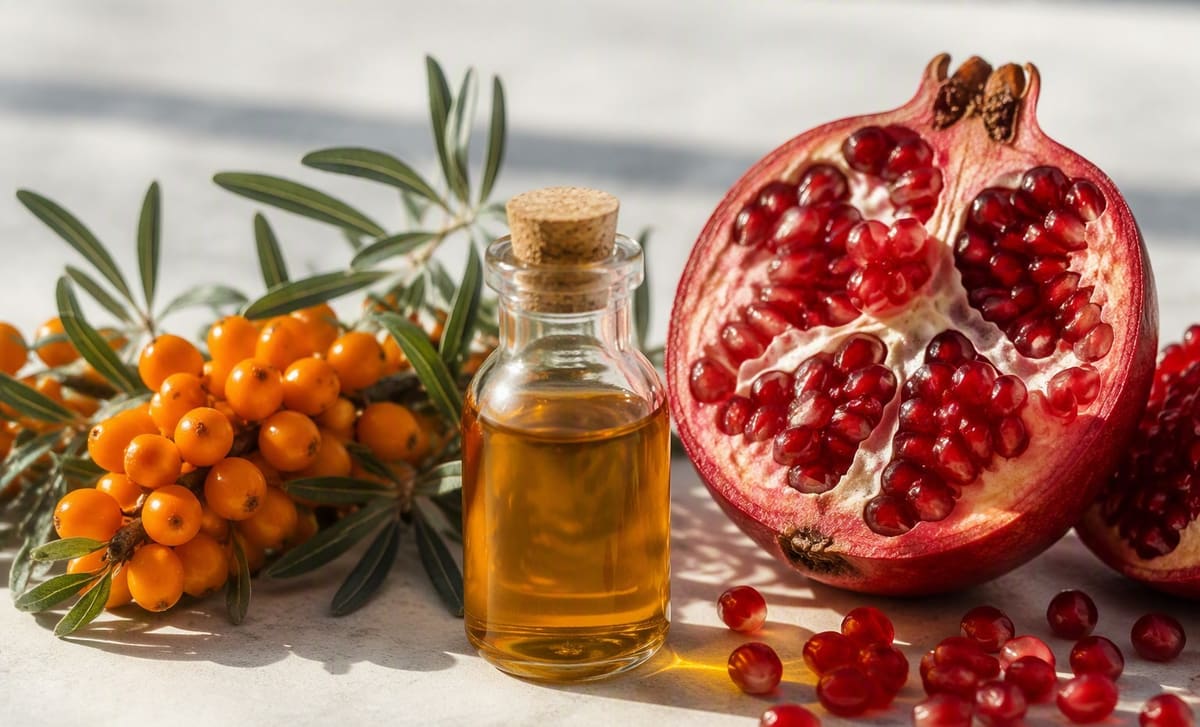
Pomegranate seed oil is the elegant niche player: punicic acid, antioxidant cachet, no pigment, and a price that reflects how little oil a seed holds. Sea buckthorn berry oil is the louder one: omega-7, deep orange carotenoids, and human skin trials behind the oral form. As topicals they are comparable luxuries. On evidence, sea buckthorn plays a different league.
The comparison
| Sea buckthorn (berry / seed oil) | Pomegranate seed oil | |
|---|---|---|
| Signature fat | Palmitoleic omega-7 / linoleic + ALA | Punicic acid (conjugated omega-5) |
| Pigment | Deep orange, can tint and stain | Pale, no staining |
| Skin evidence | Oral-oil RCTs: hydration, elasticity, collagen density | Lab research and tradition; no major human skin RCTs |
| Texture | Rich, slow-absorbing berry oil; light seed oil | Rich but elegant, fast for a heavy oil |
| Price | Mid to premium | Premium (tiny seeds, low yield) |
| Best role | Night treatment oil; oral supplement | Luxury facial oil, no tint management |
Pomegranate’s quiet competence
Punicic acid gives pomegranate seed oil a genuinely unusual fatty acid profile, and the lab research behind it is interesting. The oil feels elegant, carries no color, and suits people who want a rich facial oil without the orange aftermath. What it lacks is human skin trials: its reputation rests on chemistry and tradition, not on measured outcomes in people.
That is not a scandal. It is the normal state of niche cosmetic oils, and pomegranate is no worse than most. It is simply priced like the evidence is in, and the evidence is not.
One quirk worth knowing before you buy: pomegranate seed oil is thick and slow-pressed from tiny seeds, so genuine versions cost real money and cheap versions deserve suspicion. A bargain bottle is usually diluted with a carrier oil, and the ingredient list will tell you if you read past the front label.
Sea buckthorn’s evidence edge
Sea buckthorn’s skin claims come with receipts, modest and caveated but real. Oral oil at 1 to 2 grams daily improved instrument-measured hydration in two trials, with elasticity and collagen density improving in one each, as dissected on the skin studies page. The berry oil’s omega-7 content (15 to 54 percent of fatty acids) and carotenoid load are among the richest measured in plant oils.
The price of that chemistry is pigment management: the berry oil tints skin and stains fabric, which is why the face oil technique matters and why some users pick the pale seed oil for daytime. Pomegranate never asks any of that from you.
What each oil actually contains
Pomegranate seed oil is built on punicic acid, a conjugated omega-5 fatty acid found almost nowhere else in quantity, with a thick texture and strong antioxidant assays behind it. One rare molecule, carried in an elegant pale oil.
Sea buckthorn berry oil counters with breadth: palmitoleic omega-7 at 15 to 54 percent, palmitic and oleic fats, and carotenoids dense enough to stain fabric, per the fatty acid profile page. The seed oil adds a near 1:1 omega-6 to omega-3 option for daytime. Rare molecule versus rare profile, and only one of them tints.
The evidence, side by side
Pomegranate seed oil’s file is laboratory chemistry: punicic acid is genuinely unusual, the antioxidant assays are real, and the tradition is long. What it lacks is the step that matters here, controlled human trials measuring skin or health outcomes from the oil itself. Its cousin the juice has some human data. The seed oil mostly does not.
Sea buckthorn’s skin file is the site’s standard: small randomized trials where oral oil at 1 to 2 grams daily improved instrument-measured hydration, with elasticity and collagen density improving in one trial each, dissected on the skin studies page. One-to-two-trial lanes, industry funding caveats, no large replications. Measured beats unmeasured, and both files stay short of strong.
Cost and availability, honestly
Both are premium niche oils, and both earn suspicion at bargain prices. Pomegranate seed oil is expensive because the seeds hold little oil and pressing is slow. Sea buckthorn berry oil is expensive for the same structural reason, low yield per berry, and dilution with carriers is common enough that the fake oil guide stays busy. Used a few drops at a time, either bottle lasts months, which softens the sticker price into a per-use cost most routines can absorb.
The lane question
Both oils are topical-lane luxuries, and sea buckthorn adds the supplement lane where its trials actually live. Neither belongs in a kitchen. The practical split mirrors the marula comparison: the pigment-free elegant oil for day, the pigmented treatment oil for night. Pomegranate is the day oil in that pairing when staining is the dealbreaker. Sea buckthorn is the night oil when the omega-7 and carotenoid story, detailed on the omega-7 page, is the point.
Choose pomegranate seed oil if
- You want a rich, pigment-free facial oil and accept chemistry-plus- tradition as the evidence tier.
- Elegant feel and zero staining matter more than trial data.
- Budget allows a premium oil used a few drops at a time.
Choose sea buckthorn if
- You want the skin lane with human trials, oral or topical, at the studied doses on the study dosages page.
- The omega-7 and carotenoid profile appeals, and you will manage (or dodge, via seed oil) the tint.
- You have already read sea buckthorn vs argan oil and want the antioxidant-oil tier compared.
More matchups live on the comparisons hub.
Frequently asked questions
Is pomegranate seed oil or sea buckthorn oil better for skin?
For topical use, they are both antioxidant-rich facial oils with different signatures: pomegranate brings punicic acid and no pigment, sea buckthorn berry oil brings omega-7 and an orange tint that needs managing. For the evidence-led route, sea buckthorn pulls ahead, because oral sea buckthorn oil has human trials measuring improved skin hydration, elasticity, and collagen density, while pomegranate oil's skin story is mostly lab and tradition.
Can I mix pomegranate seed oil and sea buckthorn oil?
Yes, and formulators do. A few drops of sea buckthorn berry oil blended into a lighter, pigment-free oil like pomegranate gives you the omega-7 and carotenoid story at a dilution that will not stain your pillowcase. Patch test the blend for a week before full-face use, as with any new oil.
Which oil is better value, pomegranate or sea buckthorn?
Neither is cheap, but they price differently. Pomegranate seed oil is premium because tiny seeds yield little oil, and its evidence is chemistry plus tradition. Sea buckthorn berry oil sits mid to premium with human skin trials behind the oral route. Per dollar of measured evidence, sea buckthorn. Per drop of pigment-free luxury, pomegranate.