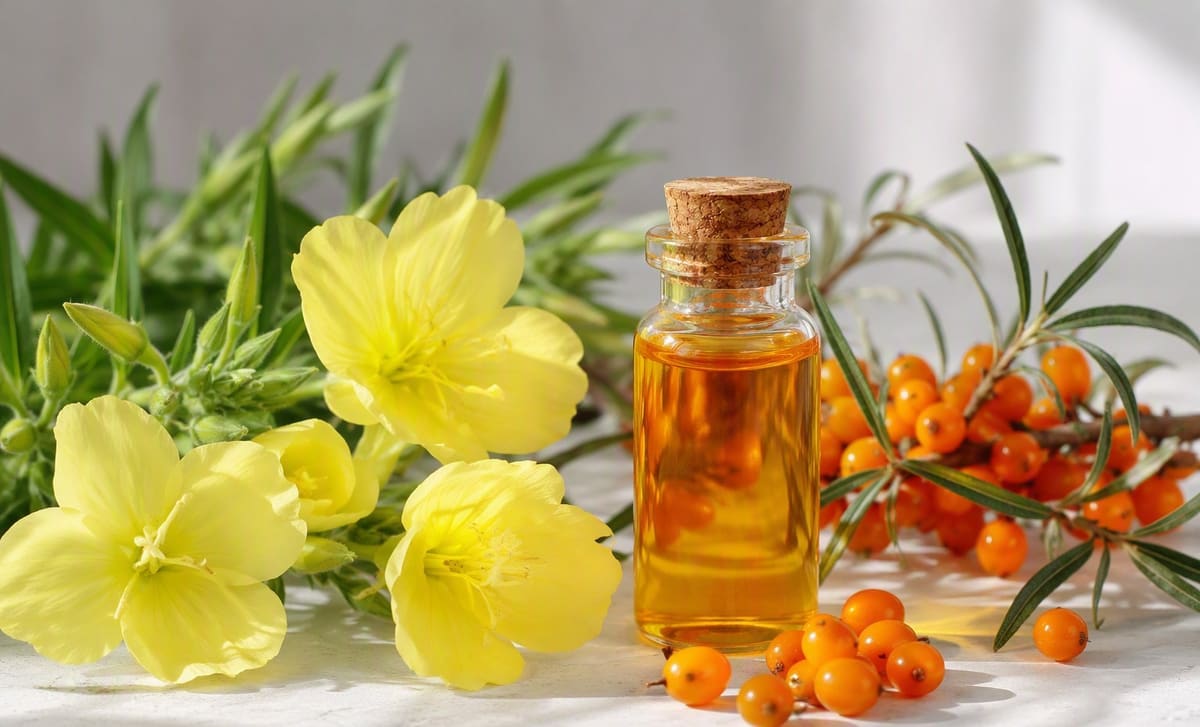
Evening primrose oil built its name on GLA and decades of women’s-health tradition, and reviews of its menopause trials have found little consistent benefit. Sea buckthorn arrived with one well-designed trial in the exact lane: 116 postmenopausal women, 3 grams of oil daily, measurably better vaginal dryness than placebo. Tradition versus one real trial, and the contrast is the whole story.
The comparison
| Sea buckthorn oil | Evening primrose oil | |
|---|---|---|
| Signature fat | Omega-7 (palmitoleic), berry oil | GLA, an omega-6 |
| Women's-health claim | Vaginal dryness, postmenopause | PMS, breast pain, hot flashes |
| Human evidence there | One placebo-controlled RCT: positive | Reviews find little consistent benefit |
| Other researched lanes | Dry eyes, skin, lipids | Eczema claims, also weak on review |
| Mechanism story | Mucosal support, non-estrogenic | Prostaglandin pathways, theorized |
| Typical dose | 3 g/day in the vaginal trial | 1-3 g/day typical products |
Evening primrose’s problem: the reviews
GLA is a real and interesting fatty acid, and evening primrose oil has been the default “women’s supplement” for two generations. The trouble is what happened when the trials were gathered: reviews of its use for hot flashes and PMS have repeatedly found little consistent benefit over placebo. The tradition is warm, the measurements are cold, and millions of bottles sell in the gap between them.
That does not make it dangerous, just weakly supported for its most famous claims. It is the supplement aisle’s clearest example of reputation outliving evidence.
The GLA mechanism is at least plausible, which is part of the trap. Gamma-linolenic acid feeds prostaglandin pathways that plausibly relate to the claimed benefits, and plausible mechanisms keep selling products long after trials disappoint. Plausible plus measured is evidence. Plausible alone is marketing copy.
Sea buckthorn’s one solid card
The vaginal dryness trial is the opposite profile: unknown to most shoppers, but methodologically real. Postmenopausal women took 3 grams of sea buckthorn oil daily for three months. Vaginal epithelial integrity improved about three times more than placebo, while vaginal pH and maturation index stayed unchanged, meaning the benefit works through a non-estrogenic pathway, the key point for women avoiding hormones. The full context lives on our women’s health hub.
One trial is one trial, and we grade it moderate, not strong. But a single placebo-controlled positive beats a decade of uncontrolled tradition every day of the week.
What each oil actually contains
Evening primrose oil is a one-note oil, and the note is GLA: gamma-linolenic acid at roughly 8 to 10 percent, an omega-6 the body can route toward prostaglandin pathways. The rest is mostly ordinary linoleic acid. Everything the product claims flows from that single molecule.
Sea buckthorn’s relevant oil, the berry fraction, is built on palmitoleic omega-7 at 15 to 54 percent of fatty acids, with palmitic and oleic fats plus carotenoids, tabulated on the omega-7 page. No GLA to speak of. Different bottle, different molecule, different claim.
Beyond menopause: the other claims
Both oils carry secondary claims worth grading. Evening primrose’s eczema lane was tested hard in the 1980s and 1990s, and systematic reviews found the benefit small to absent. Its breast-pain and PMS claims sit in the same weak-review territory. The tradition persists because the hope is real and the oil is cheap, and because a plausible mechanism keeps selling products long after the trials disappoint.
Sea buckthorn’s secondary lanes have better luck: the 100-person dry-eye trial and the small instrument-measured skin trials are positive, with the honest caveat that they are one trial each, detailed in the clinical trials catalog. Neither oil has evidence worth building a medical plan around. One has a few measured positives and the other has mostly measured nulls. The menopause page places the vaginal trial inside the wider hormone-free conversation.
Cost and availability, honestly
Evening primrose oil is one of the cheapest specialty oils in the supplement aisle, widely sold in softgels for decades. Sea buckthorn oil runs mid-priced to premium at the studied 3-gram daily dose, and a bottle empties faster than the label serving suggests, so price per studied day matters more than price per capsule. Quality varies with sourcing, which is why the buying guide exists. On a tight budget the honest move is not to buy the cheaper oil for the other oil’s job. It is to match the oil to the goal, or skip both.
The lane question
Both are supplement-lane oils taken as softgels, and neither has a kitchen or topical lane worth discussing. Both also share the same shelf rule: cool, dark, sealed, and replaced when the smell turns. The omega-7 research page covers where the sea buckthorn molecule’s story stands today, with the same one-trial-deep honesty applied everywhere else on this site.
Choose evening primrose oil if
- Your grandmother’s recommendation and your own experience matter more to you than pooled reviews, and the price is low enough to test honestly.
- You track a specific symptom for 8 to 12 weeks and keep it only if it clearly earns its place.
Choose sea buckthorn if
- Vaginal dryness is the actual goal, since that is where the placebo-controlled trial points. The studied 3-gram dose is on the study dosages page.
- You want a non-estrogenic option to discuss with your doctor.
- The wider trial lanes (dry eyes, skin, lipids) add value for you, per the clinical trials catalog.
More matchups live on the comparisons hub.
Frequently asked questions
Is sea buckthorn or evening primrose oil better for menopause symptoms?
For vaginal dryness specifically, sea buckthorn has the better card: a randomized, placebo-controlled trial of 116 postmenopausal women found 3 grams of oil daily improved vaginal epithelial integrity about three times more than placebo over 3 months, through a non-estrogenic pathway. Evening primrose oil's menopause claims rest on tradition, and reviews of its hot-flash trials found little consistent benefit. Neither replaces medical menopause care.
What is the difference between GLA and omega-7?
GLA (gamma-linolenic acid) is an omega-6 fatty acid, evening primrose oil's signature, tied to traditional women's-health use. Omega-7 (palmitoleic acid) is a rare fatty acid concentrated in sea buckthorn berry oil, tied to the mucosal dryness research. Different molecules, different claims, and only one of the two oils has a placebo-controlled trial for vaginal dryness.
Can I take evening primrose oil and sea buckthorn oil together?
At standard doses there is no known conflict, and their traditional uses overlap little. Both are concentrated fatty-acid supplements, so start one at a time, give each a fair 8 to 12 week trial with symptom tracking, and mention both to your doctor if you take any regular medication, especially anything affecting clotting.