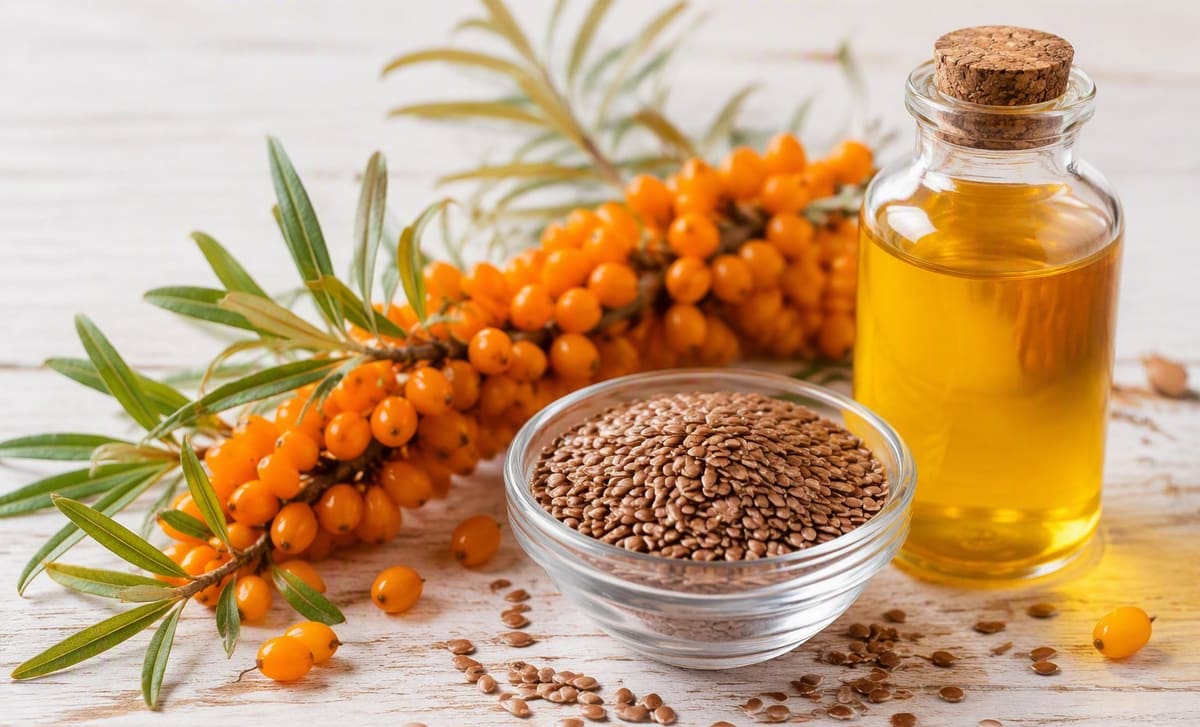
Flaxseed oil is the plant omega-3 champion: roughly half its fat is ALA, the highest concentration on the common shelf. Sea buckthorn answers with two different oils: a berry oil built on omega-7 (which flax lacks entirely) and a seed oil with less ALA than flax but an unusually balanced omega ratio. For pure omega-3 intake, flax wins. For the researched dry-eye, skin, and lipid benefits, sea buckthorn is the one with trials.
The comparison
| Sea buckthorn (berry / seed oil) | Flaxseed oil | |
|---|---|---|
| Source | Berry pulp, or seeds, of a cold-climate shrub | Flax (linseed) seeds |
| Omega-3 (ALA) | 1-3% / 20-35% | Around 50-60% |
| Omega-6 | 2-10% / 30-40% | Around 15% |
| Omega-7 | 15-54% / trace | None |
| Omega ratio | Seed oil near 1:1 (3:6) | Skewed to omega-3, which most diets lack |
| Human trial lane | Dry eyes, skin, vaginal dryness, lipids in abnormal ranges | General nutrition; lipid effects modest and mixed |
| Fragility | Berry oil fairly stable; seed oil delicate | Very delicate. Refrigerate, buy small |
The ALA conversion problem, in plain words
Both oils deliver plant omega-3 as ALA, and ALA is not the omega-3 your body actually uses for the famous cardiovascular jobs. Those are EPA and DHA, the marine forms, and the human body converts only a small fraction of ALA into them. Spoon for spoon, flax gives you more ALA to convert from, but neither oil delivers EPA or DHA directly. If marine omega-3s are the goal, fish or algae oil is the honest route, as our fish oil comparison lays out.
Where sea buckthorn plays a different game
Flax is a one-note oil: superb at that note, quiet elsewhere. Sea buckthorn splits into two products. The berry oil carries omega-7 at 15 to 54 percent of fatty acids, among the richest plant sources known, plus the carotenoids behind its color. The seed oil offers less ALA than flax but pairs it with omega-6 at nearly 1:1, a balance almost no common oil manages. Hemp seed oil sits between the two at roughly 3:1, weighed in sea buckthorn vs hemp oil. The full split lives on the seed oil vs berry oil page.
The bigger separator is human trials. Sea buckthorn has randomized studies behind dry eyes, skin hydration, vaginal dryness, and blood lipids in people with abnormal levels. Flaxseed oil’s human evidence is real but modest and mixed on lipids, with no comparable lane for eyes or skin.
What each oil actually contains
Flaxseed oil is the simplest story in the oil aisle: roughly half alpha-linolenic acid, the plant omega-3, with modest omega-6 and little else of note. Whole and milled flaxseed add lignans and fiber, but the oil itself is an ALA delivery system, nothing more. It does that job superbly.
Sea buckthorn splits in two. The seed oil carries 20 to 35 percent ALA paired with 30 to 40 percent linoleic acid, a near 1:1 ratio almost no common oil matches, plus vitamin E, as the fatty acid profile page tabulates. The berry oil is a different product entirely: omega-7 at 15 to 54 percent, carotenoids, almost no ALA. Anyone comparing flax against sea buckthorn should first ask which sea buckthorn oil, via the seed oil vs berry oil page.
The evidence, side by side
Flaxseed oil’s human data is real but modest: small trials and pooled analyses find small lipid effects, inconsistent across studies, and no condition where it is the tested, recommended answer. Its stronger case is nutritional, as a practical way to raise ALA intake.
Sea buckthorn’s file is narrower and sharper: a 15-trial meta-analysis found lipid improvements concentrated in people with abnormal levels, with nulls for glucose, blood pressure, and BMI, per the cholesterol meta-analysis page. The dry-eye trial page shows what a real condition-specific trial looks like, and flax has no equivalent. Neither oil has large independent long trials, and neither replaces medical lipid care.
Cost and availability, honestly
Flaxseed oil is cheap to mid-priced, sold in every health store, and should be bought small and kept cold because it oxidizes fast. Sea buckthorn oil is mid to premium, mostly online, with quality spread wide enough to justify the buying guide. Its berry oil keeps reasonably well for an unsaturated oil, though light still fades the carotenoids. Per gram of ALA, flax wins without contest. Per tested supplement lane, sea buckthorn is the only one with lanes.
The lane question
Flaxseed oil straddles kitchen and supplement: a finishing oil for salads that doubles as a softgel staple, never heated. Households that finish a bottle before it turns are doing the hardest part right. Sea buckthorn is supplement lane, plus a topical lane for the berry oil. Neither belongs near heat, and the omega-3-6-9 explainer maps where each fat lands once swallowed.
Choose flaxseed oil if
- You want maximum plant ALA per dollar and per spoon.
- You will actually refrigerate it and finish it fresh, because it oxidizes fast.
- Your goal is general fatty-acid nutrition, not a specific trial-backed benefit.
Choose sea buckthorn if
- Dry eyes, skin, or vaginal dryness are the target, since those trials used this oil, never flax. Doses live on the study dosages page.
- You want the omega-7 story flax cannot tell, or a seed oil with a balanced ratio.
- Your lipids are abnormal and you want the oil with pooled trial data behind it, covered on the cholesterol page.
Using both is legitimate: flax in the salad dressing, sea buckthorn in the softgel. More matchups live on the comparisons hub.
Frequently asked questions
Is flaxseed oil or sea buckthorn oil better for omega-3?
Flaxseed oil, by a wide margin. It is the richest common plant source of alpha-linolenic acid (ALA), at roughly half its fatty acids. Sea buckthorn seed oil carries a respectable 20 to 35 percent ALA with an unusually balanced omega-6 ratio, and the berry oil carries almost none. Both lose to fish or algae oil, because ALA converts poorly to the marine EPA and DHA forms.
Can I replace flaxseed oil with sea buckthorn seed oil?
For general plant-omega intake, yes: sea buckthorn seed oil delivers ALA at a lower share but in a near 1:1 ratio with omega-6, which flax does not offer. For maximum ALA per spoon, no, flax wins. The real question is the goal: omega-3 intake points to flax, the dry-eye and skin research points to sea buckthorn's berry oil or blends.
Is flaxseed oil or sea buckthorn oil better for dry eyes?
Sea buckthorn, on direct evidence. A randomized placebo-controlled trial of about 100 adults found 2 grams of sea buckthorn oil daily for three months improved dry-eye symptoms and tear osmolarity measures. Flaxseed oil has no comparable dry-eye trial. If dry eyes are the target, the studied oil is sea buckthorn, at the dose the trial used.