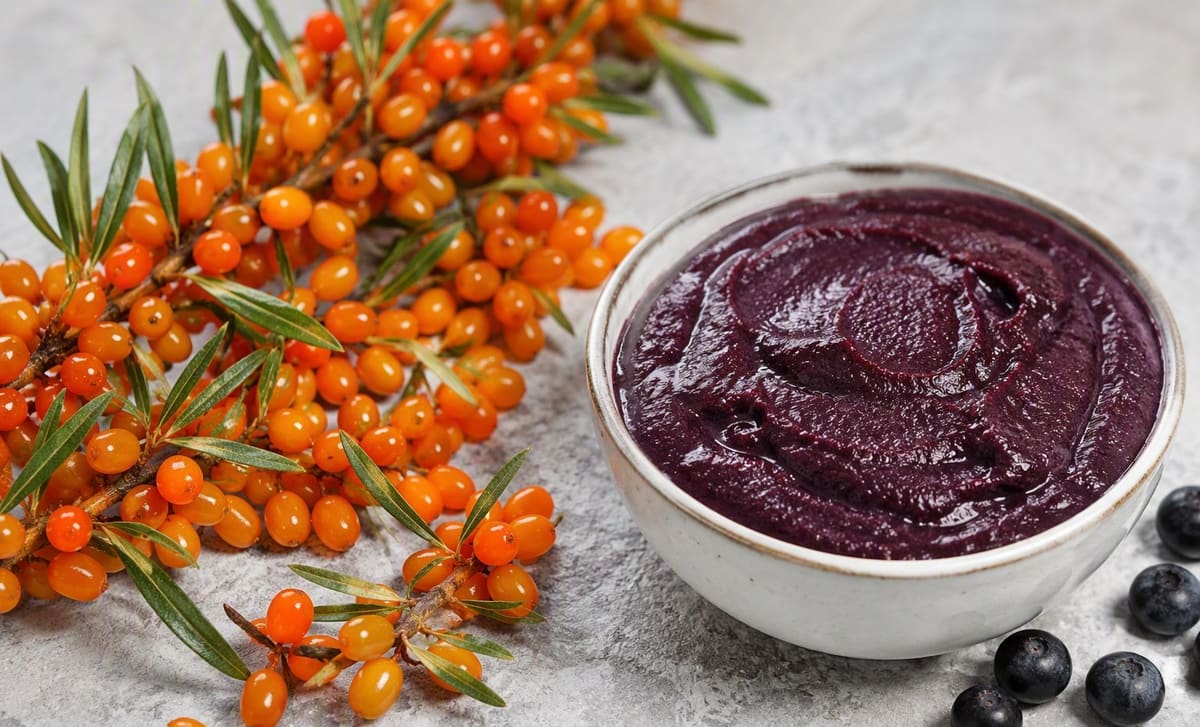
Acai is the berry that taught the world to be skeptical of berries: genuine anthocyanin-rich fruit buried under years of multi-level marketing and weight-loss claims it never earned. Sea buckthorn is a similar profile with a better paper trail: real vitamin C, a trial-backed oil, and hype of its own to watch. The antioxidant-marketing skepticism applies to both, and we apply it to ourselves.
The comparison
| Sea buckthorn | Acai | |
|---|---|---|
| Origin | Cold-climate Eurasian shrub | Amazonian palm fruit |
| Signature chemistry | Vitamin C, omega-7 oil, carotenoids, flavonoids | Anthocyanins (purple pigments) |
| Marketing history | Miracle-berry claims, ongoing | MLM waves, weight-loss claims, regulator action |
| Human outcome trials | Yes: dry eyes, skin, vaginal dryness, lipids | Essentially none for marketed claims |
| Honest role | Oil supplement plus sour ingredient | Frozen pulp and smoothie bowls, food first |
| Perishability | Fresh berries rare; frozen keeps value | Perishes in a day; sold frozen or powdered |
Chapter one: the acai lesson
Acai is a legitimately nutritious Amazonian fruit, rich in anthocyanins, and in its home region it is food, not medicine. Exported, it became the 2000s’ defining berry scheme: freeze-dried powders and juices sold through multi-level marketing with weight-loss and detox promises, until regulators chased the worst of it. The fruit was fine. The claims were fiction, and the machinery that sold them is now the case study every honest berry writer cites. Goji berry rode the same superfood wave a few years later, and the sea buckthorn versus goji berry comparison runs the same food-first test on it.
What acai actually offers a modern shopper is simple: a deep-purple, pleasantly earthy frozen pulp that makes smoothie bowls worth eating, at a fair price, from a fruit that perishes too fast to ship fresh. Bought as food, it needs no defense.
Chapter two: same skepticism, applied inward
Sea buckthorn attracts the same vocabulary: miracle berry, antioxidant giant, ancient secret. Our rule on this site is that the chemistry is real and the slogans are not. Yes, the berries carry 200 to 600 mg of vitamin C per 100 g and the oil is rich in carotenoids. And the antioxidant scores once used to rank berries, acai famously topping them, were retired by the USDA because test-tube values never predicted health effects. The full argument is on our antioxidants and ORAC page.
What separates the two berries today is outcome data. Sea buckthorn has randomized human trials for dry eyes, skin, vaginal dryness, and blood lipids in abnormal ranges, catalogued in the clinical trials catalog. Acai’s marketed claims never accumulated anything comparable.
What each one actually contains
Acai’s chemistry is genuine, whatever the marketers did with it. The pulp is rich in anthocyanins, the purple pigments it shares with blueberries and black rice, plus a fatty acid profile closer to olive oil than to most fruit. What it lacks is a standout nutrient: no headline vitamin, no rare fatty acid that other foods cannot supply.
Sea buckthorn runs the other way. Fresh berries carry 200 to 600 mg of vitamin C per 100 g, among the highest figures measured in any fruit, as the vitamin C page details. The berry oil adds carotenoids at concentrations among the richest in plant oils, plus palmitoleic acid (omega-7) at 15 to 54 percent of fatty acids, a fat almost no other food concentrates, covered on the omega-7 page.
The evidence, side by side
Acai’s human research is mostly small absorption studies showing its anthocyanins reach the blood, which was never really in doubt. Trials measuring outcomes in people, for weight, energy, skin, or anything the classic ads promised, never materialized. The fruit’s reputation was built on ORAC scores and testimonial marketing, and the USDA retired the ORAC rankings precisely because they did not predict body effects.
Sea buckthorn’s file is smaller than its marketing suggests and larger than acai’s by a distance. A meta-analysis of 15 randomized trials found blood lipid improvements concentrated in people with abnormal levels, with nulls for glucose, blood pressure, and BMI. A 100-person placebo-controlled trial found 2 grams of oil daily eased dry-eye symptoms over three months. Smaller trials cover skin hydration and vaginal dryness. All of it is catalogued with caveats in the clinical trials catalog.
Cost and availability, honestly
Frozen acai pulp is a mid-priced freezer item in most Western countries, powders run cheap to mid, and supply is stable. Sea buckthorn oil sits mid to premium as a supplement, juice concentrates are mid-priced imports, and fresh berries barely exist in retail anywhere. Neither requires a specialty importer, but neither is a two-dollar daily habit in its serious form.
The lane question
Acai lives squarely in the kitchen lane: smoothie bowls and pulp, food first, judged as food. Sea buckthorn splits lanes. The juice and powder are kitchen ingredients for people who tolerate sour, while the oil is a supplement taken at gram-measured doses. Buy acai like food and sea buckthorn oil like a supplement, and both purchases make sense.
Choose acai if
- You want a genuinely tasty frozen pulp for smoothie bowls, bought as food, not medicine.
- You enjoy it and ignore the legacy hype, which has mostly burned off anyway.
Choose sea buckthorn if
- You want the berry with human trials behind specific benefits, at the studied doses on the study dosages page.
- Vitamin C density or the omega-7 oil story fits your goals, per the nutrition hub.
- You appreciate a site that grades its own plant as harshly as the competition.
More matchups live on the comparisons hub.
Frequently asked questions
Is acai or sea buckthorn better for antioxidants?
Both are antioxidant-rich, and neither should be bought on a score. Acai's anthocyanins and sea buckthorn's carotenoids, flavonoids, and vitamin C are all real chemistry. The ORAC-style numbers once used to rank them were retired by the USDA because test-tube values never predicted body effects. The better question is which has human outcome trials, and there sea buckthorn has the deeper file.
Why was acai so heavily marketed?
Acai became the template for berry hype in the 2000s: a perishable Amazonian fruit, sold as frozen pulp and powder through multi-level marketing waves that promised weight loss and detox it never delivered. Regulators eventually chased the worst claims. The lesson generalizes: judge any berry, sea buckthorn included, by measured human trials, not by antioxidant slogans.
Which is better for skin, acai or sea buckthorn?
Sea buckthorn, on the evidence. Oral sea buckthorn oil improved instrument-measured skin hydration and elasticity in small randomized trials, while acai's skin reputation rests on antioxidant chemistry and lab work, not human outcome trials. As food, acai bowls are still a fine habit. As a skin supplement, acai has no comparable file.