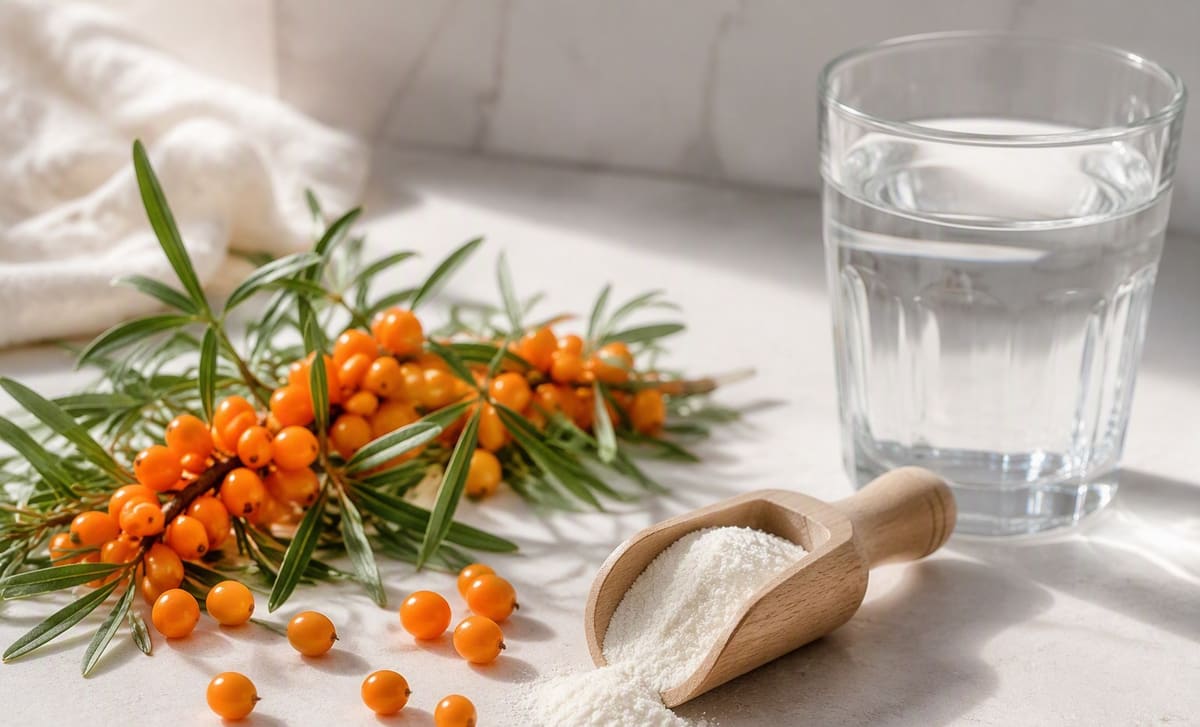
Collagen peptides have the bigger direct evidence for skin elasticity and hydration: dozens of randomized trials, most industry-funded, with modest but repeated effects. Sea buckthorn’s collagen story is one small placebo-controlled trial (collagen density up 10 percent at 1 gram of oil daily) plus a cofactor argument through vitamin C. Comparable goals, different mechanisms, and honest caveats on both sides.
The comparison
| Sea buckthorn oil | Collagen peptides | |
|---|---|---|
| What it is | Pressed berry or seed oil | Hydrolyzed collagen (bovine or marine) |
| Proposed mechanism | Fatty acids, carotenoids, antioxidants support skin | Peptides supply glycine, proline, hydroxyproline |
| Skin evidence | One placebo-controlled trial: collagen density +10%; older trial: elasticity +26% (no placebo) | Dozens of RCTs on elasticity and hydration, mostly industry-funded |
| Effect size honesty | Small trials, one industry-funded | Modest average effects, industry money throughout |
| Vitamin C angle | Berries are rich in it (oil is not) | Needs dietary vitamin C as synthesis cofactor |
| Extra lanes | Dry eyes, lipids, vaginal dryness trials | Some joint and nail studies |
| Typical daily cost | About $0.60-1.50 at studied doses | Similar range for 10-15 g peptides |
What collagen supplements actually are
Hydrolyzed means pre-digested: the long collagen protein is broken into short peptides, which is why these powders dissolve into coffee and why gelatin, the unhydrolyzed cousin, is a different product entirely. The pitch: those peptides (glycine, proline, hydroxyproline) supply the raw building blocks skin uses to make its own collagen, and some may signal skin cells directly.
The evidence is real but needs honest framing. Randomized trials do exist, dozens of them, finding modest improvements in skin elasticity and hydration over 8 to 12 weeks. The caveats: much of the literature is industry-funded, effects average out to “noticeable on instruments more than mirrors,” and your body decides where absorbed amino acids go, not the marketing department. Collagen is a legitimate, imperfect option, not a facelift in a scoop.
Source matters for shoppers more than for results: bovine collagen comes from cattle hides, marine from fish skin and scales, and the trial literature does not crown a winner between them. Marine costs more and suits pescatarians, bovine is the budget default. What does not exist is vegan collagen, since collagen is by definition an animal protein. Products sold under that name are amino acid blends or “collagen boosters,” a different thing wearing the same label. At the studied 10 to 15 grams a day, a standard tub is a month-long habit, which makes the cost-per-day comparison with softgels fairer than bottle prices suggest.
Sea buckthorn’s smaller, different file
Sea buckthorn’s direct collagen evidence is one trial: in 2024, 40 women taking 1 gram of oil daily for 12 weeks measured a 10 percent increase in skin collagen density against placebo. Small, industry-funded, but placebo-controlled. An older 2009 trial (2 grams daily, no placebo group) measured elasticity up about 26 percent and hydration up about 49 percent. Both are covered on our collagen page.
Then there is the cofactor argument. Vitamin C is required for collagen synthesis, and sea buckthorn berries are rich in it (200 to 600 mg per 100 g). But note the fine print: the vitamin C lives in the berries and juice, not the oil softgels. If cofactor support is your plan, the berry powder or juice is the form that delivers it, and our vitamin C explainer has the numbers.
The mechanisms, side by side
These two products do not actually do the same thing, and the difference decides who should buy what. Collagen peptides are supply: they deliver the exact amino acids skin uses as collagen raw material, absorbed and redistributed wherever the body needs protein. Sea buckthorn oil is support: fatty acids and carotenoids that feed the skin barrier and the lipid layers collagen lives in, plus antioxidants that may slow the damage side of the equation. Supply versus support is why the stacking logic below is genuine rather than marketing. Neither mechanism is proven to matter at the mirror level, which is why both literatures lean on instruments rather than selfies.
The funding caveat cuts both ways
Honesty requires saying this plainly: most collagen trials are funded by collagen companies, and the sea buckthorn collagen trial was industry-funded too. Industry money does not fake a result, but it chooses which questions get asked and published. On both sides, effect sizes are modest, trials run 8 to 12 weeks, and nobody has data on whether benefits persist after you stop. Independent replications are the fix, and both lanes need more of them. Treat either product as a modest nudge with a receipt, not a transformation with a guarantee.
Cost and format, honestly
Collagen peptides run about the same monthly cost as sea buckthorn oil at studied doses, so price rarely decides this one. Format might: collagen is a powder you must dissolve into something daily, sea buckthorn is a softgel you swallow in two seconds. The powder wins for people with a stable coffee or smoothie ritual. The softgel wins for everyone whose mornings are chaos.
Choose collagen peptides if
- You want the larger, more repeated (if industry-flavored) trial literature for skin elasticity.
- You also care about its joint and nail research lanes.
- You want a tasteless powder that disappears into coffee, and you eat or supplement vitamin C alongside it.
- You are not vegetarian, since every collagen peptide product is animal-derived.
Choose sea buckthorn if
- You want one product whose trial file also covers dry eyes, blood lipids, and vaginal dryness, not just skin.
- The fatty acid and antioxidant mechanism (omega-7, carotenoids, vitamin E) fits your routine better than animal-derived peptides. Vegetarians, note the berry is fully plant.
- You accept one small placebo-controlled collagen finding plus older uncontrolled data, and you prefer that honesty to a bigger but murkier literature. Studied products are in our oil guide.
- You want the cofactor built into your diet, since the berries carry vitamin C at food doses no capsule needs to match.
Or do what the mechanisms suggest: both, plus actual vitamin C from food. Building blocks, cofactor, and barrier support are three different jobs, and nothing about them conflicts. More matchups live on the comparisons hub, and sea buckthorn vs rosehip oil settles the topical side of the family.
Frequently asked questions
Is sea buckthorn or collagen better for skin elasticity?
Collagen peptides have the larger direct trial literature for skin elasticity and hydration, dozens of randomized studies, though much of it is industry-funded and effect sizes are modest. Sea buckthorn's evidence is smaller but includes one placebo-controlled trial measuring a 10 percent collagen-density increase at 1 gram of oil daily over 12 weeks. If you want the deeper (if imperfect) data set, collagen. If you want the fatty acid and antioxidant package with a smaller collagen signal, sea buckthorn.
Can I take collagen and sea buckthorn together?
Yes, and the logic is sound. Collagen peptides supply amino acid building blocks (glycine, proline, hydroxyproline), while sea buckthorn brings fatty acids and antioxidants. Add vitamin C from food or berries, since collagen synthesis needs it as a cofactor. No known interaction between the two supplements at standard doses.
Is sea buckthorn a vegan alternative to collagen?
A plant route to the same goal, not a replacement. Collagen peptides are animal-derived, so vegans skip them entirely. Sea buckthorn oil is fully plant, and its trials measured improved collagen density and elasticity, meaning it supports your own collagen production rather than supplying animal peptides. Its berries also carry vitamin C, the cofactor collagen synthesis needs. The trial file is smaller than collagen's, so calibrate expectations accordingly.