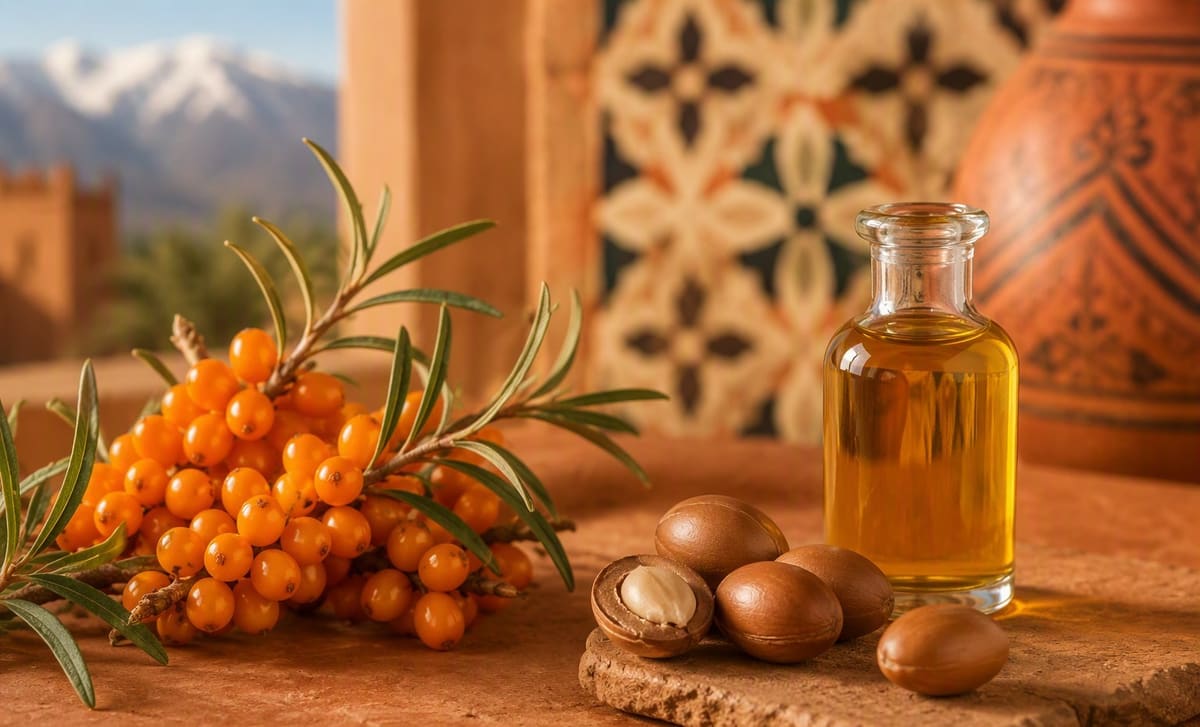
Argan oil is the daily workhorse: light, pigment-free, rich in vitamin E, and the cosmetic industry’s standard answer for hair shine and frizz for two decades. Sea buckthorn berry oil is the richer treatment oil: omega-7, carotenoids, a deep orange tint that stains, and an oral supplement evidence base argan does not have. Hair or light daily facial oil: argan. Rich night treatment or the studied inside-out route: sea buckthorn.
The comparison
| Sea buckthorn (berry oil) | Argan (kernel oil) | |
|---|---|---|
| Source | Berry flesh of a cold-climate shrub | Kernels of the Moroccan argan tree |
| Signature compounds | Omega-7 (palmitoleic), carotenoids | Oleic and linoleic acids, vitamin E |
| Texture and color | Thick, deep orange, can tint skin and fabric | Light, golden, no pigment |
| Hair use | No human hair trials; tint risk on light hair | The established cosmetic hair oil for shine and frizz |
| Human skin evidence | Oral-oil trials: hydration, elasticity, collagen density | Cosmetic use, not clinical-trial territory |
| Supplement lane | Yes, studied at 1-3 g/day | Not meaningfully |
| Typical price | Mid to premium | Budget to mid |
Why argan owns the hair conversation
Argan oil is mostly oleic and linoleic fatty acids with a generous vitamin E content, pressed from argan kernels in Morocco. That profile spreads thin, absorbs fast, and smooths the hair cuticle without much residue. Two decades of salon and consumer use made it the default hair oil for shine, frizz, and dry ends.
Sea buckthorn has no human hair trials. Zero. The berry oil’s deep orange carotenoids can also tint blonde or grey hair and every towel it touches. If you want sea buckthorn in a hair routine, the pale seed oil is the sensible form, used sparingly on ends. Even then, argan does the job with less management.
Credit where due on nutrition too: argan is one of the richer vitamin E oils, which suits both skin softening and hair care. Its sourcing story is part of the appeal, pressed from Moroccan kernels largely through women’s cooperatives, though suspiciously cheap “argan” deserves the same dilution scrutiny as any popular oil. Two decades of salon use at global scale is also a safety and tolerability record no boutique oil matches.
Where sea buckthorn earns its place
The face is a different conversation. Argan is a fine light moisturizer, but that is where its story ends. Sea buckthorn berry oil brings palmitoleic acid (omega-7), a fatty acid rare in the plant world, plus carotenoids at concentrations among the richest of any plant oil. It is thicker, slower to absorb, and better suited to night use mixed into a cream, the technique on our face oil page.
The bigger separator is the oral route. In one trial, 2 grams of oral oil daily raised measured skin hydration by about a third at one month and nearly half at three months, with elasticity up roughly a quarter. A 2024 placebo-controlled trial at 1 gram daily measured collagen density up 10 percent at 12 weeks. The details live on the skin hub. Argan has no comparable supplement literature, so inside-out is simply not a lane it competes in.
About clogging claims
The comedogenic numbers floating around for both oils are formulator lore, not lab measurements, and we say so instead of pretending otherwise. Argan is the lighter feel and the usual suggestion for oily or breakout-prone skin. Sea buckthorn’s pale seed oil is its lighter variant, while the berry oil is the rich end of the scale. Either way, patch test for a week or two before full-face use, because individual skin rewrites every general rule. Our comedogenic glossary entry explains why those ratings deserve skepticism.
Skin types, mapped honestly
Dry and mature skin is where sea buckthorn berry oil earns its keep: thicker texture, carotenoids, and omega-7 in an occlusive package that suits night use. Oily and combination skin usually prefers argan or the pale sea buckthorn seed oil, lighter options that absorb before they shine. Sensitive skin gets no automatic winner: both oils are gentle for most people, and the patch test decides. If breakouts are your main concern, the acne page covers the topical and oral angles in more detail than a comparison can.
The mixing option
You do not actually have to choose. A drop or two of sea buckthorn berry oil in a pump of argan gives you argan’s light texture and vitamin E with a diluted dose of carotenoids and omega-7, and the tint drops to a manageable warmth. Mix in your palm per use rather than premixing a bottle, so each oil keeps its own shelf life. It is the rare both-ways answer in this series that costs nothing extra, and it solves the commitment problem too: one bottle of each covers hair, face, and night treatment with no third purchase.
Price, honestly
Argan is a budget to mid-priced oil, widely sold as a single-ingredient organic product, and a bottle lasts months at face-oil doses. Sea buckthorn berry oil sits mid to premium, because the berries yield little oil and verified sourcing costs more. If a sea buckthorn oil is priced like argan, check the ingredient list for carrier oils before celebrating. Cost per use narrows the gap a little, since face oils are measured in drops, but argan still wins the budget argument outright.
Choose argan oil if
- Hair shine, frizz, or dry ends are the goal. This is argan’s proven lane.
- You want one light, cheap, pigment-free oil for face and body.
- You are breakout-prone and want the lighter texture (still patch test).
- You dislike the idea of orange tint on skin, towels, and pillowcases.
Choose sea buckthorn if
- You want a rich night treatment for dry or mature skin and will manage the orange tint.
- The inside-out strategy appeals: oral oil with actual human skin trials behind it. Products are scored in our oil guide.
- You already compared it against the other orange face oil in sea buckthorn vs rosehip oil and want the heavier hitter.
- You want one oil family that covers topical use and a studied oral supplement at the same time.
More matchups live on the comparisons hub.
Frequently asked questions
Is sea buckthorn or argan oil better for hair?
Argan, and it is not a close call. Argan is the proven cosmetic hair oil: light, pigment-free, and built on oleic and linoleic acids that smooth the hair shaft and add shine without much weight. Sea buckthorn has no human hair trials at all, and the deep orange berry oil can tint light hair and towels. If you want sea buckthorn on hair, use the pale seed oil and keep it off white pillowcases.
Will sea buckthorn or argan oil clog pores?
The comedogenic ratings circulating online for both oils are formulator lore, not lab measurements. No standardized, lab-tested clogging score exists for either oil. Argan is the lighter feel and the usual pick for oily skin. Whichever you choose, patch test on a small area for a week or two before full-face use.
Can I mix sea buckthorn oil with argan oil?
Yes, and the blend is practical. Argan thins sea buckthorn's richness and dilutes the orange tint, while sea buckthorn adds carotenoids and omega-7 to argan's oleic-linoleic base. A drop or two of berry oil in a pump of argan works as a night treatment. Mix in your palm rather than in the bottle, so each oil keeps its own shelf life, and still expect some tint transfer to fabric.