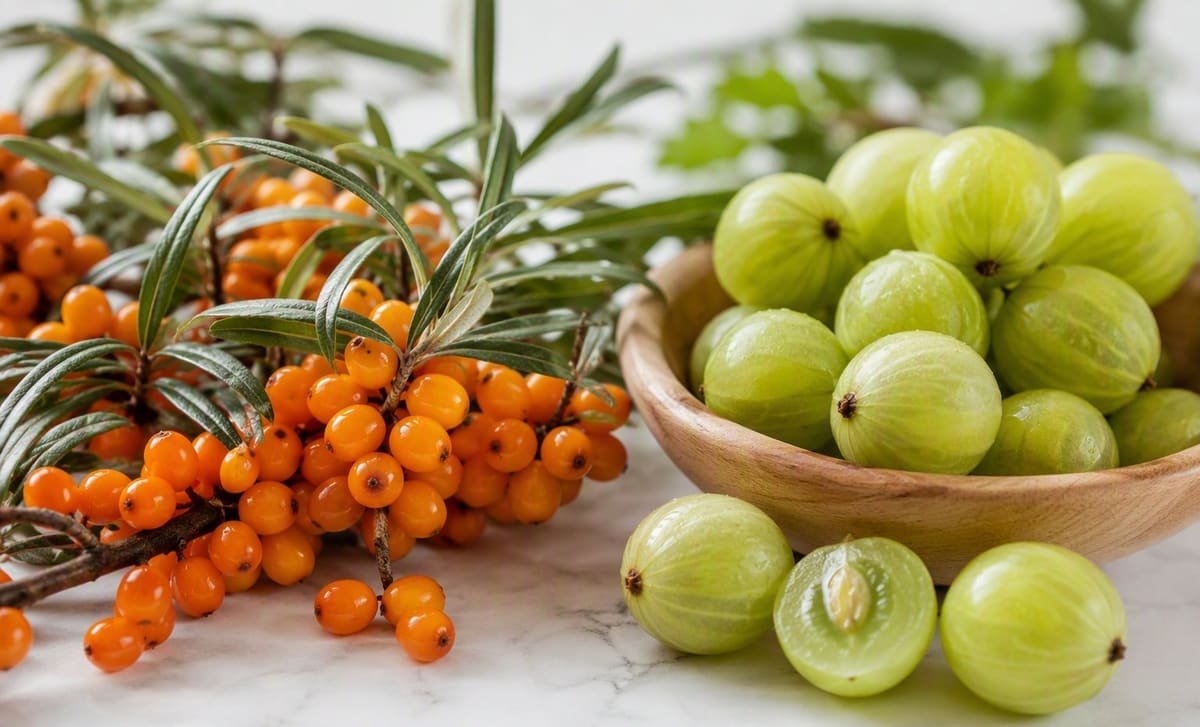
Amla and sea buckthorn are both sour, vitamin-C-loaded berries with centuries of traditional medicine behind them. Amla’s evidence style is depth of tradition plus early human pilot studies. Sea buckthorn’s is a small but instrumented set of randomized trials in specific lanes: blood lipids, dry eyes, skin. Neither replaces the other, and neither one should be bought on vitamin C content alone.
The comparison
| Sea buckthorn | Amla (Indian gooseberry) | |
|---|---|---|
| Tradition | Tibetan and Central Asian medicine | Ayurveda, one of its most-used fruits |
| Vitamin C | About 200-600 mg per 100 g fresh berries | Top-tier fruit source, same territory or higher |
| Signature extras | Omega-7 oil, carotenoids, flavonoids | Tannins and polyphenols that stabilize its vitamin C |
| Human evidence style | Randomized trials: lipids, dry eyes, skin (small n) | Traditional use plus small pilot studies (lipids, glucose) |
| Common forms | Oil softgels, juice, powder | Powder, juice, triphala blends, candy |
| Reality check | Very acidic juice; oil stains | Very sour; often sweetened in products |
| Cost pattern | Mid to premium | Cheap as powder, varies in blends |
Two kinds of evidence, stated honestly
Amla is one of Ayurveda’s oldest medicines, and that tradition is real knowledge: centuries of observed use for digestion, vitality, and later metabolic concerns. Modern research has added small human pilot studies on blood lipids and blood sugar, promising directions with small samples and short durations. No large pooled analysis exists yet.
Sea buckthorn’s tradition runs through Tibetan and Central Asian medicine, and its modern evidence is narrower but more instrumented. A 2022 meta-analysis of 15 randomized trials found significant improvements in triglycerides, total cholesterol, and LDL, concentrated in people with abnormal lipids. A 100-person trial measured dry-eye improvement at 2 grams of oil daily over three months. Small trials too, but randomized and pooled. The full map is on our benefits hub.
So: amla has the deeper book of tradition, sea buckthorn has the tidier stack of trials. Both statements are true at once. Black seed oil sits in the same tradition-rich, trial-poor spot, weighed in sea buckthorn versus black seed oil.
A note on what those evidence styles mean in practice. Pilot studies are how every supplement story starts: small groups, short runs, results that often shrink when bigger trials arrive. Pooled randomized trials sit several steps up the ladder, because pooling averages out single-study luck. Amla is at the start of that ladder in its metabolic lanes, while sea buckthorn is a few rungs up in its lipid lane. Neither sits at the top, where prescription drugs live.
What would move amla up the ladder? A few large, independent randomized trials in its lipid and glucose lanes, ideally pooled the way sea buckthorn’s were. The tradition is not the weak point, the sample sizes are. Until those trials exist, the honest ranking stands: deeper book versus tidier stack, and your lane decides.
The vitamin C race nobody should run
Both berries sit near the top of the fruit league for vitamin C. Sea buckthorn runs about 200 to 600 mg per 100 g fresh weight depending on species and harvest, and amla is routinely cited in the same few-hundred-mg territory, sometimes higher. Processing decides more than species: heat and storage degrade vitamin C in both, so a fresh or properly dried product of either beats a mistreated one.
Practical translation: both deliver vitamin C comfortably at food doses. Pick based on what else each berry brings, not on which wins a lab measurement that varies batch to batch.
Labels worth reading
Amla sells as powder, juice, triphala blends, and candied versions that quietly undercut the health pitch with sugar. The candy aisle deserves special suspicion: some products carry more sugar than amla, turning a sour medicinal fruit into confectionery with a health halo. Triphala blends vary widely in how much amla they actually contain, and plain powders range from fresh and potent to stale and inert.
Sea buckthorn sells as oil softgels, juice, and powder, with its own label games: berry oil diluted with cheap carriers like sunflower oil, or seed oil sold without saying which plant part it came from. Check amla labels for added sugar, and check sea buckthorn oil labels for the plant part and the carrier list. Both games are common, and both are legal, which is why the reading is on you.
The kitchen lane both berries share
One thing this pair offers that no oil-versus-oil matchup can: both are food first. Amla goes into chutneys, pickles, juices, and the classic dried-and-salted snack across India. Sea buckthorn goes into juices, jams, and smoothies across northern Europe and Asia. Daily food use across centuries is the oldest safety data there is, and both berries have it.
The shared catch is the acid. Both juices are enamel-grade sour undiluted, so dilute, take with food, and rinse your mouth after. A small daily glass of either, diluted, is a reasonable habit. A daily straight shot of either is a dentist conversation waiting to happen.
Cost per day, honestly
Amla powder is one of the cheapest supplements in this entire series: a daily spoon runs a few cents, and even premium organic powders stay in coffee-change territory. Sea buckthorn oil softgels sit mid to premium, closer to a dollar a day at studied doses. Neither is expensive in absolute terms, but if budget is the deciding factor, amla wins the price argument as clearly as sea buckthorn wins the trial-count one.
Choose amla if
- You want the Ayurvedic staple with the long tradition, especially as an affordable daily powder.
- Your interest is its metabolic pilot-study territory and you accept early, small-study evidence for what it is.
- You already use triphala or Ayurvedic routines and want the classic form.
- Budget leads the decision and you want a food-grade berry habit for pennies a day.
Choose sea buckthorn if
- You want the specific lanes with randomized human data: abnormal lipids (see the cholesterol page), dry eyes, and skin.
- The omega-7 oil angle interests you, since amla has no comparable fatty acid story. Products are scored in our oil guide.
- You prefer one berry with measured trials over one with a larger traditional literature.
- Dry eyes or skin hydration are on your list, lanes amla has never studied.
Whichever you pick, buy the form you will actually use daily. More berry matchups live on the comparisons hub, including sea buckthorn vs goji berry, the sweet berry beside this sour one, and sea buckthorn vs rosehip oil covers the face-oil side of the family.
Frequently asked questions
Which has more vitamin C, amla or sea buckthorn?
Both sit in the top tier of fruits. Sea buckthorn berries run roughly 200 to 600 mg per 100 g depending on species and harvest, and amla is routinely cited in the same few-hundred-mg territory or higher. Exact numbers swing with source, ripeness, and processing, and heat degrades vitamin C in both. The honest answer: neither purchase should be decided on vitamin C alone, because both deliver it at food doses.
Can I take amla and sea buckthorn together?
At food amounts, yes. Both are sour, acidic berries with long food traditions, and small combined servings are unremarkable. If you plan concentrated supplements of both, bring the list to your doctor, mainly because stacking supplements of any kind deserves a review. Undiluted juices of either berry are hard on tooth enamel and sensitive stomachs, so dilute and take with food.
Which is better for cholesterol, amla or sea buckthorn?
Sea buckthorn has the stronger file. A 2022 meta-analysis of 15 randomized trials found improved triglycerides, total cholesterol, and LDL in people with abnormal lipid levels, and an 11-trial analysis from 2017 reached the same conclusion. Amla's lipid data is a handful of small pilot studies, promising but not yet pooled. Whichever you lean toward, abnormal lab results are a doctor conversation, not a supplement decision made alone.