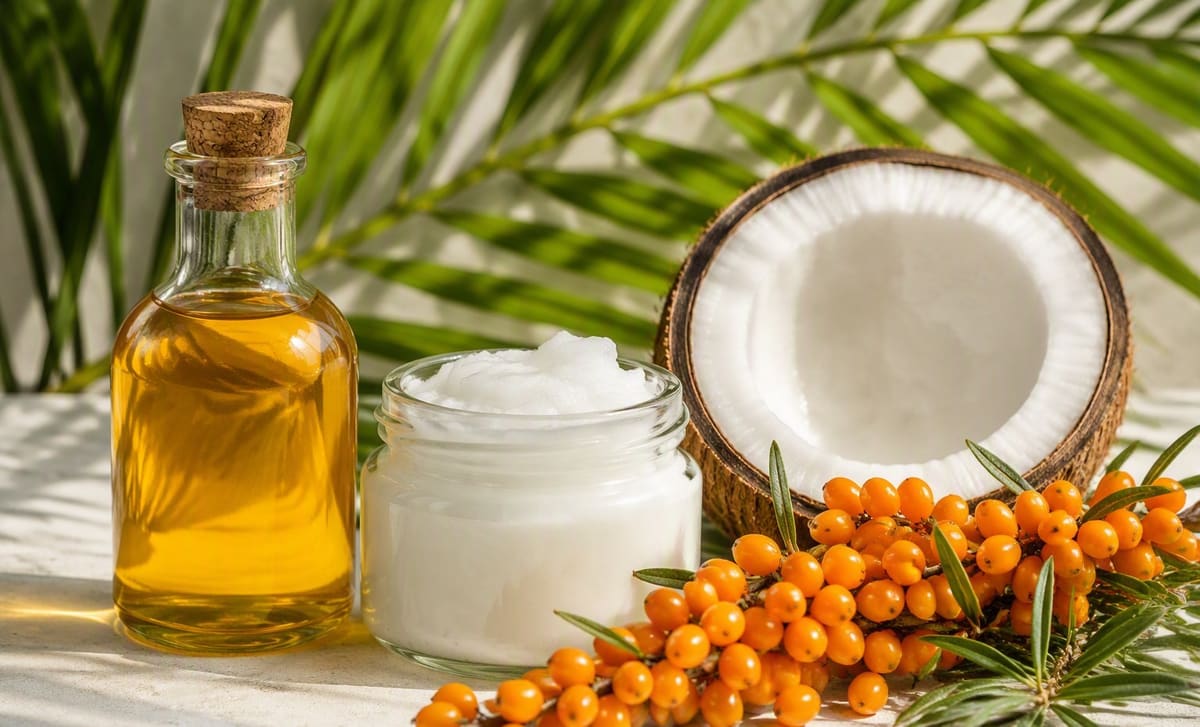
Coconut oil is a saturated-fat workhorse: cheap, shelf-stable, good in a hot pan, and a decent hair and body moisturizer. Sea buckthorn is an unsaturated specialist: fragile, pigmented, expensive, and the one with human trials behind dry eyes, skin, and blood lipids. Eating, skincare, and haircare each give a different winner, and the heart conversation favors the unsaturated side.
The comparison
| Sea buckthorn oil | Coconut oil | |
|---|---|---|
| Fat profile | Mostly unsaturated (omega-7, 9, plant 3 and 6) | Mostly saturated (lauric-led) |
| Kitchen use | Finishing oil, never high heat | Stable for frying and baking |
| Heart conversation | Lipid markers improved in abnormal ranges (pooled trials) | Saturated fat raises LDL vs unsaturated oils |
| Skin use | Rich treatment oil; oral trials for hydration | Body moisturizer and makeup remover |
| Hair use | No trials; tint risk from carotenoids | Established cosmetic oil for shine and ends |
| Color and staining | Deep orange, stains fabric | Clear-white, no pigment |
| Price | Mid to premium | Budget, everywhere |
The saturated fat conversation, kept short
Coconut oil is about 80 to 90 percent saturated fat, unusual for a plant oil, and feeding studies consistently show it raises LDL cholesterol relative to unsaturated oils. The “but MCTs” counterargument covers a fraction of the oil, not the whole jar. Meanwhile pooled sea buckthorn trials found improved lipid markers in people with abnormal levels. For the kitchen-and-heart question, the heart hub logic applies: unsaturated oils are the default, coconut is the occasional flavor choice.
Where coconut honestly wins
Coconut oil penetrates the hair shaft better than most oils, costs a fraction of sea buckthorn, and works as a body moisturizer, makeup remover, and oil-pulling medium without staining anything orange. Sea buckthorn has no human hair trials and its berry oil tints light hair and towels. For hair and general body use, coconut is the sensible buy.
For facial skincare, the calculus flips. Coconut is heavy, and oily or breakout-prone faces often avoid it. Sea buckthorn’s berry oil is a rich night treatment and its oral form has actual skin trials behind it, covered on the skin hub.
The clogging numbers, hedged properly
Every “coconut oil scores 4 of 5 comedogenic” chart online is publisher and formulator lore, not a lab measurement, and the same goes for sea buckthorn’s ratings. No standardized clogging score exists for either oil. Skin reacts individually, so patch test any new oil on a small area for a week or two before committing your face to it.
What each oil actually contains
Coconut oil is roughly 80 to 90 percent saturated fat, dominated by lauric acid, with a small medium-chain fraction that the “MCT” marketing extrapolates far beyond its share. It carries no significant vitamins or carotenoids. It is an energy-dense culinary fat, and judged as that, it is fine. Its heat stability and neutral-to-sweet flavor are exactly what a kitchen wants, which is why generations of cooks in tropical regions built cuisines on it long before Western wellness marketing found it.
Sea buckthorn is two oils. The berry oil is mostly unsaturated: palmitoleic omega-7 at 15 to 54 percent, palmitic and oleic fats, plus carotenoids and tocopherols among the richest measured in plant oils, per the oil nutrition page. The seed oil adds a near 1:1 omega-6 to omega-3 profile. Neither fraction is a cooking fat.
The evidence, side by side
Coconut oil’s human evidence is the feeding-study record: it raises LDL cholesterol relative to unsaturated oils, consistently enough that cardiology guidance treats it like other saturated fats. Its cosmetic evidence is the kind small studies and long practice support: decent moisturizer, decent hair oil, patch test applies.
Sea buckthorn’s evidence is the trial file described above: pooled randomized trials found lipid markers improved in people with abnormal levels, plus the dry-eye, skin, and vaginal trials. Different questions, different methods, and only one of the two oils has been tested as a supplement for measurable outcomes. The cholesterol page keeps the lipid numbers with their caveats.
The lane question
Coconut oil owns the kitchen lane: shelf-stable, heat-tolerant, cheap by the jar. It also holds a legitimate cosmetic lane for body and hair. Sea buckthorn owns almost no kitchen lane beyond a finishing drizzle for the adventurous, and the cooking page shows the few uses it does have. Its real lanes are the supplement softgel and the night-treatment face oil, technique on the oil on face page. Shoppers who buy sea buckthorn for the pan, or coconut for a clinical outcome, have both oils in the wrong lane.
Cost and availability, honestly
Coconut oil is budget-priced and sold in every supermarket on earth. Sea buckthorn oil is mid to premium, mostly online and health stores, with enough quality spread that the fake oil guide earns its place. The price gap is real and the jobs do not overlap, so this is one comparison where buying both for different jobs is the honest answer.
Choose coconut oil if
- You want one cheap jar for cooking, hair, and body.
- High-heat cooking is the use case.
- Budget and availability matter more than research lanes.
Choose sea buckthorn if
- You want the unsaturated profile with pooled human lipid data behind it.
- Dry eyes, skin, or vaginal dryness are the goal, via oral oil at studied doses, per the dosage page.
- You are comparing face oils and want the richer treatment option, after reading sea buckthorn vs rosehip oil.
More matchups live on the comparisons hub.
Frequently asked questions
Is sea buckthorn oil healthier than coconut oil?
For eating, the fatty acid profiles answer it. Coconut oil is mostly saturated fat, which raises LDL cholesterol relative to unsaturated oils in feeding studies. Sea buckthorn oil is mostly unsaturated, and pooled human trials found it improved lipid markers in people with abnormal levels. For skin and hair, they are different cosmetic tools, and coconut wins on price and availability.
Does coconut oil clog pores?
The comedogenic ratings circulating online for coconut oil (and for sea buckthorn) are formulator and publisher lore, not lab measurements. No standardized, lab-tested clogging score exists for either oil. Coconut is heavy enough that oily and breakout-prone skin types often avoid it on the face. Whichever oil you try, patch test on a small area for a week or two first.
Can you cook with sea buckthorn oil?
It is a finishing oil only. High heat damages its carotenoids and unsaturated fats, and the strong sour-fruity flavor and orange pigment would dominate most dishes anyway. A drizzle over finished food or a measured spoon with a meal is the normal route. For frying and baking, a stable culinary oil is the right tool.