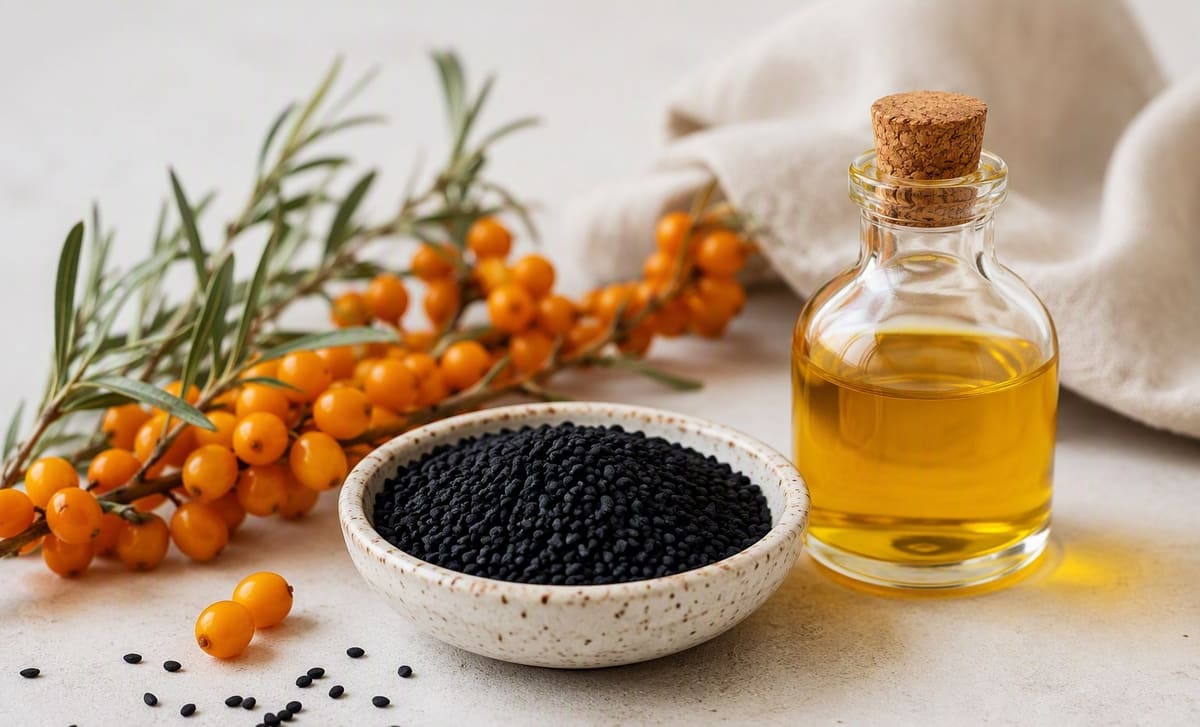
Black seed oil and sea buckthorn oil share a profile: ancient remedy, distinctive chemistry, and modern marketing that outruns the human evidence. Black seed’s thymoquinone has small, early trials across respiratory and metabolic claims. Sea buckthorn has randomized trials and two lipid meta-analyses in its specific lanes. Both files are young. Sea buckthorn’s is measurably deeper.
The comparison
| Sea buckthorn oil | Black seed oil (Nigella sativa) | |
|---|---|---|
| Signature compound | Omega-7, carotenoids, flavonoids | Thymoquinone |
| Tradition | Tibetan and Mongolian medicine | Middle Eastern and South Asian remedy |
| Traditional lanes | Skin, digestion, vitality | Respiratory and metabolic complaints |
| Human evidence | RCTs: dry eyes, skin, vaginal dryness; 2 lipid meta-analyses | Small early trials across several claims |
| Taste and format | Sour oil; softgels or liquid | Peppery, bitter oil; softgels or liquid |
| Evidence grade here | Moderate to strong in its lanes | Preliminary to moderate |
Black seed’s file, stated fairly
Nigella sativa seeds have been used across the Middle East and South Asia for respiratory and metabolic complaints for centuries, and thymoquinone, the oil’s signature compound, is genuinely interesting in laboratory research. Human trials exist for several claims, and they are small, short, and scattered across conditions, the classic profile of a remedy at the “promising, not yet proven” stage. Anyone selling it as a cure for anything has left that evidence behind.
Sea buckthorn’s file, stated the same way
The same discipline applies here, with a deeper data floor. Sea buckthorn’s human trials are randomized and cover defined outcomes: a 100-person placebo-controlled dry-eye trial, two instrument-measured skin trials, a 116-woman vaginal dryness trial, and two independent meta-analyses on blood lipids finding improvements concentrated in people with abnormal levels, per our cholesterol page. Small trials still, but controlled and pooled where it counts.
Both oils fail the same test in the same place: neither has large, independent, long-duration human trials, and neither replaces medical care for the conditions their traditions claim.
The honest contrast
Tradition gives both plants a long head start. Measurement separates them today. Black seed’s best human data is a scatter of small trials across many claims. Sea buckthorn’s is a smaller number of claims, each with a controlled trial or a pooled analysis behind it, all catalogued in the clinical trials catalog. Breadth versus depth, and depth is what this site grades.
What each oil actually contains
Black seed oil’s signature is thymoquinone, the pungent compound behind much of its laboratory interest, carried in an oil otherwise built on ordinary linoleic and oleic fats. The peppery, bitter taste is the plant announcing itself, and it is why so many buyers choose softgels.
Sea buckthorn is two oils. The berry oil carries palmitoleic acid (omega-7) at 15 to 54 percent of fatty acids, rare in the plant world, plus carotenoids dense enough to stain fabric, as the omega-7 page lays out. The seed oil is a different product: linoleic and alpha-linolenic acids in a near 1:1 ratio with vitamin E, detailed on the fatty acid profile page.
What the traditions actually claim
Black seed’s tradition is respiratory and metabolic: coughs, wheeze, blood sugar, the medicine chest of the Middle East and South Asia. Sea buckthorn’s is skin, digestion, and vitality, the Tibetan and Mongolian pharmacy. Both traditions are long and sincere. Both also predate controlled measurement by centuries, which is why this site grades them as starting points, not verdicts. The traditional use versus evidence page is the full method.
Cost, dose, and availability, honestly
Both are mid-priced supplement oils, sold as liquid and softgels, and both are easy to find online and in health stores. Studied sea buckthorn doses run 1 to 3 grams daily, so a bottle lasts weeks to months, and black seed products typically suggest similar amounts. Neither is a budget killer, and neither justifies luxury pricing. If a bottle of either costs like a prestige serum, you are paying for the story.
The lane question
Both oils are supplement-lane products. Neither belongs in a frying pan, black seed for its bitterness and heat-sensitive compounds, sea buckthorn for its sour intensity, pigment, and delicate carotenoids. Neither is really a topical either, despite what labels hint, though sea buckthorn berry oil has a cosmetic life as a night treatment. The honest daily pattern for both is a measured dose with food, tracked against a specific goal, with the safety review as the standing reference for tolerability.
If you are weighing both
Trying both at once tells you nothing, because you will never know which oil did what. The workable approach is sequential: pick the oil that matches your actual goal, run it at a consistent dose for 8 to 12 weeks with symptoms tracked, then judge. Black seed makes sense as the experiment when its traditional respiratory or metabolic lanes are the interest. Sea buckthorn makes sense when the target is one of its measured lanes. Buying both for vague wellness is how supplement cabinets fill up with expensive bottles nobody finishes.
Choose black seed oil if
- Its traditional respiratory and metabolic lanes are your interest and you accept early-stage evidence.
- You want to test a single distinctive oil with centuries of use behind it, tracked honestly over weeks.
Choose sea buckthorn if
- Dry eyes, skin, vaginal dryness, or abnormal lipids are the target, at the studied doses on the study dosages page.
- You want the remedy whose claims have been measured, not just repeated.
- The omega-7 and carotenoid chemistry appeals, per the oil nutrition page.
More matchups live on the comparisons hub.
Frequently asked questions
Is black seed oil or sea buckthorn oil better?
They answer different questions. Black seed (Nigella sativa) oil, led by its thymoquinone, has small human trials across respiratory and metabolic claims, all early-stage. Sea buckthorn has randomized trials and two lipid meta-analyses for dry eyes, skin, vaginal dryness, and cholesterol in abnormal ranges. For the conditions sea buckthorn was tested in, it has the deeper file. For black seed's traditional lanes, the evidence is promising but young.
Can I take black seed oil and sea buckthorn oil together?
At standard doses there is no known conflict, and their traditional uses barely overlap. Both are concentrated plant oils, so the usual rules apply: introduce one at a time so you can tell what agrees with you, take them with food, and tell your doctor about both if you use any regular medication.
Can you cook with black seed oil or sea buckthorn oil?
Neither is a cooking oil. Black seed oil's peppery bitterness and sea buckthorn oil's sour intensity and pigment make both poor frying candidates, and their delicate compounds dislike high heat. Both are taken by the spoon or in softgels as supplements. For the pan, use a stable culinary oil and keep these two for measured doses.