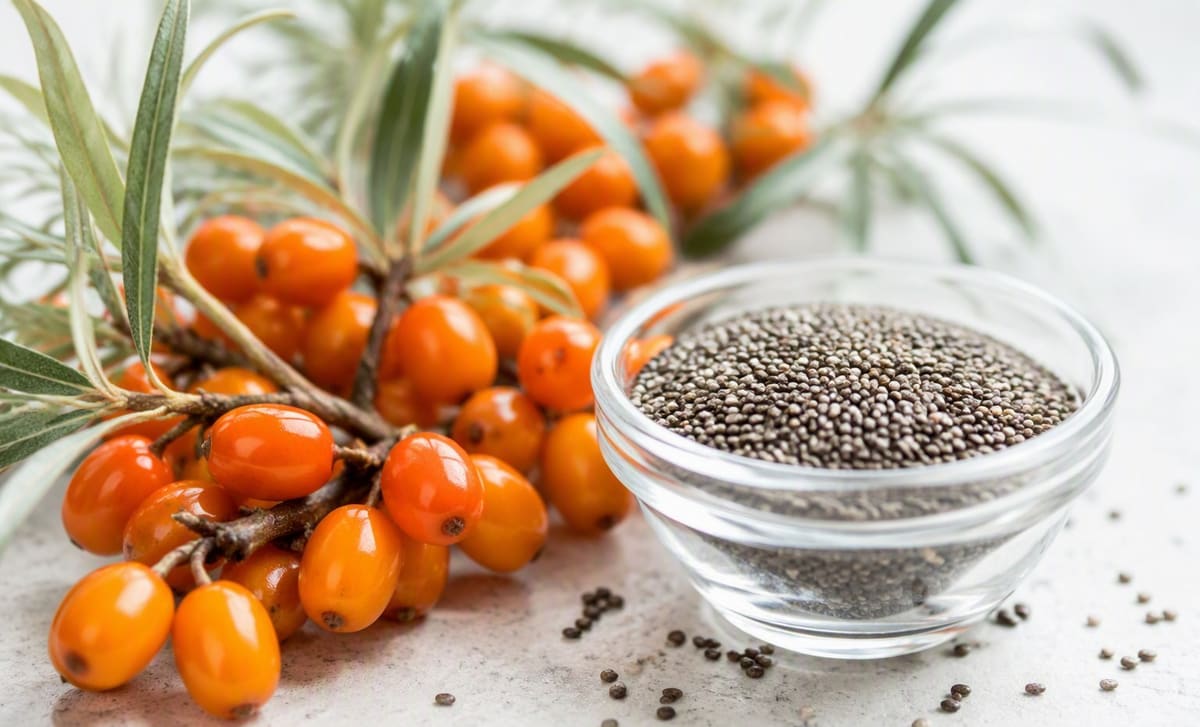
Chia seeds are the food-first answer: a cheap spoon of fiber, plant omega-3, and minerals stirred into breakfast, with the general health logic of fiber-rich whole foods behind them. Sea buckthorn is the supplement-first answer: a concentrated oil with randomized trials for specific conditions. The wisest readers use each for what it is.
The comparison
| Sea buckthorn | Chia seeds | |
|---|---|---|
| Form | Oil softgels, juice, powder | Whole or ground seeds |
| Headline content | Omega-7 oil, vitamin C, carotenoids | Fiber (about a third by weight), ALA, minerals |
| Omega-3 type | ALA in seed oil (20-35%) | ALA inside whole seeds |
| Evidence style | Randomized trials for specific conditions | Nutrition science of fiber-rich whole foods |
| Daily habit | Capsules or measured oil with meals | Spoon into oats, yogurt, smoothies |
| Cost per day | About $0.60-1.50 at studied doses | Pennies |
| Philosophy | Supplement-first | Food-first |
Chia’s quiet case
A spoon of chia delivers fiber (about a third of the seed by weight), ALA, and minerals, gel-forming in liquid, filling, and boring in the best way. Its health case rests on the broad nutrition science of fiber-rich whole foods rather than on any headline trial, and that is a feature: cheap, safe, easy to sustain for years, and compatible with everything else you eat. Few supplements survive that comparison.
The kitchen reality helps too. Chia disappears into oats, yogurt, smoothies, and puddings without changing the flavor of anything, which is why households actually finish the bag. The best nutrition habit is the one nobody notices doing.
Sea buckthorn’s specific case
Sea buckthorn oil is the opposite profile: a concentrated product tested against specific outcomes. Randomized trials found benefits for dry eyes, skin hydration, vaginal dryness, and blood lipids in people with abnormal levels, and the clinical trials catalog keeps the receipts. That specificity is the whole point. Nobody takes 2 grams of oil daily for vague wellness. They take it because a trial measured something they care about.
The omega-3 question deserves its own sentence. Chia and sea buckthorn seed oil both deliver ALA, the plant form, which the body converts poorly to the marine EPA and DHA. The famous sea buckthorn berry oil carries almost no omega-3 at all. If marine omega-3s are the goal, neither of these is the answer, as our fish oil comparison explains.
What a daily serving actually delivers
A typical chia serving, two tablespoons at about 25 grams, delivers roughly 8 grams of fiber, 4 to 5 grams of ALA, and useful magnesium, wrapped in a seed that costs pennies. The fiber number is the standout: few foods deliver that much for that little money and effort, and the fiber page covers why that matters daily.
A typical sea buckthorn dose, 2 grams of oil in softgels, delivers the studied amount of omega-7, carotenoids, and tocopherols with almost no fiber and no protein. It is a targeted capsule, not a food, and it asks to be judged by trial outcomes rather than by nutrient tables.
The evidence, side by side
Chia’s direct trial record is thin: small studies on satiety and blood markers with modest, mixed results. Its real backing is indirect and honestly framed, the broad nutrition science linking fiber-rich eating patterns to better long-term outcomes. Chia inherits that evidence as a convenient fiber vehicle, not as a proven treatment for anything.
Sea buckthorn’s backing is direct but narrow: a 15-trial lipid meta-analysis finding benefit concentrated in abnormal ranges, a 100-person dry-eye trial, and smaller skin and vaginal trials, pooled and caveated on the cholesterol meta-analysis page. Neither file supports cure language. One supports a food habit, the other supports specific supplement uses.
The omega-3 fine print
Both products sell on omega-3, and both deliver the plant form, ALA. The body’s conversion of ALA to the marine EPA and DHA is poor, so neither chia nor sea buckthorn seed oil substitutes for fish or algae oil where those are the goal. The omega family glossary keeps the three forms straight.
Cost and availability, honestly
Chia is grocery-store cheap everywhere, shelf-stable for months, and sold in bulk. Sea buckthorn oil runs roughly $0.60 to $1.50 per studied daily dose from reputable sellers, with quality varying enough that the buying guide exists. Storage differs too: chia keeps in a cupboard for months without attention, while sea buckthorn oil wants a cool dark spot and a cap you actually close. On cost per day of habit, chia wins by an order of magnitude. On cost per tested outcome, the comparison stops making sense, because chia was never tested for sea buckthorn’s lanes.
The lane question
Chia is kitchen lane, full stop: a seed you eat. Sea buckthorn is supplement lane for the oil and kitchen lane for the sour juice and powder. The omega-3-6-9 explainer maps where each fat lands once it is in the body.
Choose chia seeds if
- You want a daily fiber and plant-omega habit at grocery-store prices.
- Food-first is your philosophy and supplements are a last resort.
- You need something the whole household will actually eat.
Choose sea buckthorn if
- A specific condition is the target: dry eyes, skin, vaginal dryness, or abnormal lipids, per the cholesterol page and the study dosages page.
- You already eat well and want the targeted layer on top of it.
- The omega-7 story, which chia cannot tell, is the point.
More matchups live on the comparisons hub.
Frequently asked questions
Are chia seeds or sea buckthorn better for you?
Different tools for different jobs. Chia seeds are a whole food: fiber, plant omega-3 (ALA), and minerals in a cheap daily spoon, with the general health logic of fiber-rich foods behind them. Sea buckthorn oil is a targeted supplement with randomized trials for dry eyes, skin, vaginal dryness, and blood lipids in abnormal ranges. Eat chia for daily food habits; take sea buckthorn for its specific tested uses.
Do chia seeds and sea buckthorn oil provide the same omega-3?
Both provide plant ALA, not the marine EPA and DHA. Chia delivers ALA inside a whole seed with fiber, which is the gentler, food-based route. Sea buckthorn seed oil delivers ALA at 20 to 35 percent of fatty acids in a concentrated oil, while the famous berry oil carries almost none. Neither replaces fish or algae oil, since ALA converts poorly.
Can I take chia seeds and sea buckthorn oil together?
Yes. A fiber-rich seed and a concentrated oil do not duplicate each other, and at normal food and supplement doses there is no known conflict. Take the oil with a meal, keep the chia habit if you enjoy it, and introduce one new thing at a time so you can tell what is doing what.