Buy berry oil (or a berry-seed blend) if your goal is any of the studied benefits: dry eyes, skin hydration, vaginal dryness. The omega-7 and the trial evidence live in the berry. Buy seed oil if your goal is light topical use, especially on oily or acne-prone skin. Buy a blend if you want one bottle to do both jobs reasonably well.
This is the buying-decision version. The full chemistry (fatty acid percentages, carotenoids, vitamin E) lives in our seed oil vs berry oil deep dive.
See the data behind this chart
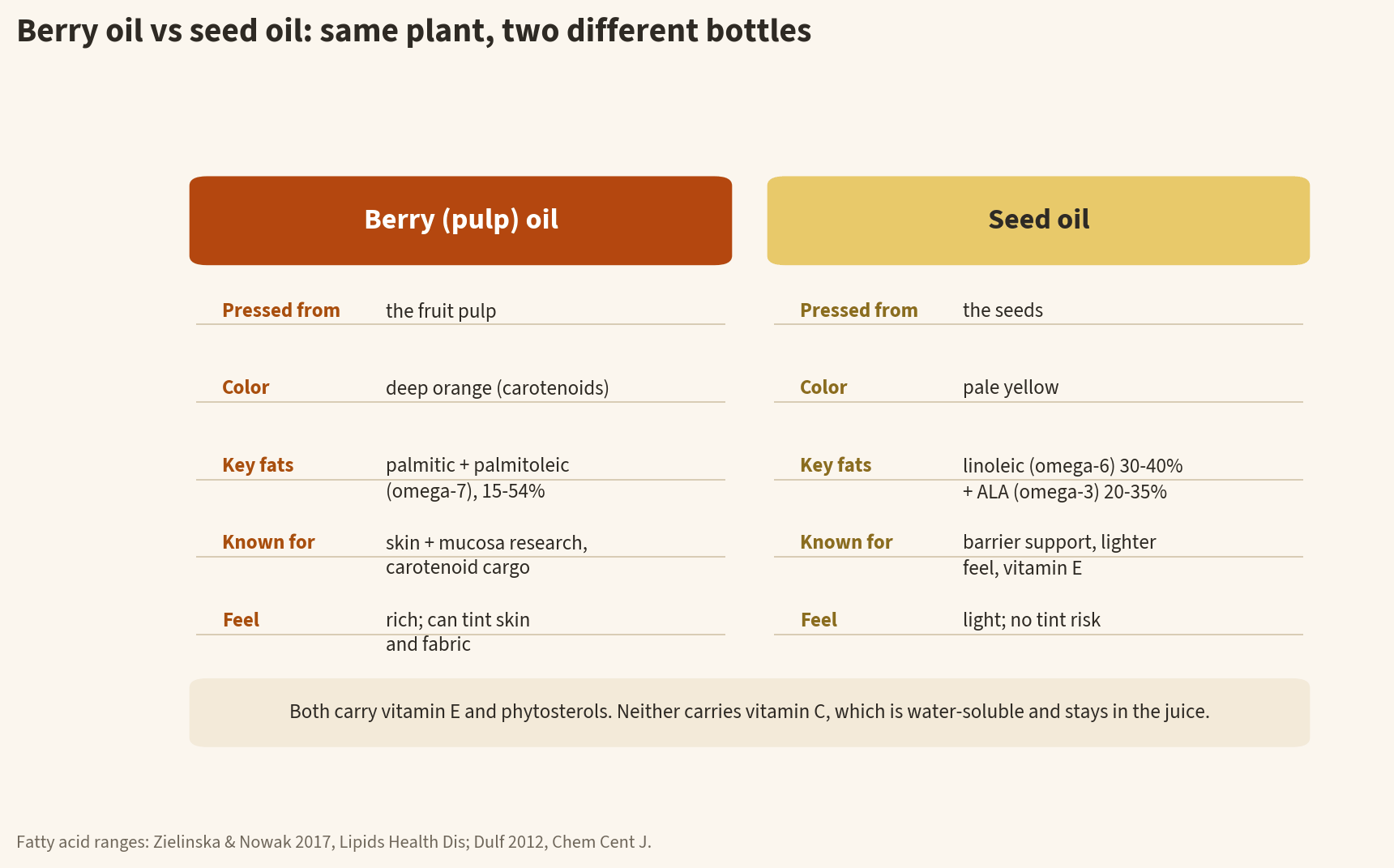
| Berry (pulp) oil | Seed oil | |
|---|---|---|
| Pressed from | Fruit pulp | Seeds |
| Color | Deep orange (carotenoids) | Pale yellow |
| Key fats | Palmitic + palmitoleic (omega-7), 15-54% | Linoleic (omega-6) 30-40% + ALA (omega-3) 20-35% |
| Known for | Skin and mucosa research | Barrier support, vitamin E |
| Feel | Rich; can tint skin and fabric | Light; no tint risk |
Some readers need a step back before either bottle, because the berry versus seed question only matters once you have settled on oil at all. The form-by-form overview covers the softgels, juice, and powder sitting next to it on the same shelf.
Where each oil comes from
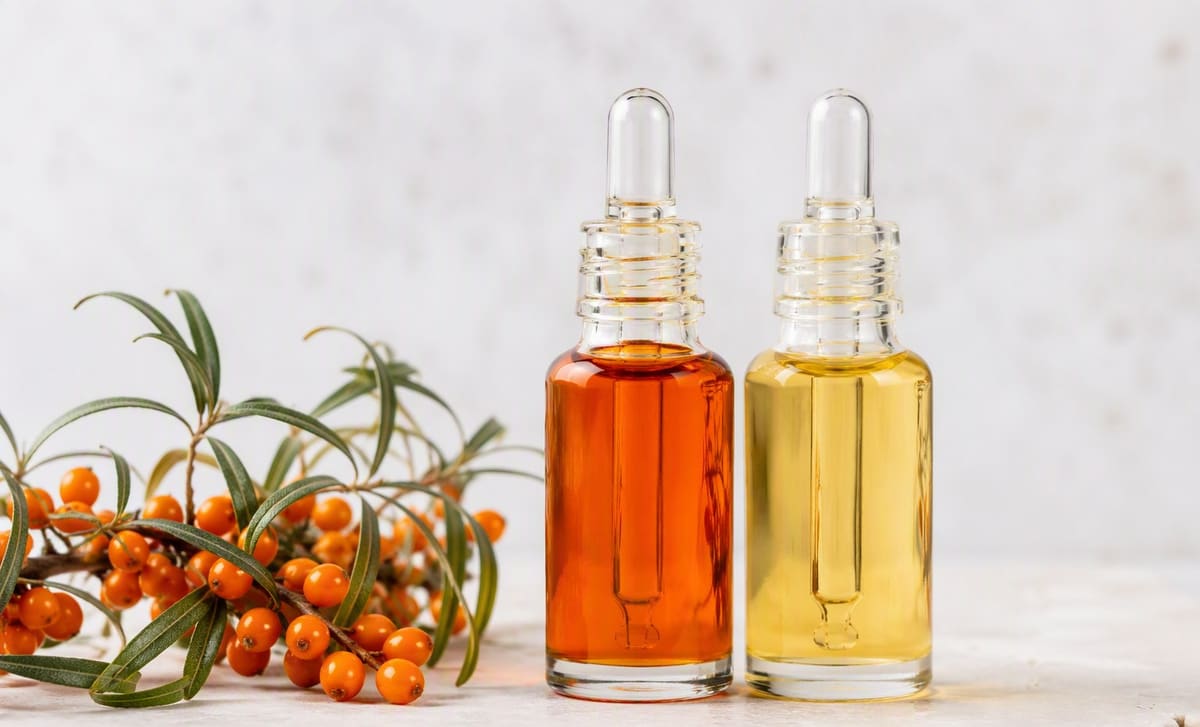
A sea buckthorn berry is mostly orange flesh wrapped around a small dark seed, and the two parts give chemically different oils. Berry oil (also called pulp or fruit oil) is pressed or CO2-extracted from the flesh: thick, deep orange, strongly scented. Seed oil comes from the crushed seeds: pale yellow, light, mild. A bottle labeled only “sea buckthorn oil” could be either one, or a mix, which is why the plant part is the first label line we check.
The fatty acid split
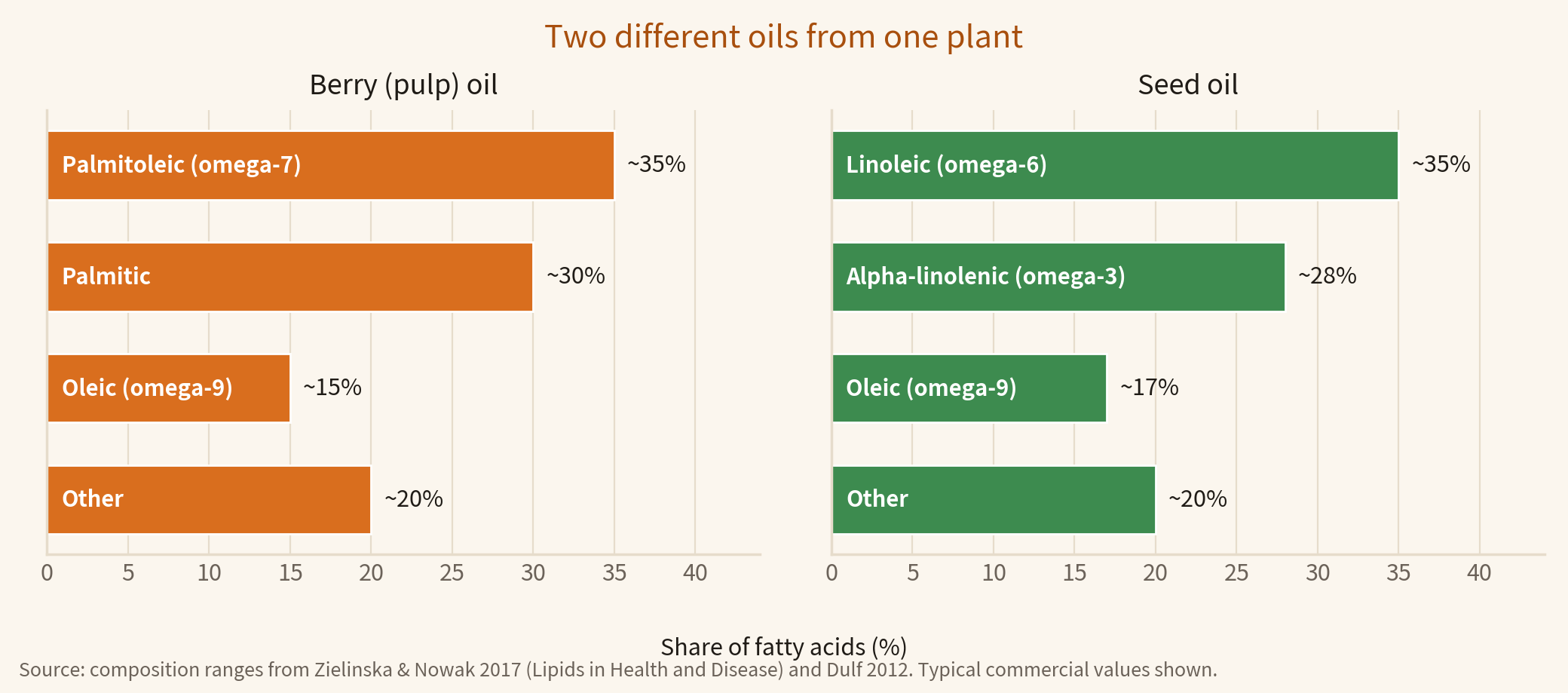
Composition studies of Hippophae rhamnoides oils converge on consistent ranges, varying by subspecies, origin, and harvest:
- Berry oil: palmitoleic acid (omega-7) at 30 to 40% of fatty acids, with palmitic acid around 30%. Add a heavy carotenoid load (the orange) and vitamin E, and you get one of the few meaningful plant sources of omega-7.
- Seed oil: linoleic acid (omega-6) at 30 to 40% and alpha-linolenic acid (omega-3) at 20 to 35%, a near 1:1 balance, with virtually no omega-7.
Treat any label printing one precise figure without a range as marketing, not analysis.
See the data behind this chart
| Fatty acid | Berry (pulp) oil | Seed oil |
|---|---|---|
| Palmitoleic (omega-7) | ~35% | trace |
| Palmitic | ~30% | low |
| Linoleic (omega-6) | low | ~35% |
| Alpha-linolenic (omega-3) | low | ~28% |
| Oleic (omega-9) | ~15% | ~17% |
What the human trials actually dosed
- Dry eyes: a seed-and-berry oil blend, 2 g a day for three months.
- Vaginal dryness after menopause: an oil blend, 3 g a day for three months.
- Skin hydration: oral sea buckthorn oil at 1 to 2 g a day in the two trials.
- Seed oil alone: nothing that still stands. The one controlled trial that dosed seed oil on its own, in hypertensive adults, was retracted in 2026.
- The caution entry: the study that flagged a mild anti-clotting effect used berry oil at a high 5 g a day in 12 men. Signal, not proof, but worth knowing if you take blood thinners.
Read that list and the buying rule writes itself: for the studied supplement benefits, researchers gave people berry oil or a blend. Seed oil’s own trial base is now empty.
The decision table
| Your goal | Buy | Why |
|---|---|---|
| Dry eyes (studied) | Berry-seed blend | Matches the oil blend used in the trial |
| Skin hydration (studied) | Berry oil or blend | Omega-7 plus carotenoids, the tested combination |
| Vaginal dryness (studied) | Blend | The trial dosed a seed-plus-berry oil |
| Daily face oil, oily skin | Seed oil | Light, pale, linoleic-rich, no tint |
| Night treatment, dry skin | Berry oil | Carotenoid-rich; mix into cream to manage tint |
| One bottle for everything | Blend | Compromise that does both jobs decently |
Why do blends exist?
Blends aren’t a marketing invention. Two forces created them. First, the research: the dry-eye and vaginal trials dosed seed-plus-berry oil, so a blend softgel is the closest shelf product to the study formulas. Second, the economics: blending the expensive berry oil with seed oil brings the cost per day down while keeping the whole-berry fatty acid spectrum in one capsule.
The mistake this page exists to prevent
The single most common bad purchase in this category is seed oil bought for an omega-7 benefit. The seed has essentially none, as the omega-7 explainer shows. Labels that say only “sea buckthorn oil” without naming the plant part enable exactly this confusion, which is why label transparency carries so much weight in our oil buying guide.
Price reality
Berry oil costs more to produce (less oil per berry, harder extraction) and prices accordingly. Seed oil undercutting it dramatically is normal. Seed oil sold AT berry prices with vague labeling is a red flag, not a bargain.
Buying guidance
- The label names the plant part and, ideally, the blend ratio. The best verified example prints 800 mg berry oil plus 200 mg seed oil per serving, with the omega-7 percentage right on the panel.
- Pure seed oil should cost noticeably less than pure berry oil.
- For topical-only goals, seed oil or a light face blend is enough. The face oil page covers the routine.
- For supplement goals, the scored options live in the oil guide and the capsules guide.
What neither oil gives you
Vitamin C. It’s water-soluble, so it stays with the juice and the water fraction of the berry flesh, and no pressing or CO2 run pulls it into the oil. Any product page implying its sea buckthorn oil delivers vitamin C is blurring two different products into one. If vitamin C is the goal, the vitamin C page shows which forms actually carry it, and the juice page covers the form that keeps it.
Blend your own
Commercial blends mix the two oils in one bottle, and you can do the same thing on your counter: a bottle of each, measured rather than guessed. Some buyers run berry oil for the supplement dose and seed oil for the face, which is often the cheaper way to keep both in the house. For topical mixing, the dilute oil guide has the ratios that keep tint and feel sane. For supplement mixing, count total grams of oil against the studied doses, the same math as any bottled blend.
Storage and shelf life
These are unsaturated oils, and unsaturated oils oxidize. Air, light, and heat are the three accelerants, so buy dark glass, cap it tight, keep it cool, and let the fridge extend the clock once the bottle is open. Rancidity announces itself. A sharp, bitter, paint-like smell means the bottle is done, however much is left. Buy the size you’ll finish in a couple of months rather than the economy jug. The storage guide covers every form in the house.
Who should skip which
Anyone on blood thinners or facing surgery should clear any sea buckthorn oil with a doctor first, on the strength of the 5-gram platelet signal above. Oily and acne-prone faces should skip straight berry oil and start with seed, as the face oil page details. And anyone whose real target is vitamin C should skip oils entirely. For the trial doses behind every claim here, the study dosages page is the reference table.
The verdict in one line
Match the bottle to the goal, not to the prettiest label: berry or blend for the studied benefits, seed for light topical duty.
Frequently asked questions
Should I buy sea buckthorn berry oil or seed oil?
For supplement goals (dry eyes, skin hydration, the studied benefits), buy berry oil or a berry-seed blend: that is where the omega-7 and the trial evidence live. For light topical use, oily or acne-prone skin, or daytime wear, buy the pale seed oil. A blend covers both if you want one bottle.
Can I mix sea buckthorn berry oil and seed oil myself?
Yes, and that is exactly what commercial blends do: the two oils combine with no chemistry drama. Measure total grams against the studied doses rather than guessing, and store both bottles dark and cool. Many people instead run berry oil for the supplement dose and seed oil for the face, which is often the cheaper two-oil routine.