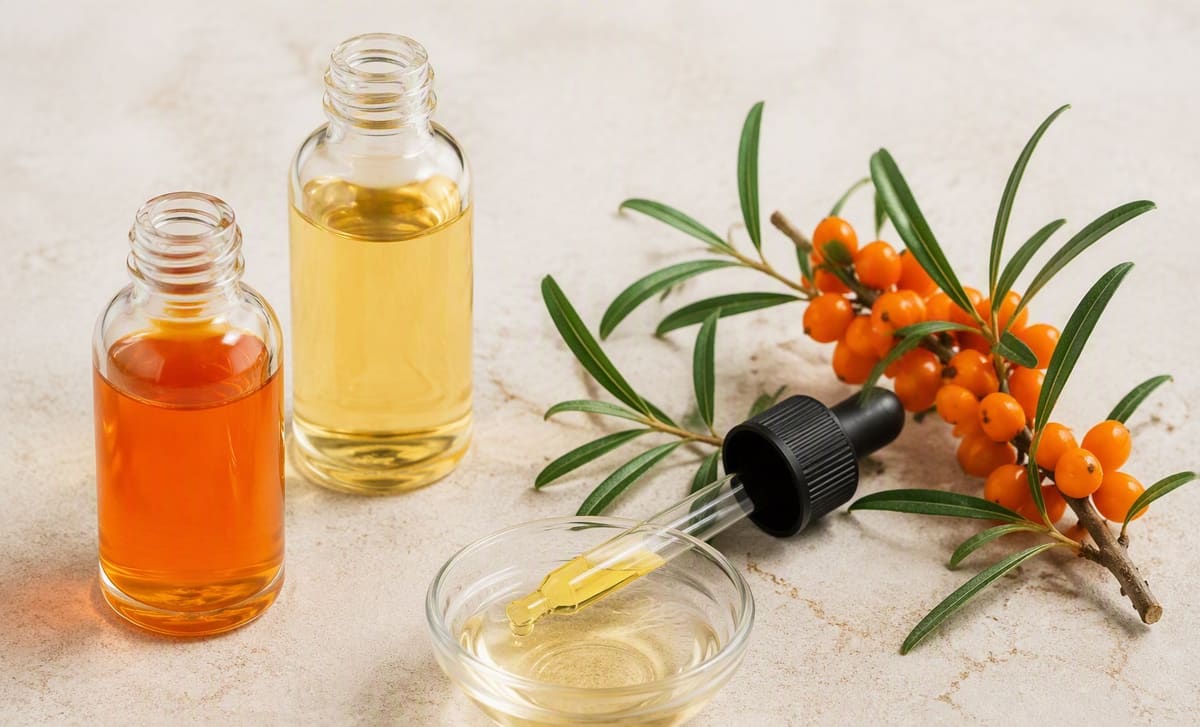
Dilute sea buckthorn berry oil in a light carrier: jojoba, squalane, or rosehip for the face, any plain body oil or your moisturizer for the body. Start at 1:10 on the face, work up toward 1:3 as your skin proves it tolerates the strength. Dilution tames the orange tint and the intensity without making the oil pointless.
Why dilute at all
Berry oil straight from the bottle is thick, deep orange, and enthusiastic. Used neat it can tint fair skin visibly, overwhelm oily or breakout-prone faces, and stain everything it touches. Dilution fixes all three while keeping the carotenoids and fatty acids in play. The pale seed oil needs none of this, which is one reason it exists, per the seed vs berry breakdown.
The carriers that work
- Jojoba. Light, stable, and close to skin’s own feel. The default face carrier.
- Squalane. Weightless and fast-absorbing, good for oilier skin.
- Rosehip oil. Light, linoleic-rich, and it brings its own topical résumé. The full comparison is on the rosehip page.
- Your regular moisturizer. One or two drops of berry oil blended into a nightly dollop, the mixer method from the face routine page.
The ratios
- Face, starting out: 1 drop berry oil to about 10 drops carrier (1:10). Two weeks here tells you how your skin votes.
- Face, established: up to 1:3 for dry or mature skin at night.
- Body: 1:5 in any plain body oil or lotion, no special rules.
- Scalp and hair: seed oil needs no dilution. Berry oil on lengths can go 1:5 into a light oil. The hair hub has the full routine.
Mix single servings in your palm. Premixing a bottle sounds efficient and means you have thrown two oils’ shelf lives into one jar.
The rules that prevent regret
- Patch test first. A coin-sized patch on your inner arm, a few days, before anything touches your face.
- Separate it from strong actives in the same moment. Do not layer the oil straight over a fresh retinol application. Different nights or different ends of the routine keep tempers calm.
- Night first. Any remaining tint fades on the pillowcase, not your collar. White pillowcases exempt nobody.
- Less is the dose. A drop is a unit. A pipette is a mess.
The drop math, once
Ratios sound technical and are not. One part berry oil to ten parts carrier means 1 drop of berry oil per 10 drops of carrier, mixed in your palm seconds before it touches your face. A standard dropper gives roughly 20 drops per milliliter, so a 1:10 face blend is about half a milliliter of carrier per drop of berry oil. Mix one face-worth at a time. Palm chemistry beats bottle chemistry, and nothing goes rancid in thirty seconds.
By skin type
- Oily or breakout-prone. Skip the berry oil on your face and use straight seed oil instead, or keep berry at 1:10 in squalane, the lightest carrier here. Two evenings a week is a sensible ceiling to start.
- Dry or mature. The 1:3 night blend in jojoba or rosehip is your range, worked up to over weeks, not days.
- Combination. Zone it: seed oil or the weak blend across the T-zone, richer ratios on the cheeks.
- Sensitive. Extend the patch test to a full week, start at 1:10 or weaker, and introduce nothing else new at the same time. The allergy page lists the reactions that mean stop entirely.
Troubleshooting the usual problems
- Still orange in the morning. Dilute further, use fewer drops, or move the blend fully behind your moisturizer. Tint is dose, and dose is drops.
- New breakouts after two weeks. Stop the berry oil, keep or switch to seed oil, and reassess. Nobody has comedogenicity data for this oil, so your face gets the deciding vote.
- Pilling under sunscreen. Too many layers or oil on dry skin. Press into damp skin, wait two minutes, then layer.
- It smells stronger than expected. Normal for a whole-berry oil. Dilution softens scent along with color.
What dilution does not change
Dilution changes tint, texture, and tolerance. It does not make a weak oil strong or a strong oil pointless: the fatty acids and carotenoids still land on your skin, just carried further. What no ratio can do is replicate the oral trial results, which came from swallowing 1 to 2 grams a day. The face oil explainer covers ready-blended products if palm chemistry is not your hobby, and the how-to-use hub maps every other way to put the oil to work.
The premade question
Ready-blended face oils with sea buckthorn inside are legitimate products, and the label math is the same: sea buckthorn high on the ingredient list means a strong blend, near the end means a whisper. Your palm remains the cheapest lab. Mix fresh, mix small, and the ratios above stay in charge of the result.
Frequently asked questions
What can I mix sea buckthorn oil with?
Light, stable carriers work best: jojoba, squalane, or rosehip oil for the face, and any plain body oil or your regular moisturizer for the body. Mix in your palm right before applying rather than premixing a bottle, so each oil keeps its shelf life.
Will diluting sea buckthorn oil stop it staining my skin?
It reduces tint a lot, which is the main reason to do it. At one part berry oil to ten parts carrier, most skin tones show no visible orange. At stronger ratios the tint can still show on fair skin, which is why evening use and a patch test come first.