Sea buckthorn oil may help dry eyes, and the evidence is better than most supplement claims: one randomized, double-blind, placebo-controlled trial of 100 people found that 2 grams a day for three months blunted the seasonal rise in tear film osmolarity and reduced the worst redness and burning symptoms. It did not fix everything, and it is not a replacement for eye care, but the study is real.
Dry eye is miserable, and the supplement shelf is full of promises. Sea buckthorn is one of the few with an actual randomized trial behind it, which is why this page exists, and why it sits at the top of the eyes hub. It is also why we can tell you precisely what the oil did and did not do, because the researchers measured both.
What the research shows
The Larmo 2010 trial (the one everyone cites)
Researchers in Finland recruited 100 adults with dry-eye symptoms and randomly assigned them to 2 grams of sea buckthorn oil (a blend of seed and berry oil) or a placebo, taken as 1 gram twice daily with meals, for three months over winter. Winter matters here: cold, dry air naturally worsens tear film osmolarity, the saltiness of your tears that drives the burning and grittiness of dry eye.
Both groups got worse as winter set in, which is exactly what you would expect. But the sea buckthorn group got less worse, and the difference was statistically significant:
| Measure | Sea buckthorn group | Placebo group | Significance |
|---|---|---|---|
| Rise in tear film osmolarity | Smaller increase | Larger increase | P = 0.04 (all participants), P = 0.02 (per-protocol) |
| Worst redness score reported | 6% of participants | 36% of participants | P = 0.04 |
| Worst burning score reported | 12% of participants | 32% of participants | P = 0.05 (all participants, not significant), P = 0.04 (per-protocol) |
| Eye-symptom days (contact-lens wearers) | 65% of days | 81% of days | P = 0.049 |
| The other 23 tracked symptoms | No significant difference | No significant difference | Not significant |
Read that last row again, because it is the part the marketing pages skip. Of the roughly two dozen symptoms tracked, most showed no significant difference. Sea buckthorn did not cure dry eye. It took the edge off the worst of it, for some measures, in one well-run trial.
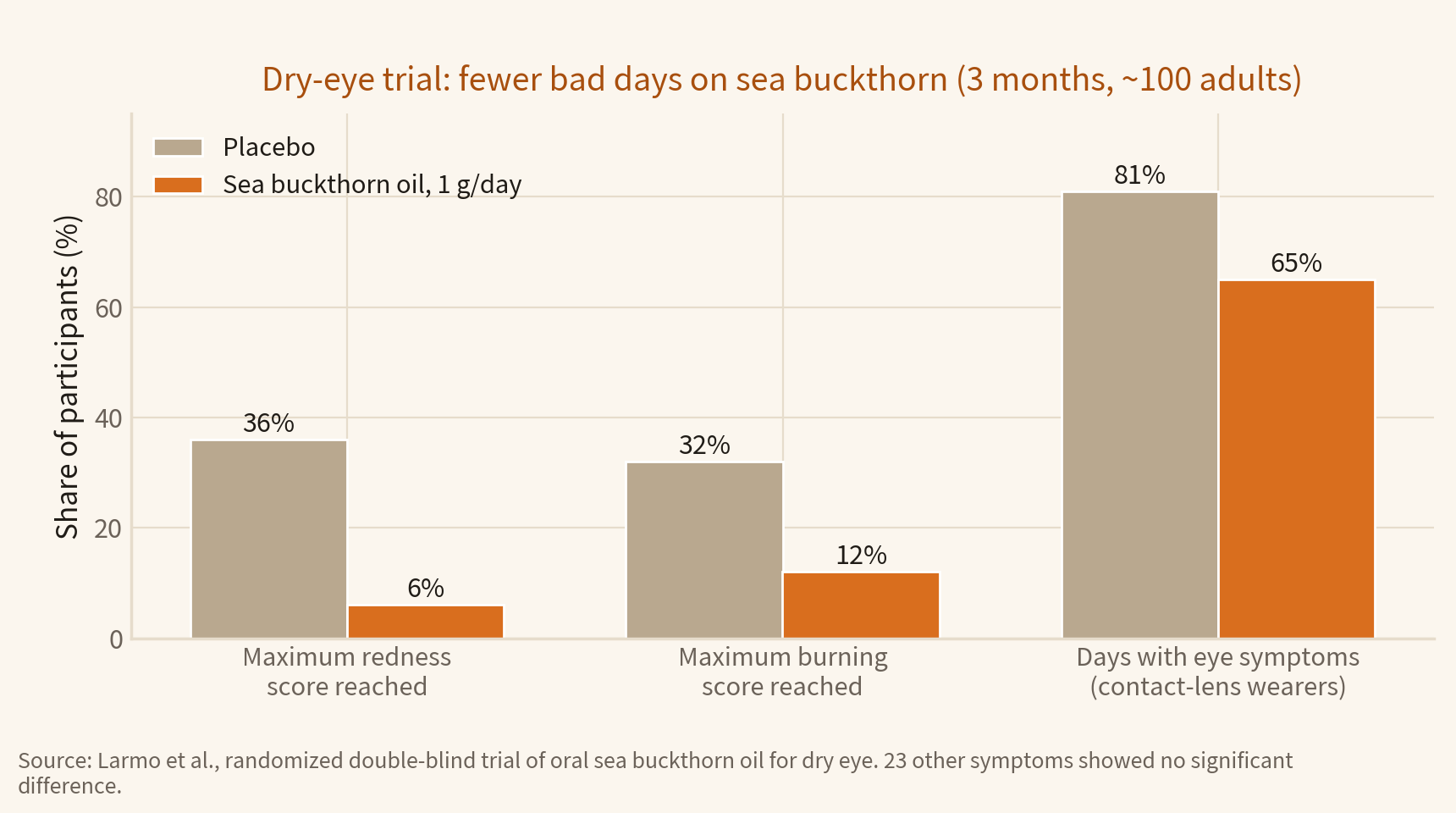
See the data behind this chart
| Outcome | Placebo | Sea buckthorn oil |
|---|---|---|
| Maximum redness score | 36% | 6% |
| Maximum burning score | 32% | 12% |
| Symptom days (contact-lens wearers) | 81% | 65% |
The follow-up that complicated the story
In 2011, the same team checked whether the oil worked by changing the fatty acids in the tear film itself. It did not. Tear-film fatty acid composition looked the same in both groups, which means the benefit, whatever drives it, does not come from omega-7 simply showing up in your tears. The mechanism is still unknown, and anyone who tells you otherwise is guessing.
How it might work
The leading theories involve the oil’s anti-inflammatory compounds and its effect on mucosal membranes generally (the same membrane family lines your eyes, mouth, and other tissues that dry out). The blend’s carotenoids and vitamin E may play a role. Honest answer: researchers do not know yet, and the fatty-acid follow-up makes the simple “omega-7 lubricates your eyes” story unlikely.
What we do not know yet
- Whether results replicate in a second, independent trial (none published so far).
- Whether benefits persist after you stop taking it.
- Whether berry oil alone works as well as the blend used in the study.
- Whether it helps severe dry eye or only mild to moderate symptoms.
- Whether it reaches the evaporative, meibomian-gland form specifically, since the trial enrolled by symptoms rather than gland imaging.
If you want to try it
The studied approach is 2 grams of a seed-and-berry oil blend daily, split across two meals, for three months. The product closest to the study formula that we have scored is the blend in our capsules guide: a certified-organic 800/200 berry-seed softgel at about $0.75 to $1.50 a day depending on dose.
One brand aims itself squarely at this use: Membrasin, built around dry eyes and mucous-membrane dryness and one of the few labels that prints omega-7 in milligrams. Our review likes that transparency, but it also shows the catch, since matching the trial’s 2 grams would take more capsules a day than the label recommends.
See the blend we rate highestTwo cautions. First, high-dose berry oil showed a mild antiplatelet effect in a small study, so talk to your doctor first if you take blood thinners or have surgery planned. Second, sea buckthorn is an add-on, not a substitute: keep your artificial tears, your humidifier, and your eye doctor.
The bottom line
For a supplement claim, this one has unusually solid footing: a real placebo group, 100 participants, and significant results on the symptoms that make dry eye miserable. The honest summary is “modest help, well-documented,” and at about a dollar a day, it is a reasonable three-month experiment to run with your doctor’s blessing.
The trial, one level deeper
Two details repay attention. First, the winter setting was the test: both groups worsened as cold, dry air pushed tear osmolarity up, and the result was that the oil group worsened less. This was a prevention-of-worsening finding as much as an improvement finding. Second, the statistics: the osmolarity effect was P = 0.04 across all participants and P = 0.02 among those who completed the protocol exactly, which is what “per-protocol” means. Both clear the conventional bar, and neither is so strong that a second trial would not be welcome.
The contact-lens wrinkle
Lens wearers are a dry-eye-prone subgroup, and they were the one group with an extra significant finding: eye-symptom days were 65% on the oil versus 81% on placebo. Note the P value, 0.049, just under the conventional line. Treat it as encouraging rather than decisive, and if you wear lenses, keep your lens-care routine and rewetting drops exactly as prescribed while you experiment.
How to raise it with your doctor
Bring the specifics: Larmo and colleagues, Journal of Nutrition, 2010, 100 adults, 2 grams of a seed-and-berry blend daily for three months. Say you want to match that dose, not the label’s single softgel. Mention blood thinners or planned surgery if relevant, because of the antiplatelet signal. And frame it as what it is: an addition to artificial tears and humidifiers, not a replacement. The dry eye trial page covers the methods, the dosage tool translates the 2 grams into products.
Frequently asked questions
Does sea buckthorn oil help dry eyes?
Evidence is moderate. In a randomized double-blind trial of 100 people, 2 grams of sea buckthorn oil daily for three months reduced the seasonal worsening of tear film osmolarity and lowered maximum redness scores compared with placebo. Burning scores dropped too, but that result missed significance when everyone assigned to the oil was counted. Most other symptoms showed no significant difference.
How much sea buckthorn oil should I take for dry eyes?
The trial used 2 grams per day (1 gram twice daily with meals) for three months. That is the dose to discuss with your doctor, not the single softgel many labels suggest.
How long does sea buckthorn oil take to work for dry eyes?
The trial ran three months and measured benefits at the end. Do not expect relief in days. If you try it, give it the full study duration and track your symptoms.