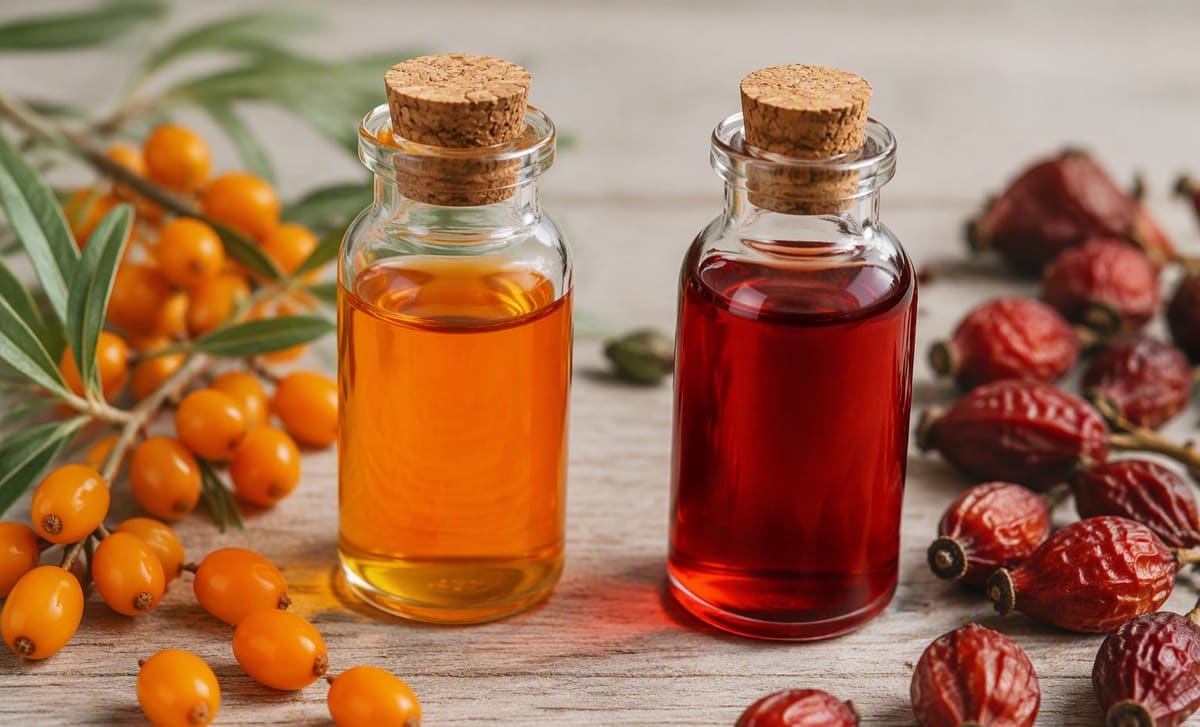
Rosehip oil is the lighter daily facial oil: fast-absorbing, linoleic-rich, with natural provitamin A compounds. Sea buckthorn is the richer treatment oil and the only one with omega-7 and oral supplement evidence behind it. Oily or normal skin wanting a simple face oil: rosehip. Dry or mature skin, or anyone chasing the studied benefits: sea buckthorn.
The comparison
| Sea buckthorn (berry oil) | Rosehip (seed oil) | |
|---|---|---|
| Source | Berry flesh (also a seed oil variant) | Rose seeds |
| Signature compounds | Omega-7 (30-40%), carotenoids | Linoleic + linolenic acids, provitamin A (trans-retinoic acid traces) |
| Texture and color | Thick, deep orange, can tint | Light, golden, no tint |
| Clogging risk | Low (publisher ratings; no lab-tested number) | Low (publisher ratings) |
| Human skin evidence | Oral-oil trials: hydration, elasticity, collagen density | Smaller topical studies, mostly scars and photoaging |
| Supplement lane | Yes: studied at 1-3 g/day | Not meaningfully |
| Typical price | Mid to premium | Budget to mid |
About those clogging numbers
The comedogenic ratings circulating online for both oils are formulator lore, not lab measurements. No standardized, lab-tested clogging score exists for either oil, which is why the table now says so out loud. Skin reacts individually, so patch test any new oil on a small area for a week or two before putting it all over your face, whatever any chart claims.
Fatty acid profiles, translated
Rosehip is a seed oil built on linoleic and alpha-linolenic acids, the light polyunsaturated fats. Linoleic-rich oils absorb fast and feel almost dry on the skin, which is why oily and combination types tend to love them.
Sea buckthorn berry oil runs the opposite way. Composition studies put its palmitoleic acid (omega-7) at 30 to 40% of fatty acids, with palmitic acid around 30%, plus the carotenoids behind its orange color. It is richer, slower to absorb, and more occlusive. Note that sea buckthorn also makes a seed oil, pale and light like rosehip, but that is a different product with its own profile, covered in the berry vs seed breakdown.
The vitamin A story, told carefully
Rosehip’s fame rests partly on natural trans-retinoic acid traces and beta-carotene, a gentler retinoid-like angle. Real, but present in small amounts, and not comparable to prescription retinoids despite what marketing implies. Beta-carotene is a vitamin A precursor your body converts only as needed, which is why rosehip does not carry retinoid-style irritation risk for most users.
Sea buckthorn counters with carotenoids at much higher concentration, which is exactly why it tints skin and pillowcases. If you already use a prescription retinoid, treat both oils as moisturizers alongside it, never as replacements.
The vitamin C myth, retired for both
Neither oil contains meaningful vitamin C. It is water-soluble and stays in the fruit, not the oil, as our vitamin C explainer details. Any product page claiming otherwise for either oil fails basic chemistry.
Stability and storage
Rosehip’s polyunsaturated richness makes it one of the more fragile oils on the shelf: heat, light, and air degrade it, and a turned bottle smells like old crayons. Buy small bottles in dark glass and use them within a few months of opening. Sea buckthorn berry oil, built on a more saturated fatty acid base, keeps somewhat better, though its carotenoids still fade in light. Either way, one fresh small bottle beats one big cheap bottle.
Price, honestly
Rosehip is a budget to mid-priced oil, widely sold as a single-ingredient organic product. Sea buckthorn berry oil sits mid to premium: the berries yield little oil, and verified sourcing costs more. Per ounce, good rosehip usually costs less than good sea buckthorn berry oil. If a sea buckthorn oil is priced like rosehip, check the ingredient list for carrier oils before celebrating.
The evidence, side by side
Rosehip’s human skin evidence is topical and small: a few short studies on scars and photoaging stretching back decades, positive but old, small, and rarely replicated. For a cosmetic oil at cosmetic prices, that is a fair file, and its scar lane is the one place it edges sea buckthorn.
Sea buckthorn’s skin file runs through the oral route: small randomized trials where 1 to 2 grams of oil daily improved instrument-measured hydration, with elasticity and collagen density improving in one trial each, dissected on the skin studies page. One-to-two- trial lanes with honest caveats. Topically, neither oil has the kind of human trial base that would settle the face-oil argument, which is why this page leans on profiles and use patterns instead. The marula comparison grades the third face oil in this tier by the same standard.
The verdict by goal
- Daily facial oil, oily or combination skin: rosehip. Lighter, cheaper, no tint management needed.
- Dry or mature skin, night treatment: sea buckthorn berry oil, mixed into cream. Technique on the face oil page.
- Inside-out skin strategy or dry eyes: sea buckthorn, because rosehip has no supplement trial base. The studied products are in our capsules guide.
- Scars and stretch marks: rosehip has the slightly better (still small) topical literature there.
- Reactive or breakout-prone skin: patch test first with either oil, since no lab-tested clogging data exists for both.
How to choose in three questions
- What is your skin like on a normal day? Oily or combination points to rosehip. Dry or mature points to sea buckthorn berry oil.
- What is the goal? Light daily moisture is rosehip’s lane. Rich night treatment, or the studied oral benefits, is sea buckthorn’s.
- Will you manage an orange tint? If not, rosehip, or sea buckthorn’s pale seed oil instead.
For the broader evidence map, the skin hub shows what sea buckthorn has actually been tested for, and our face oil guide scores the products worth buying. More comparisons live on the comparisons hub.
Frequently asked questions
Is sea buckthorn or rosehip oil better for skin?
For light daily facial use on oily or normal skin, rosehip (light, fast-absorbing, linoleic-rich). For dry or mature skin and for omega-7's researched benefits, sea buckthorn. Rosehip brings provitamin A compounds, sea buckthorn brings omega-7 and carotenoids. They solve overlapping but different problems and can be alternated.
Can rosehip oil and sea buckthorn oil be used together?
Yes, and alternating is common: rosehip in the morning for its light feel and no tint, sea buckthorn berry oil at night for the richer treatment. Patch test each oil separately first, introduce one at a time, and remember that neither replaces sunscreen or a retinoid your dermatologist prescribed.