For people with abnormal cholesterol, pooled trial data shows sea buckthorn oil (about 1.5 to 3 grams daily over 4 to 12 weeks) improving total cholesterol, LDL, and triglycerides. People with normal levels saw little change. The trials were small, so treat this as a promising signal to discuss with your doctor, not a statin alternative.
What the pooled data says
Meta-analyses gather the small randomized trials on sea buckthorn and blood lipids and average their results. Three findings repeat:
- Total cholesterol and LDL drop in participants who started with abnormally high levels.
- Triglycerides improve in that same group.
- Healthy volunteers barely move. Normal lipids stay normal.
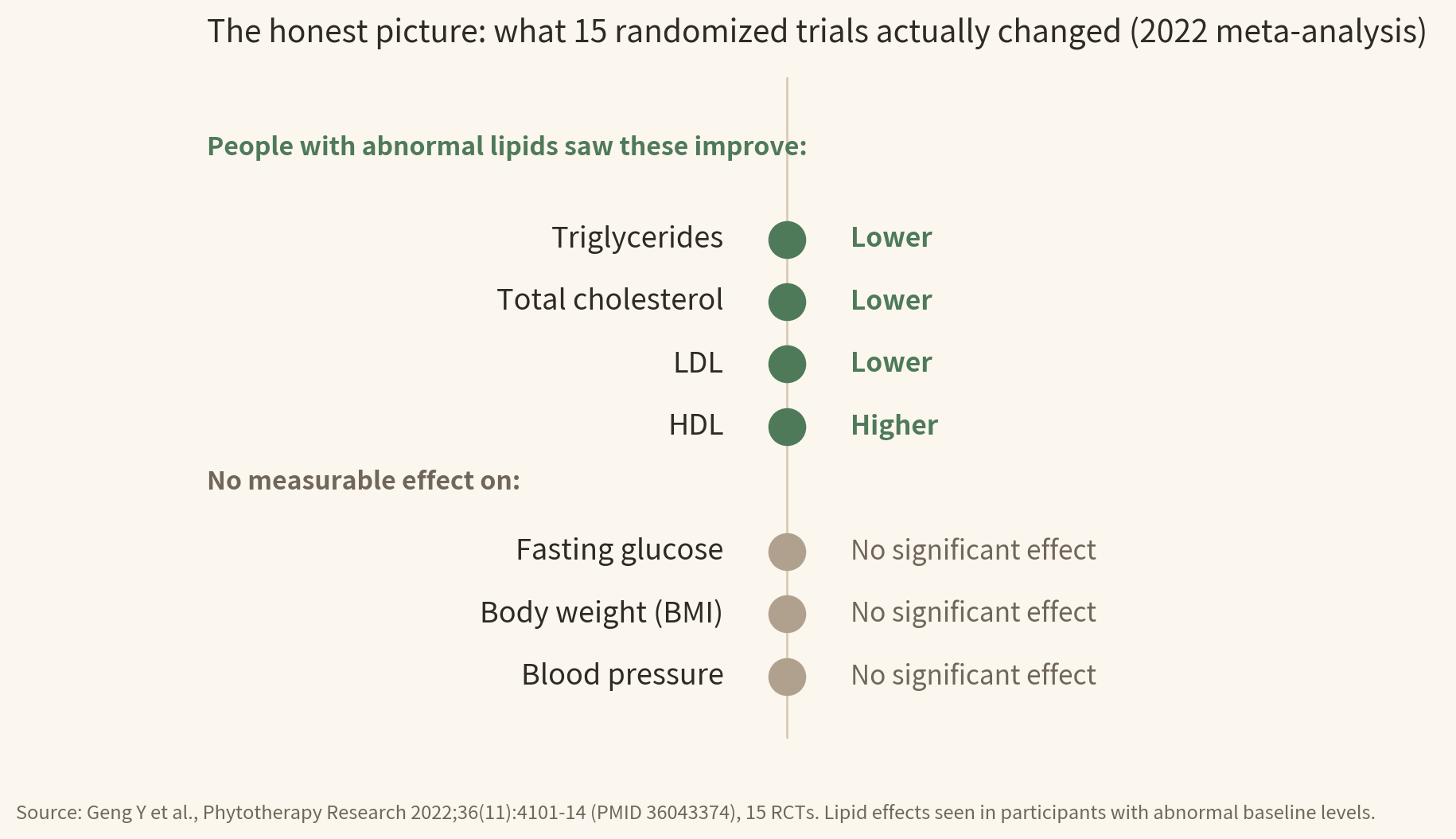
The 2022 meta-analysis of 15 trials behind those numbers found no significant effect on fasting blood glucose, blood pressure, or BMI. Cholesterol is where the signal lives. The rest is silence, which is why the heart hub grades this claim well above its neighbors.
See the data behind this chart
| Outcome | Verdict in the 2022 meta-analysis (15 RCTs) |
|---|---|
| Triglycerides | Lower in participants with abnormal baseline levels |
| Total cholesterol | Lower in the same group |
| LDL | Lower in the same group |
| HDL | Higher in the same group |
| Fasting glucose | No significant effect |
| Body weight (BMI) | No significant effect |
| Blood pressure | No significant effect |
The honest caveats: the underlying trials are small, run for weeks rather than years, and measure lab numbers rather than heart attacks or strokes. Nobody has shown that sea buckthorn changes those outcomes.
Why “abnormal first” makes biological sense
The oil carries omega-7, plant sterols, and flavonoids, each with plausible lipid mechanisms. Plausible mechanisms plus a consistent signal in abnormal lipids is exactly what “moderate evidence” looks like. It is also why we tell healthy readers to skip this use: the data offers you nothing to fix.
What LDL and HDL actually do
Cholesterol travels in parcels, and the labels matter. LDL parcels deliver cholesterol into artery walls, where it can lodge and build the plaque of atherosclerosis, which is why LDL is the target of nearly every lipid therapy. HDL parcels run the reverse route, carrying cholesterol back to the liver. Triglycerides are a third number, tracking the fat your blood carries after meals. A lipid panel is three different questions at once, and the sea buckthorn data answers each of them a little, in the right direction, for people whose answers started wrong.
The three tiers, sorted
- Real evidence: pooled randomized trials, two independent meta-analyses, consistent direction. Total cholesterol, LDL, and triglycerides down, HDL up, concentrated in people with abnormal baselines. Small short trials, marker endpoints, and the full dissection lives in the cholesterol meta-analysis breakdown.
- Plausible: the mechanism story. The oil carries phytosterols, which partially block cholesterol absorption, plus omega-7 and flavonoids with lipid-relevant lab data, as the phytosterols page explains. Plausible mechanism plus consistent pooled signal is what moderate evidence means.
- Marketing: “nature’s statin,” “cleans your arteries,” and any claim of preventing heart attacks or strokes. The file ends at markers, and honest pages stop there too.
A 12-week self-experiment, done properly
- Get a baseline lipid panel. No baseline, no verdict.
- With your doctor’s approval, match the studied range: 1.5 to 3 grams of oil daily with meals, alongside whatever is already prescribed.
- Change nothing else you can hold steady. If you overhaul your diet the same week, the experiment has two variables and no answer.
- Recheck the panel at 8 to 12 weeks, the trial window. Moved numbers earn continued use. Flat numbers are the answer too.
- Report the result to your doctor either way, and keep every prescription unless they change it.
For comparison, the fish oil comparison grades the other popular lipid supplement by the same rules, and the two files make an instructive pair.
Common mistakes
- Treating a one-capsule label serving as a studied dose. Many products sell convenience, and the trials used 1.5 to 3 grams. Match the research, not the marketing.
- Judging by how you feel. Lipids have no feelings attached. The lab panel is the only scoreboard.
- Buying for normal lipids. The clearest pattern in the pooled data is that normal stays normal. There is nothing for the oil to fix.
How big is the effect, honestly?
Neither meta-analysis promises a statin-sized shift. The pooled trial effects are real but modest, the kind that shows up as a useful nudge on a lab panel rather than a transformation. That calibration matters for decisions. For someone with mildly abnormal lipids working on diet and movement, a modest nudge alongside standard care is a reasonable companion. For someone with severely abnormal lipids, modest is not enough, and prescription options with outcome data carry the load. The oil’s role scales with how much room there is between your numbers and the target.
If you and your doctor try it
- Match the studied range: 1.5 to 3 grams of oil daily, with meals. The dosage page converts grams to softgels.
- Recheck your lipids after 8 to 12 weeks, the trial window. Data, not vibes.
- Keep prescribed medication unless your doctor says otherwise. Every trial that found benefit used sea buckthorn alongside standard care.
Products whose labels state their oil content clearly are scored in the capsules guide. And read the blood-thinner caution first, because lipid patients are often exactly the people taking those drugs.
Frequently asked questions
Does sea buckthorn lower cholesterol?
Moderate evidence says yes for people with abnormal levels. Meta-analyses pooling small trials found sea buckthorn oil (typically 1.5 to 3 grams daily for 4 to 12 weeks) lowered total cholesterol, LDL, and triglycerides in participants with hyperlipidemia, while people with normal lipids saw little change. Trial sizes were small, so the effect is promising rather than proven.
Can I replace my statin with sea buckthorn?
No, and do not frame it that way even to yourself. Statins cut heart attacks, strokes, and deaths in large outcome trials. Sea buckthorn moved lipid markers in small short trials and has never measured an outcome. If you want to try it alongside your prescription, that is a fair discussion with your doctor. If you want off your statin, that discussion is also with your doctor, and sea buckthorn is not the argument that wins it.