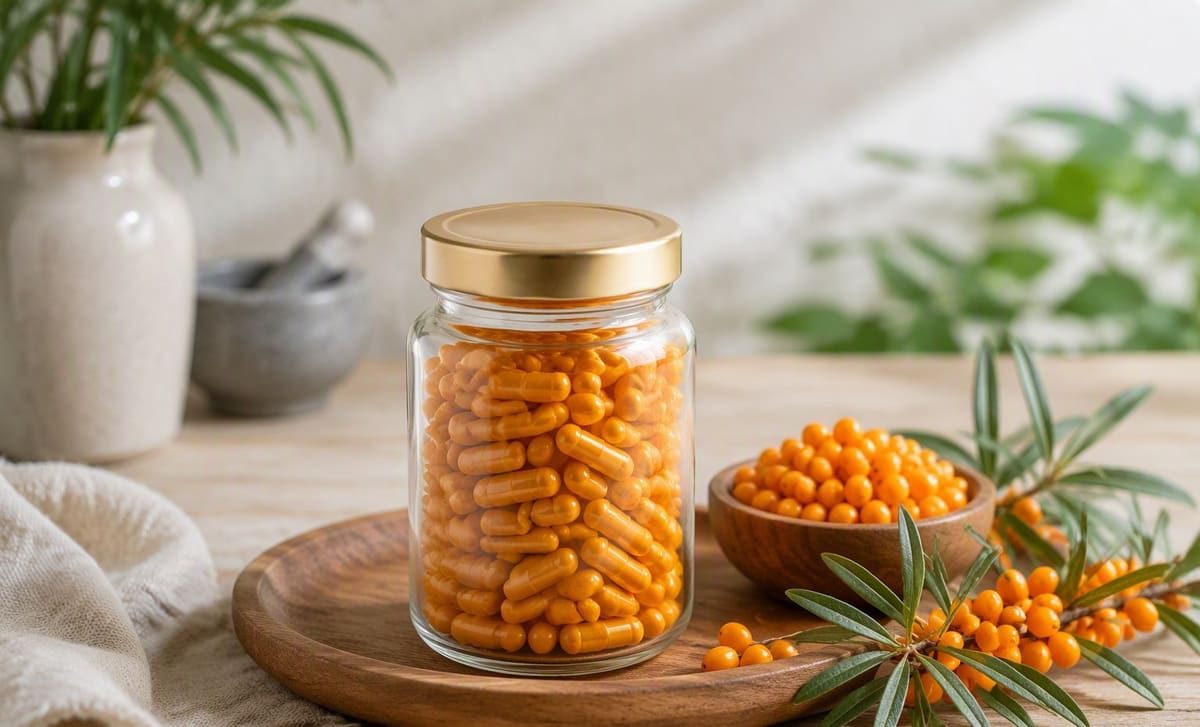
The real Patanjali sea buckthorn product is a capsule, not a juice: a 30-capsule, 15 g bottle sold as omega 3, 6, and 9 support for the heart, skin, and immunity. It is cheap and everywhere in India, and it is genuine sea buckthorn. What the label leaves out is the detail that decides a dose, the plant part, the omega-7 percentage, and the milligrams of oil per capsule. It scores 6.1 in our rubric.
Research-based review per our editorial policy. We scored the sea buckthorn capsule from its published label, since that is the Patanjali product that actually exists. We have not tested it in a lab or by hand.
The scorecard
| Criterion | Weight | Patanjali result | Score |
|---|---|---|---|
| Purity and sourcing | 30% | Mass-market, no plant part or named origin on the panel | 6.5 |
| Fatty acid profile | 25% | Omega 3, 6, 9 claimed; no mg of oil, no omega-7 figure | 6.0 |
| Third-party testing | 20% | No published assays we could find | 5.5 |
| Value | 15% | Cheap and everywhere, but 15 g is about a week at studied doses | 6.5 |
| Transparency | 10% | Thin sea-buckthorn-specific label detail | 5.5 |
Those weights are not tuned to Patanjali. Every brand we score meets the same five, so this sits below the mainstream names on documentation and above nothing in particular on price.
The juice confusion, cleared up first
Start here, because it is the question most people are really asking. There is no Patanjali sea buckthorn juice in any meaningful sense. Type “patanjali sea buckthorn juice” or “sea buckthorn juice patanjali” into a marketplace and you get combo packs that staple a third-party juice to a strip of Patanjali capsules, plus a scatter of unrelated listings. The Patanjali product that genuinely exists, on the company’s own site, is the capsule. So if a juice bottle is what you want, you are shopping the open market covered in the India buying guide, not a Patanjali shelf.
What we verified
- The product: a Patanjali Sea Buckthorn Capsule, 30 capsules, 15 g net, which works out to about 500 mg of oil per capsule.
- The label claim: high content of omega 3, 6, and 9 fatty acids, with stated uses for the heart, for psoriasis, and for immunity, at two capsules daily.
- The price: an MRP of ₹468 on the official Patanjali site in August 2026, with street prices near ₹425 across marketplaces.
- What we could not verify: the plant part (berry or seed), an omega-7 percentage, the milligrams of oil per capsule beyond the 15 g arithmetic, and any third-party lab assay.
The omega numbers, read closely
Here is a small tell worth catching. Patanjali sells this on omega 3, 6, and 9, and sea buckthorn’s headline compound is omega-7, which the label never mentions. That is not a scandal. It usually means the formula leans on seed oil or an unspecified blend rather than the omega-7-rich berry oil, and it is exactly the kind of thing a plant-part line on the panel would settle. This one does not carry that line. If omega-7 is what you came for, the seed versus berry page explains why the missing word matters.
The dose math nobody prints
Thirty capsules at 500 mg is 15 g of oil in the bottle. The human trials dosed 2 to 3 g a day, so a studied day is 4 to 6 of these capsules, and the whole bottle is about a week at that rate. At the label dose of two capsules, you are taking 1 g a day, roughly half the lowest studied amount, and the bottle stretches to about fifteen days. So the true cost runs near ₹31 a day at the label dose and closer to ₹62 a day at a studied dose, both figured off the ₹468 MRP. The capsules guide has the full method, and the cost-per-day tool runs your actual bottle.
Where Patanjali falls short
Documentation, plainly. The panel names the plant but not the part, claims omega 3, 6, and 9 but prints no percentages, and gives a net weight but no clear milligrams of oil per capsule. There is no third-party assay we could find. None of that makes the capsule bad. It makes it hard to match against a studied dose, which is the one thing a supplement label should let you do.
Who should buy it
Indian buyers who want the cheapest, most available way to try sea buckthorn in capsule form, and who are fine treating the dose as approximate. Plenty reach this page unsure what the fruit is even called, since in India it is the Leh berry as often as sea buckthorn, and the sea buckthorn in Hindi and Indian names page untangles the words behind the label. A good share arrive searching sea buckthorn in hindi patanjali, or patanjali sea buckthorn benefits in hindi, wanting the bottle read back in their own language. The benefits are the graded ones we list everywhere, blood lipids on the strong end, with no altitude bonus for coming from Ladakh. At street prices it is among the easiest sea buckthorn products to find in the country, and convenience has real value the rubric does not fully capture.
Who should skip it
Anyone matching a trial dose to the milligram, or buying specifically for the omega-7 in berry oil. For those goals you need a panel that prints the plant part and the percentages, and this one does neither. The brands ranking lists the labels that do.
One safety note. Sea buckthorn oil showed a mild antiplatelet signal at high doses in one small study, and concentrated supplements are unstudied in pregnancy. If you take blood thinners or are pregnant, read the safety hub first.
How it compares
Against the other Indian names, Patanjali competes on price and reach, not on paperwork. The WellWith and Ayuzera juices actually print ingredient percentages and an FSSAI number, which is more label detail than this capsule offers, though they are juices rather than the studied oil. Biosash sells a broader Ladakh-origin range at MLM prices. Patanjali’s edge over all of them is simple: it is the one you can buy almost anywhere in India for the least money. Its weakness is just as simple, and it is the missing label detail.
What would raise or lower the score
Raise it: a plant-part line, an omega-7 percentage, and milligrams of oil per capsule on the panel, or a published assay. Any one would lift the 5.5 on transparency and testing, where this product loses the most. Lower it: a price rise without any new documentation, which would erase the one real advantage here.
What to verify before you buy
Read the current pack for a plant part and a per-capsule oil weight, because labels get revised. Count the capsules a studied day needs, four to six, and divide the price by the days that gives you rather than by the bottle. If the number works for you and approximate dosing is fine, it is a cheap way in. If you need the printed percentages, buy from a label that prints them.
Frequently asked questions
Does Patanjali sell a sea buckthorn juice?
Not really. Patanjali's genuine sea buckthorn product is a capsule, sold as a 30-capsule, 15 g bottle. Searches for a Patanjali sea buckthorn juice mostly land on third-party combo packs that bundle someone else's juice with Patanjali capsules, not on a Patanjali-made juice.
What is the Patanjali sea buckthorn price?
The capsule bottle listed at an MRP of ₹468 on the official Patanjali site in August 2026, with street prices around ₹425 on marketplaces. That is 30 capsules, roughly 15 g of oil total, so at the studied 2 g a day one bottle lasts only about a week.
Is Patanjali sea buckthorn good?
It is cheap and easy to buy in India, and it is the same species as any other sea buckthorn. The catch is documentation. The label names no plant part, no omega-7 percentage, and no milligrams of oil per capsule, and we found no published third-party assays. It scores 6.1 in our rubric.