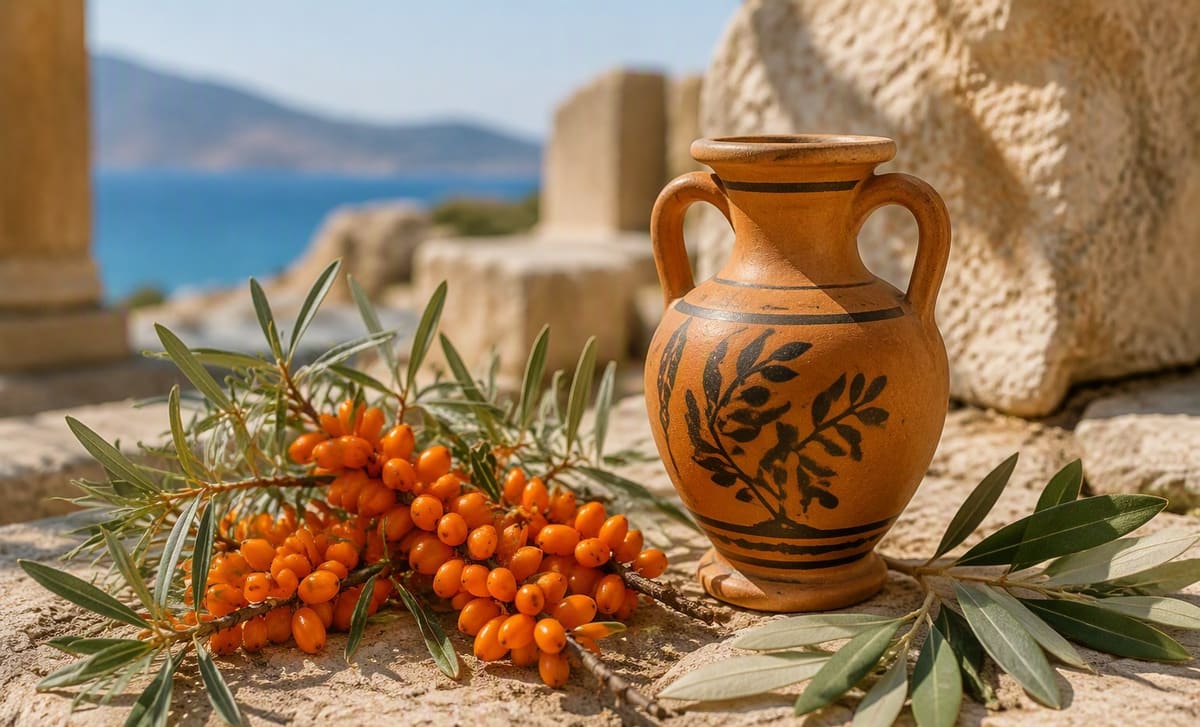
The Greek chapter of sea buckthorn’s story is one part etymology and one part legend. The genus name Hippophae, built from hippos (horse) and phaos (shine), is real Greek. The story behind it, horses pastured on the shrub growing famously glossy coats, is the traditional account attached to that name. And the classical reference usually cited for it is an attribution, not a passage we can quote.
The name is real, the story is traditional
Hippos plus phaos gives you shining horse, and the account that came down with the name says ancient Greeks fed or pastured horses on the plant and prized the coats that followed. We present it exactly that way: the traditional account, repeated since antiquity, not verified history, which is how the history hub tiers every chapter. The plant hub’s name page unpacks the rest of the plant’s naming.
The Theophrastus attribution
The classical citation you will see everywhere: Theophrastus, the successor of Aristotle often called the father of botany, mentioned a thorny plant whose browsing made horses’ coats gleam. The honest status is that later writers attribute this observation to Theophrastus, and we could not verify the specific passage, so we repeat the attribution without inventing quotes. Even taken at full strength, it records a pasture observation, not a medicine.
What Greece gave the plant, and what it did not
We find no evidence of Greek cultivation, and no Greek medical tradition built on the berry. The deep documented medical record is Tibetan, covered on the Tibetan medicine page, and the deep legend record is Mongol-flavored, covered on the Genghis Khan page. Greece gave the plant its name and its best story, not its medicine chest.
Why the story persists
A Greek name plus a horse story is perfect brand material, and two thousand years of retelling polished it smooth. Our rule on this site is simple: legends get labeled. The Ayurveda page applies the same rule to a different tradition.
The plant behind the Greek name
Whatever the etymology records, the shrub the Greeks named was almost certainly the coastal and riverbank sea buckthorn of southern Europe, the same species mapped on the where it grows page. It was a wild plant of open ground, browsed by stock, never an orchard crop. Greek writers knew many thorny shrubs, and matching ancient names to modern species is guesswork more often than translators admit. The pasture observation at the story’s core at least fits the setting: animals on open range eat thorny shrubs, and herders notice what follows.
What the leaves had to do with it
The working part of the legend is fodder. Sea buckthorn foliage is genuinely browsed, and it carries protein and oils that a sparse pasture lacks, as the leaves page notes for the same plant today. A herder watching horses thrive on the browse had something real to praise. The leap from thriving to gleaming coats is the storyteller’s step, and the two steps deserve separate labels.
From a Greek word to a modern label
The name traveled further than the plant ever did in Greek hands. Linnaean botany kept Hippophae when it formalized the genus, and every supplement label that prints the Latin now carries the old horse story in two syllables. It is the most durable piece of marketing in the plant’s history, written before marketing existed. The botanical name page unpacks what the full binomial discloses.
The honest verdict
File the Greek chapter as a name with a story attached. The name is verifiable, the story is traditional, and neither one is a medicinal record. That verdict costs the plant nothing, since the Tibetan texts carry the documentation the Greek chapter never had, and the name itself remains the most recognizable label the shrub owns.
Frequently asked questions
Did the ancient Greeks use sea buckthorn?
They named it, at least in the traditional account: Hippophae combines hippos (horse) and phaos (shine), tied to the story that horses fed on the plant grew glossy coats, an observation attributed to Theophrastus. Documented Greek medicinal use is not something we can verify. The plant's deep medical documentation is Tibetan, roughly a thousand years later.
Where does the word Hippophae come from?
From Greek hippos, horse, and phaos, shine or gleam, usually read as shining horse. The name is genuinely old Greek. The story attached to it, horses pastured on the shrub growing famously glossy coats, is the traditional account handed down with the name, repeated since antiquity and verified nowhere we can check.