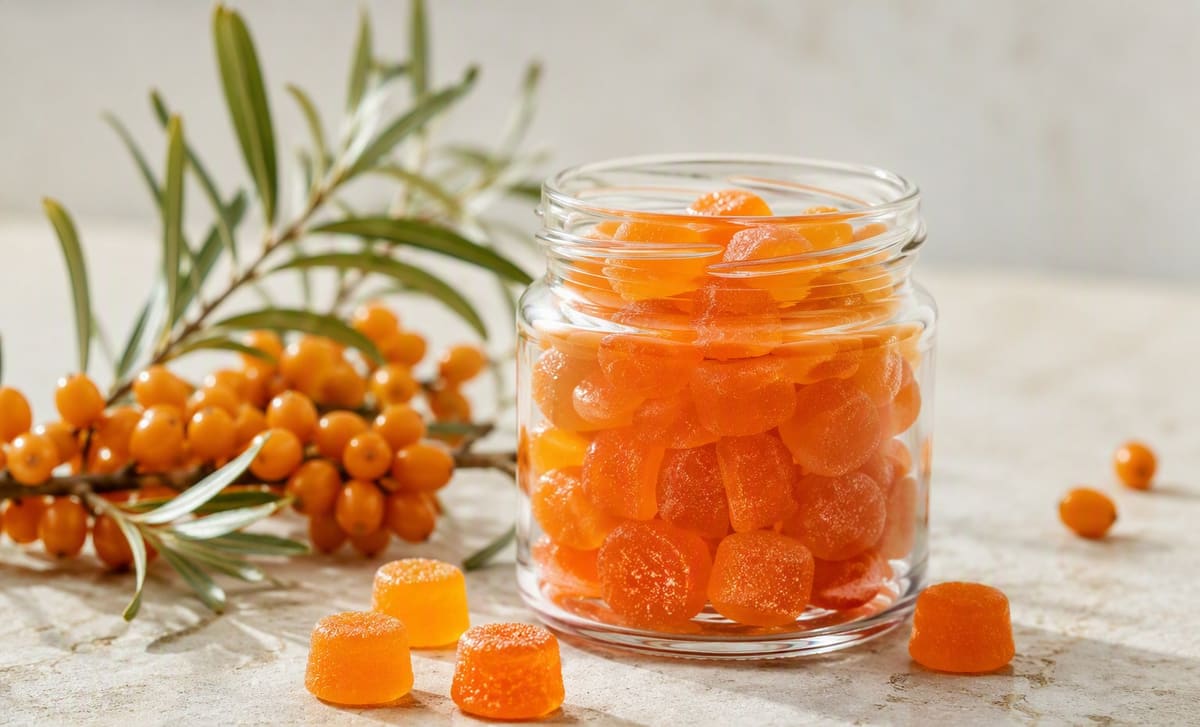
Sea buckthorn gummies are candy with a health halo: sugar first, a token amount of sea buckthorn second, and packaging that borrows the oil trials anyway. The label math rarely survives contact with the studied doses. They suit exactly one group: people who will never swallow a softgel, for whom a weak dose taken daily beats a strong one abandoned.
The candy problem
A gummy is a sugar delivery system by construction. Sugar or syrup leads the ingredient list, gelatin or pectin gives the chew, and the active ingredient rides along in whatever amount the flavor allows. Sea buckthorn is intensely sour and the oil is intensely earthy, so the amount that fits in a palatable gummy is small. The pleasant taste is not a bonus. It is the evidence that there is not much berry inside.
Every option in what the aisle actually stocks trades dose for something else. A gummy trades it for taste.
The label math that decides everything
One number settles any gummy: milligrams of sea buckthorn oil (or powder) per piece. The human trials dosed 1 to 3 grams of oil a day, that is 1,000 to 3,000 milligrams, measured against placebo. Hold any gummy’s stated amount against that range.
Three outcomes are possible. The label states a serious amount and the serving count to match, which is rare and usually means eating a handful of candy daily. The label states a small amount, which tells you the trial results do not apply to this product. Or the label does not state an amount at all, which answers the question by refusing to. The dose guide has the studied numbers in one place for the comparison.
Who gummies genuinely suit
The person who will not take softgels: the pill-averse, some teenagers with a parent steering, anyone whose supplement history is a graveyard of abandoned bottles. For them, a modest daily amount is not nothing, and the habit is the point. Everyone else pays the sugar tax for nothing: softgels carry more oil per piece, cost less per gram, and skip the sweetener, per the capsules guide.
The three checks if you buy them anyway
- Milligrams per gummy, stated. No number, no purchase.
- The plant part. Berry oil means omega-7. Powder or “fruit extract” means a different, less-studied profile, per the seed vs berry breakdown.
- Sugar per serving. You will be eating this daily. Know what daily means.
The forms comparison places gummies where they belong: the adherence form, not the evidence form.
How a gummy gets made
The process explains the product. Sugar or syrup cooks down with gelatin or pectin, the active ingredient blends in late because heat degrades it, and the mix sets in molds under a sugar or oil coating. Every extra milligram of sour, earthy sea buckthorn fights the flavor, so the formulation caps the dose long before nutrition does. Pectin gummies are the vegan lane: same candy logic, different gel.
The arithmetic to run in the aisle
Three numbers settle any jar. Milligrams of sea buckthorn per gummy, times gummies per serving, gives the per-serving amount. Divide 1,000 mg, the lowest studied daily dose, by that amount, and you have the servings a studied dose would require. Then read the sugar per serving and multiply by the same number. If the milligrams are not stated, the exercise ends before it starts, and so should the purchase. The study dosages page is where the 1,000 mg floor comes from. A worked example with invented numbers, for the shape of it: at 100 mg per gummy, the studied floor means ten gummies a day, and at 2 g of sugar each, that is 20 g of sugar riding along. Run your own jar’s real numbers the same way.
The sugar question, sized honestly
A couple of gummies a day adds a few grams of sugar, a footnote for most adults but real for diabetics and small children. Sugar-free versions swap in sugar alcohols, which bring their own limits: enough of them, and the digestive complaints arrive on schedule. Neither version changes the dose problem above.
Cost per actual gram
Gummy pricing deserves the same math as the dose. Take the jar price, divide by total milligrams of sea buckthorn inside, and compare with a softgel bottle run through the same formula. The gummy number usually lands several times higher, because you are paying for candy engineering first and berry second. The cost per day tool does the division for you.
Kids, teens, and the candy problem
No pediatric trials of sea buckthorn exist in any form, so no gummy can honestly claim studied benefits for children. What gummies do offer families is the one legitimate gummy advantage: adherence, because a teenager who refuses softgels might keep a gummy habit. Frame it as a treat with some berry in it, dose it like candy, and store it like medicine, out of reach, because anything that tastes like candy gets eaten like candy.
When a gummy is the right call
One scenario earns the format: the confirmed pill-refuser with a real reason to supplement, where a modest daily amount taken for months beats a studied dose abandoned in week one. Everyone in that camp knows who they are. Everyone else is buying candy at supplement prices, and the capsules page shows the no-sugar route two steps away.
Storage
Heat melts gummies into one large gummy, and humidity glues them together. Keep the jar sealed, on a cool shelf, and never in the car. If the contents have fused into a single mass, the serving math is over and so is the jar.
Frequently asked questions
Do sea buckthorn gummies work?
Only if they deliver a studied amount of the oil, and most do not. The trials dosed 1 to 3 grams of oil daily, while a typical gummy carries a small fraction of that in sea buckthorn content, plus sugar. If the label does not state milligrams of sea buckthorn oil per gummy, you cannot verify the dose, and unverifiable doses do not have trial results behind them.
Are gummies better than capsules?
For adherence in people who refuse pills, maybe. For everything else, no: softgels carry more oil per piece, no added sugar, and verified labels. A gummy you actually take beats a softgel you abandon, but a softgel you take beats a gummy in every measurable way.
Are sea buckthorn gummies okay for children?
There are no pediatric trials of sea buckthorn in any form, so no gummy can claim studied benefits for kids. As an occasional food-level treat they are candy with some berry in it, dosed and stored accordingly. Keep the jar out of reach, because anything that tastes like candy gets eaten like candy.